Get Full Government Meeting Transcripts, Videos, & Alerts Forever!
Get email alerts on the Pole Attachments Make Ready topic
No spam. Unsubscribe anytime.
Pole-attachment debate centers on telecom vs. cable rates and 'make-ready' cost allocation
Summary
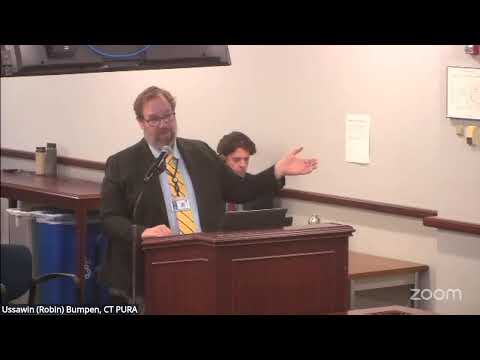
Intervenors, the Office of Consumer Counsel and state agencies pressed PURA to address how pole-attachment rental formulas and make-ready costs should be allocated; parties proposed a regulatory-liability approach to protect ratepayers while supporting broadband deployment.
Parties at the PurA oral argument urged the authority to revisit how pole-attachment rental rates and replacement ("make-ready") costs are allocated between utilities, broadband attachers and electric ratepayers.
Broadband providers Crown Castle and Go Net Speed, and the New England Connectivity and Telecommunications Association (NECTA), argued that if rates are to be unified the appropriate benchmark is the FCC’s longstanding cable-rate formula, not the higher telecom formula. NECTA said the proposed decision’s move to “unify” rates at the telecom formula would raise rates and lacked notice and evidentiary support in the record. Crown Castle and Go Net Speed told the panel lower rates foster broadband deployment and competition.
OCC and other consumer advocates pressed for limits on making electric ratepayers the default backstop for make-ready and pole-replacement costs. OCC said record evidence shows electric ratepayers currently shoulder a disproportionate share of make-ready costs and proposed that the authority treat disputed make-ready revenue as a regulatory liability: the company would recover revenue in the rate year but the amount would be held as a liability and reconciled in the next rate case after a determination of proper allocation.
UI’s representatives told commissioners that maintaining poles in compliance with the National Electric Safety Code (NESC) is an electric-system obligation and that a retroactive reallocation of costs would be legally and practically fraught; the company also noted that a regulatory-liability treatment requires that revenue actually be collected before a liability can be established.
Why it matters: the decision affects broadband deployment costs, pole-rental revenues, and ratepayer bills. Several speakers said a sudden switch to the telecom formula or retroactive re‑allocations without clear evidence could discourage attachers and slow broadband projects the state seeks to accelerate.
Key numeric context from the record: parties discussed approximately $24.4 million of pole-related costs framed as a revenue-impact figure and a roughly $3.16 million revenue equivalent that could be captured through a regulatory-liability mechanism; Crown Castle referenced roughly $2.0 million in mutual-aid costs that should not be borne by attachers. UI and intervenors also discussed a substantial backlog of attachment requests that they say impedes deployment.
Next steps: OCC and DEEP urged PURA to permit the regulatory-liability approach as a compromise that preserves funding to support broadband rollout while protecting ratepayers. Commissioners asked parties to file written motions and supporting proposed language; the authority will consider those filings along with the record before issuing any final rate rulings.