Get Full Government Meeting Transcripts, Videos, & Alerts Forever!
Get email alerts on the Federal Grants topic
No spam. Unsubscribe anytime.
St. Paul grants director warns federal funding rules and pauses have created widespread uncertainty for city programs
Summary
Grants Director Lindsay Bacher told the St. Paul City Council organizational committee that recent executive orders, an OMB funding freeze and rapid federal policy changes created uncertainty for city grant programs and that the city is preparing contingency plans and pursuing nonfederal funding options.
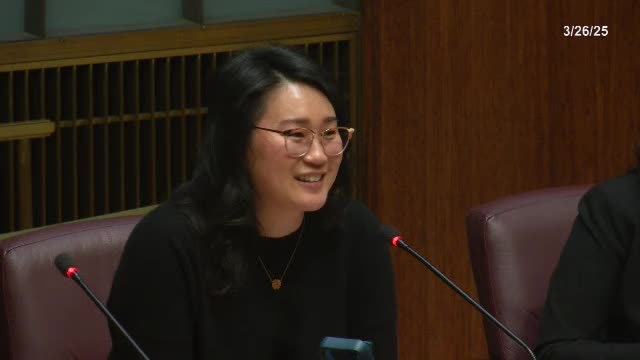
Lindsay Bacher, the City of St. Paul’s grants director, told the City Council’s organizational committee that rapid federal policy shifts and an Office of Management and Budget funding freeze earlier this year created “a lot of unpredictability and uncertainty” for city grant programs.
Bacher described why the changes matter to St. Paul: the city has projects and services supported by a mix of active contracts, awards in pre‑award or negotiation phases, and pending proposals that could be delayed or altered by federal action.
Bacher said the OMB memo issued Jan. 27 that temporarily froze federal financial assistance produced immediate disruption nationwide. She described a sequence of judicial orders and agency reversals — a one‑week administrative stay, an OMB rescission that created conflicting signals, and a subsequent preliminary injunction issued by a federal judge — that together left grantees and program officers unsure which guidance to follow.
She told the committee that some agency instructions initially halted specific activities (for example, Department of Energy notices to remove Diversity, Equity and Inclusion and Justice40 work from DOE grant work plans), but later reversals allowed some work to resume. Bacher also cited other federal developments with potential local impact: reviews of Inflation Reduction Act and Infrastructure Investment and Jobs Act disbursements, Department of Transportation memoranda revisiting greenhouse gas calculations and partially obligated grants, an NIH proposal (later rescinded) to cap indirect rates, and EPA litigation over the Greenhouse Gas Reduction Fund.
Bacher gave a snapshot of the city’s federal portfolio as she described it: "we have about $260,000,000 in receivable federal funding," which she broke down as roughly $192,000,000 in grants actively under contract, about $140,000,000 described as one‑time project grants, approximately $66,000,000 in awards in a pre‑obligation phase, and another roughly $66,000,000 in pending proposals under consideration. She also said the city had described a figure as ongoing operational support, quoted in the presentation as "$5,253,000,000," which was presented as the city’s characterization of multi‑year operational support lines. Bacher described those figures as approximate and said award timing and access could change given the recent federal litigation and agency guidance.
Bacher listed local programs that rely on federal funding, including geothermal upgrades at Como Park Zoo and North End Community Center; the 10‑year lead service line replacement paired with state funding; Right Track youth internships; a planned five‑year forestry youth jobs program; redevelopment grants that support affordable housing and economic development (she said roughly $3,000,000 annually); emergency response and public safety training supported by grants; and unsheltered‑response work such as the Familiar Faces program.
On mitigation, Bacher said the city has worked closely with the City Attorney’s Office to review executive orders, agency memos and ongoing litigation, and has directed departments to maintain strong grant management and documentation practices, submit reimbursement requests regularly, and plan contingency options. She said staff are also exploring nonfederal funding streams for current and future projects.
Councilmember Yang thanked Bacher for the presentation and asked for clarification of the legal timeline. Yang also asked for more detailed information about which projects are in negotiation or pre‑award phases and whether the committee could see a simple spreadsheet listing those items. Bacher said she would follow up outside the meeting and bring additional details to the council.
The presentation did not include any formal council motions or votes. Bacher characterized the city’s next steps as internal mitigation (legal review, strengthened documentation and reimbursement practices), contingency planning, and outreach to identify alternative funding sources.
Bacher concluded by telling council members that the city will continue monitoring litigation and agency guidance and will provide follow‑up briefings to the council as warranted.