Get Full Government Meeting Transcripts, Videos, & Alerts Forever!
Get email alerts on the Land Use Development topic
No spam. Unsubscribe anytime.
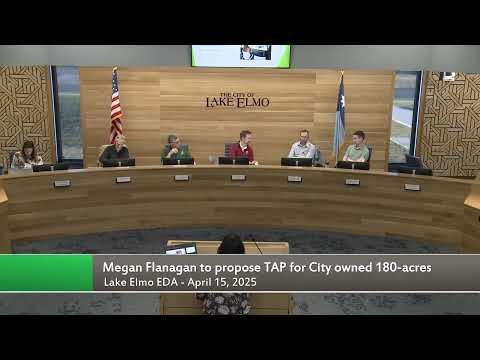
Lake Elmo EDA approves Urban Land Institute TAP to study 180-acre settlement parcel
Summary
The Lake Elmo Economic Development Authority voted to hire the Urban Land Institute for a technical assistance panel (TAP) to develop land‑use recommendations for 180 acres tied to a settlement; the EDA approved the deeper, multi‑day option and directed staff to work with a ULI steering committee and the city council on next steps.
The Lake Elmo Economic Development Authority voted to accept a proposal from the Urban Land Institute to conduct a technical assistance panel (TAP) to study roughly 180 acres tied to the city’s settlement, approving the longer, deeper TAP option at the EDA meeting. The motion to accept the TAP and proceed with the extended option carried with no opposition.
The TAP will give Lake Elmo a multi‑day, cross‑sector panel of ULI volunteers to visit the site, interview stakeholders, and produce detailed recommendations about land use, phasing and revenue potential. Megan Flanagan, the ULI presenter, described two options: a day‑and‑a‑half TAP with four to six local panelists, a roughly 30‑page summary and an estimated cost of about $17,500 plus meals; and a longer TAP with an extra work day, additional panelists (including out‑of‑market experts if needed), a more in‑depth 50‑page report and an estimated cost of about $35,000.
Flanagan said stakeholders are identified by a steering committee that includes ULI panel chairs and the project sponsor — usually city staff — and that the steering committee refines the specific questions the TAP will answer. "A TAP is conducted at the request of a community that is asking for our members to share their expertise on a specific land use or policy challenge," Flanagan said.
Members and staff discussed what the TAP should address. Questions suggested for the steering committee included which uses would generate the most property tax revenue, pros and cons of dividing or selling the site, and phasing: whether a single developer should build in phases or whether multiple developers should build different portions over time. One council member noted the parcel’s origin in the city’s lawsuit and settlement with 3M and framed the site as an "economic tool" to help address potential future cleanup costs.
City staff told the EDA the next formal steps after receiving the TAP report would likely mirror prior planning work: the council would acknowledge and workshop the report, staff would determine whether comprehensive‑plan amendments are needed, and the city would draft an RFP if it chose to seek development proposals. The community development director described the TAP as part of the planning process that could lead to comp‑plan amendments and an RFP returned to the EDA and council for further action.
Panel composition and content were raised as important: Flanagan said steering‑committee work identifies missing expertise and that ULI can recruit national experts when necessary. She also said recent economic conditions will likely be raised by panelists and advised including participants with capital‑markets or financial expertise to address market timing and financing considerations.
EDA members debated depth versus cost. One EDA member moved for the extended option, saying the extra cost was small compared with potential losses from inappropriate development choices; another member seconded the motion. After a brief discussion and confirmation that the county community development authority (CDA) had a grant that might cover about 50 percent of the cost, the EDA voted "Aye" with no opposition and approved the motion.
The EDA also asked whether the city has used ULI previously; staff recalled ULI involvement around 2017 on the "old village," but not a TAP of this scale and said the city has not done a similar TAP recently. Flanagan said ULI has performed more than 20 TAPs in Minnesota over the past 15 years and can produce either an informal presentation to staff or a formal presentation to the EDA and council when the work is complete.
Next steps recorded in discussion: staff will work with ULI to form a steering committee and refine the TAP questions; the EDA and council would review the draft report and likely hold a workshop; staff would identify whether comp‑plan changes or an RFP are needed; and the city will pursue available grant funding, including a potential county CDA grant to offset TAP costs.
Votes at a glance: Motion to accept the ULI TAP and proceed with the extended multi‑day option — approved, unanimous (recorded as "Aye"; no opposed votes were recorded).