Get Full Government Meeting Transcripts, Videos, & Alerts Forever!
Get email alerts on the Housing Short Term Rentals topic
No spam. Unsubscribe anytime.
Surry County board directs staff to draft short-term rental ordinance after advisory committee review
Summary
Following a yearlong advisory process and a public survey, Surry County staff presented recommendations on short-term rental regulation. The board voted to proceed with drafting a local ordinance and related tax provisions.
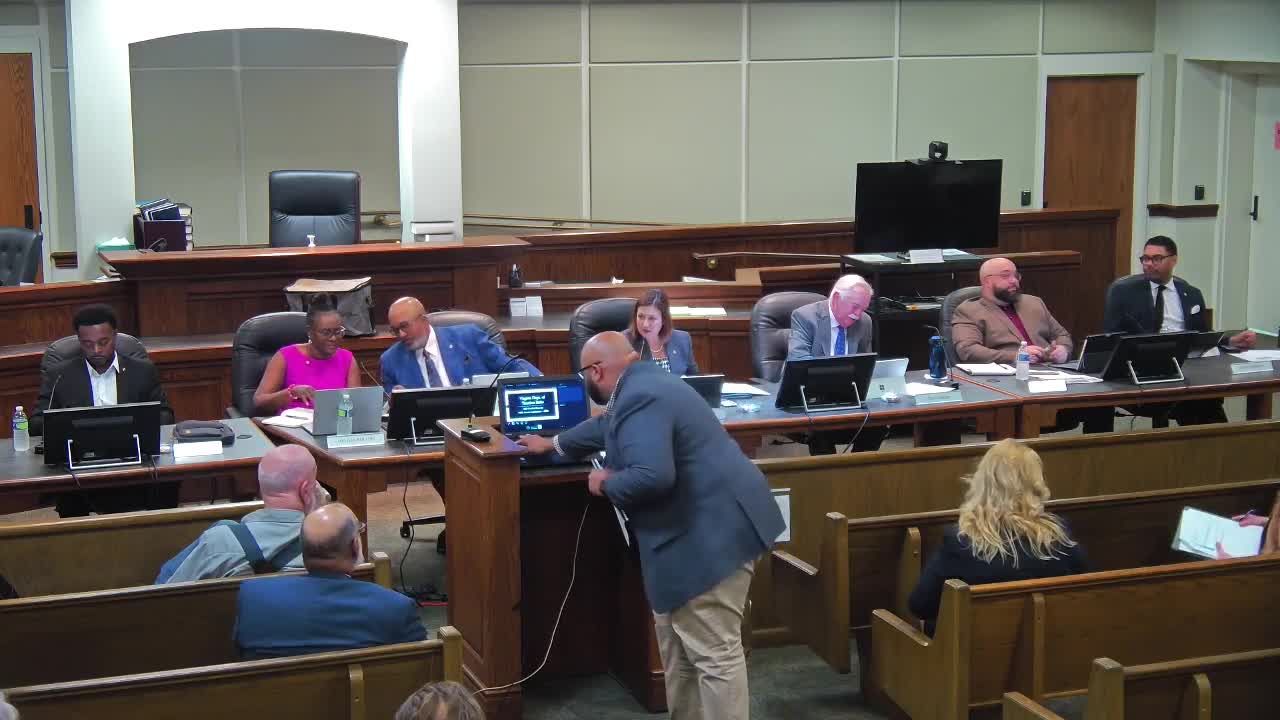
Surry County supervisors on April 3 directed county staff to begin drafting an ordinance to regulate short-term rentals after receiving a presentation on the county’s advisory-committee process and high-level recommendations.
County staff said the advisory committee—composed of residents, planning commissioners, economic-development representatives and county staff—worked for roughly a year and considered existing Virginia law, peer counties’ ordinances, and responses to a community survey. Staff and Summit Consulting summarized findings and proposed a framework that would use the state's permissive authority to establish a local registry, a reasonable annual registration fee, transient-occupancy tax collection and limited local standards for parking, trash, noise and neighborhood character.
Staff explained that Virginia law permits local registries but exempts certain situations, including owner-occupied home shares (the homeowner occupies the dwelling during rental periods) and many forms of active farms. The state code defines a short-term rental as occupancy of a dwelling or room for fewer than 30 consecutive days in exchange for a charge; the statute also distinguishes tiny homes on wheels, recreational vehicles, boats and tents, which are treated differently for local regulation. Staff emphasized that the county’s authority is limited by those state definitions and AG opinions and that local ordinances must be crafted within that framework.
Committee process and survey Staff said the county released a 23-question online survey last summer and received 104 responses. The advisory committee reviewed listings on platforms (Airbnb, VRBO and others) to identify where short-term rentals are concentrated in the county (mostly around riverfront areas) and to catalog common regulatory approaches in Virginia. Staff reported that roughly 45 Virginia localities have adopted short-term rental regulations and that those ordinances vary with respect to parking rules, occupancy limits, party/noise prohibitions and safety or screening requirements.
Recommended elements The county’s recommendations are high-level and would be refined during ordinance drafting. They include: - A state-authorized local registry with an annually renewable registration and a "reasonable" fee tied to county administrative costs, and $200-per-violation fines for failing to register. - Collection and remittance of a local transient-occupancy tax via platforms to the commissioner of revenue. - Zoning allowances by district: allow by-right in agricultural and industrial districts; by conditional use in many residential districts; not permitted in some sensitive districts (exact district mapping to be finalized). - Standards addressing parking, trash storage and disposal, noise/party prohibitions, size and screening to fit neighborhood character, and safety/contact information for emergency response.
Public-comment and board action Residents at the meeting raised questions about survey outreach and called for mailed notices to ensure broader participation, and others asked about enforcement and the definition of 30-day stays for frequent travelers such as traveling nurses.
Supervisor Thomas Hardy moved that staff proceed with drafting an ordinance and related tax measures based on the committee’s recommendations. The motion was seconded and approved by voice vote. No roll-call vote tally was recorded in the transcript.
If the board directs staff to draft an ordinance, staff said the next steps would include drafting legally defensible ordinance language, returning a draft to the planning commission for review, and following the typical ordinance-adoption process—public hearings, planning commission recommendation and final action by the board.
Staff noted exceptions required by state law (owner-occupied home-share exemptions and active-farm exemptions) and emphasized the county cannot regulate certain mobile or nonpermanent structures that state code exempts from short-term-rental definitions.