Get Full Government Meeting Transcripts, Videos, & Alerts Forever!
Get email alerts on the Energy Infrastructure topic
No spam. Unsubscribe anytime.
Surry County approves ordinance enabling battery energy storage systems after public hearing
Summary
The Surry County Board of Supervisors voted April 3 to adopt a zoning text amendment that creates a conditional-use framework for battery energy storage systems in the county.
The Surry County Board of Supervisors voted April 3 to adopt a zoning text amendment that creates a conditional-use framework for battery energy storage systems in the county.
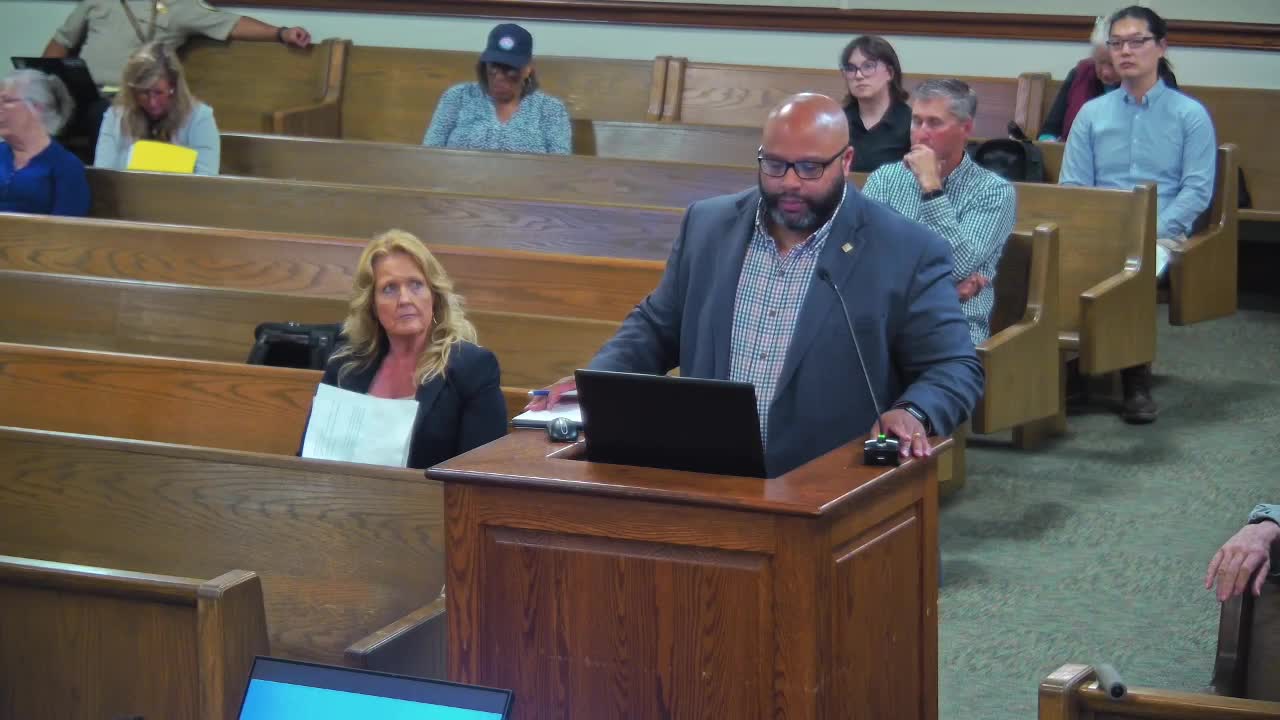
The ordinance amendment—presented as a zoning text change to define and regulate battery energy storage systems (BESS)—was opened for public hearing on April 3, followed by applicant presentations, public comment and a formal vote approving the amendment.
County planning staff said the amendment was drafted after a private developer requested permission to locate a BESS in Surry County and provided draft language. Staff and the applicant modeled the draft on the county's recent solar ordinance and on ordinances adopted by other Virginia localities. The document incorporates operations, safety, setbacks, buffers, noise limits, emergency-response planning and decommissioning requirements. Attorney Scott Foster (Gentry Locke) said the draft tracks the county's solar ordinance format and borrows legal and technical provisions from several existing ordinances in Virginia.
Ed Rumbler, representing the applicant, described BESS technology and economic benefits, saying the installations typically charge from the grid during low-demand hours and discharge during peak periods. He told the board that modern projects are compact—often fitting many battery modules within a few shipping-container-style enclosures—and can generate significant tax revenue on a relatively small acreage footprint.
Matt Kim, a fire-protection engineer who advised on safety standards, told supervisors that the draft ordinance is conservative from a fire-safety perspective and that common onsite battery chemistries for stationary, utility-scale storage are typically lithium iron phosphate (LFP). He said enclosure ratings and IP (ingress protection) levels mitigate water intrusion and that Modern BESS modules are designed to withstand spray and limited immersion; he also said the draft ordinance references up-to-date safety standards. The draft ordinance explicitly references the National Fire Protection Association’s energy storage standard (NFPA 855) as the technical baseline for detection, suppression and operational controls.
Key provisions in the adopted text include: - Setbacks: a default 200-foot setback from property lines and 500 feet from residences and commercial structures in most zones, with different standards for M-1 and M-2 industrial zones; a 20-foot noncombustible buffer immediately inside perimeter fencing and a 100-foot vegetative buffer beyond that; ability for the county to increase setbacks on a case-by-case basis. - Noise: a base limit of 65 dBA measured at property lines and a 55 dBA limit measured at the outer wall of any occupied structure on adjacent parcels in agricultural (AR) districts that existed at the time a project receives a conditional-use permit; applicants must submit a final noise study with site-plan approval and the zoning administrator may authorize sound-wall mitigation if needed. - Safety and emergency response: applicants must submit emergency-response plans, fire-safety design and plans to the satisfaction of county emergency services; the ordinance requires adherence to up-to-date NFPA standards and to the Virginia building code as applicable. - Operations and performance: requirements for performance and operational plans, traffic and construction management, lighting (dark-sky compliant), bonding and decommissioning assurances similar to the county’s solar ordinance.
During public comment, residents raised safety and noise concerns and asked the board not to rush approval. Mike Hamilton asked what battery chemistry the project would use and how that affects emergency procedures. Several residents—including former planning commissioners and emergency responders—urged careful review of first-responder capabilities, on-site mitigation and the opportunity for site visits to operational BESS facilities. Resident Shalom Pierce supported the project’s potential revenue but recommended independent review of the applicant’s draft by an outside consultant and opposed a same-night vote in order to allow more time for public input.
Planning staff told the board the planning commission recommended approval by a 9–1 vote after multiple hearings and post-hearing revisions with the applicant. County staff and the applicant said they are working to schedule a field visit to a nearby operational facility for the board and planning commission members.
Supervisor Thomas Hardy moved to approve the zoning text amendment; the motion was seconded and carried after a voice vote. The vote record in the meeting transcript is recorded as "All in favor, Aye," with no roll-call tally included in the minutes.
The ordinance amendment creates the conditional-use pathway for future BESS conditional-use permit applications; any specific project would return to the planning commission and the board for review of site-specific conditions and permit terms.