Get Full Government Meeting Transcripts, Videos, & Alerts Forever!
Get email alerts on the Housing Rezoning topic
No spam. Unsubscribe anytime.
Planning Department unveils draft rezoning map to expand housing choice; public offers mixed reactions
Summary
The Planning Department presented the April 2025 draft "Expanding Housing Choice" rezoning plan, a multi-pronged package that would add capacity across transit and commercial corridors, create a local alternative to the state density bonus, and use limited form-based density decontrol off main streets to help San Francisco demonstrate the capacity the state requires in its RHNA allocation.
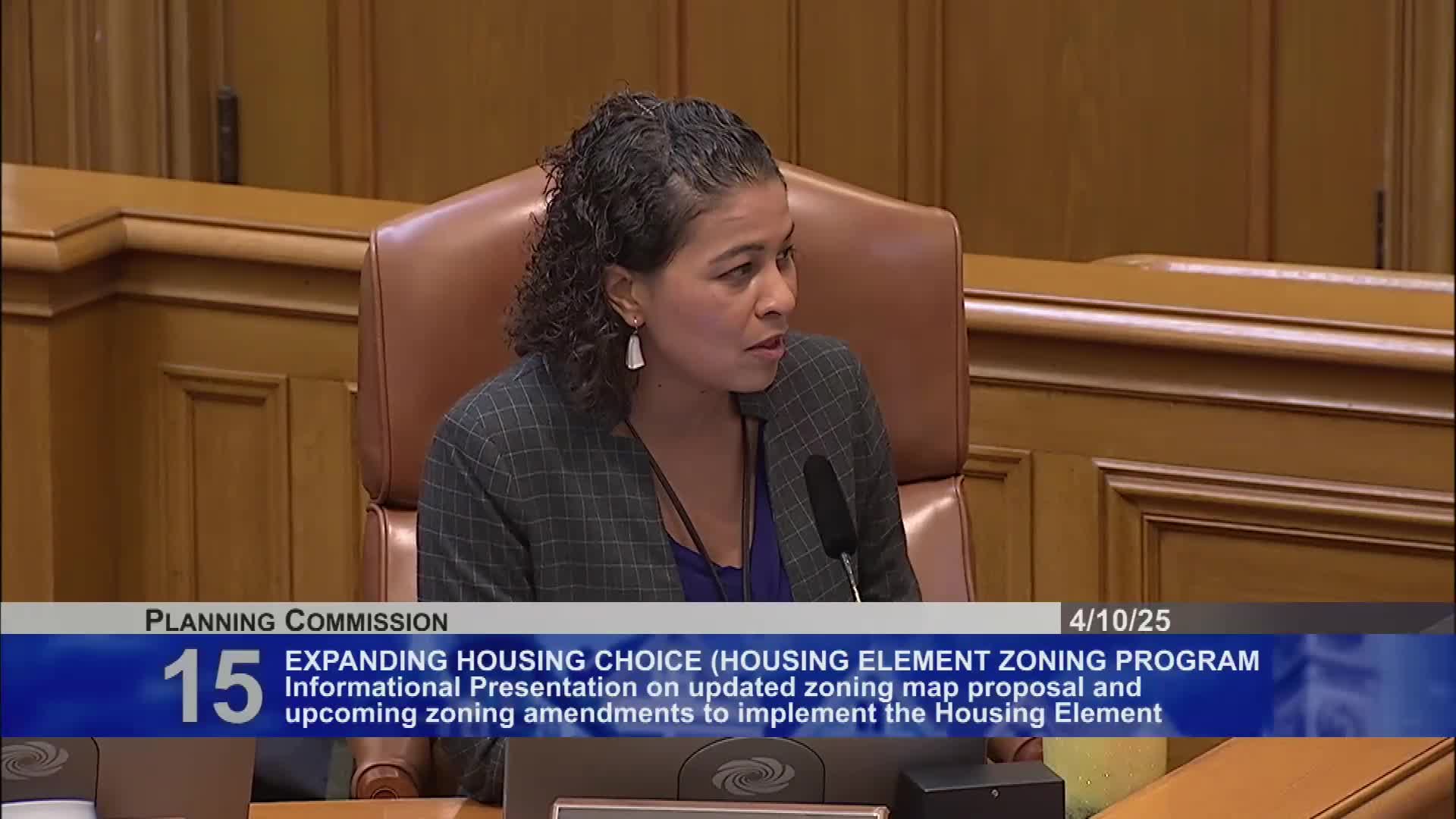
The San Francisco Planning Department presented its "Expanding Housing Choice" rezoning package at an informational hearing April 10, outlining a draft zoning map and a new optional "local program" intended to create zoning capacity the city must demonstrate under state housing law.
Lisa Chen, principal planner and project manager, said the rezoning is anchored in the housing element and the state's regional housing needs allocation (RHNA). "This project, expanding housing choice, is rooted in our obligation to affirmatively further fair housing and expand opportunities for people to live in San Francisco," Chen said during the staff presentation.
Staff told commissioners the region and state assigned San Francisco an RHNA target of about 82,000 homes across all income levels, and that the city's pipeline and existing capacity leave a shortfall of roughly 36,000 units. To meet statutory requirements and "affirmatively further fair housing," staff said the department's draft map concentrates much of the new capacity within high-opportunity areas (higher-performing schools, lower pollution and higher incomes) so that households with affordable units can access opportunity.
Major features of the April 2025 draft map and associated legislation, as described by staff:
- Form-based density decontrol in many residential blocks off main corridors: in parts of the city staff proposes to remove local numerical density limits while keeping existing height limits (commonly 40 feet) so projects can achieve more units within the same building form. Projects using this local option would not be allowed to also stack state density-bonus incentives on top of that decontrol.
- A two-track approach for corridors and nodes: the department proposed base heights for many corridors (40 to 55 feet) and higher local-program maximums (up to 65, 85 or, in select transit hubs, 140 feet) that projects could reach either by using the state density-bonus pathway or by opting into the local program.
- A "local program" alternative to the state density bonus: staff proposed a menu of local waivers and concessions (unit-mix flexibility, modest setbacks, rear-yard rules, loading and some parking waivers) designed to make projects feasible while preserving local review and clear, objective standards. The local program would allow some on-site or in-lieu options for affordable housing and a special alternative for small projects (under 25 units) to provide a fully rent-controlled building in lieu of other compliance mechanisms.
Planning staff said the local program is grounded in feasibility work that showed targeted changes could improve viability for marginal projects and that a clearer local option could compete with state incentives while maintaining municipal control over final form and conditions.
Staff emphasized safeguards and parallel work: the draft map proposes transit-oriented concentration of mid-rise buildings, selective high-rise areas at major transit hubs, and transitional buffers in some places; it would not change protections in youth-and-family districts. Staff also described ongoing work on tenant protections, small-business supports, a sites analysis for subsidized affordable housing, a racial and social equity analysis and coordination with other city agencies on infrastructure needs. The department said adoption, if the Board of Supervisors and mayor approve it, must be certified by the state Department of Housing and Community Development (HCD) by January 2026.
Public comment filled the room for more than three hours and displayed broad divisions:
- Supporters — including housing advocacy groups, many district-based "Neighbors for Housing" organizations, real-estate and transit advocates, and many individual residents — urged approval and called the plan an overdue and necessary step to allow families, workers and seniors to remain in the city. Supporters urged staff to expand some coverage (for example, speakers pressed to add Bernal Heights to the rezoning map) and to go further in some corridors.
- Opponents — neighborhood groups, historic-preservation advocates, the REP SF and Neighborhoods United coalitions, and speakers from some small-business and senior-advocacy organizations — urged caution. They expressed concerns that large upzoning would accelerate displacement, favor market-rate developers over the production of deeply affordable housing, threaten small businesses and neighborhood character, and increase infrastructure and service demands.
Commissioners and staff noted multiple next steps: staff will publish more maps and renderings, finish the local program code language and the affordable-sites analysis, continue outreach to neighborhoods that raised specific concerns, refine the financial-feasibility work that underpins the local program, and prepare a full adoption package for the Board of Supervisors and HCD review. Staff also said it will provide additional informational briefings on small-business supports and on tenant-protection proposals.
Staff framed the rezoning as one piece of a broader housing-element implementation effort that includes tenant-protection legislation, funding strategies for subsidized housing, and interagency infrastructure planning. Commissioners thanked staff for the presentation and asked for more district-level visualizations and additional analyses tying rezoning outcomes to affordable-housing production and infrastructure capacity.
No formal vote was taken; the hearing was informational. Planning staff and the mayor's office will now continue the legislative drafting and outreach process prior to formal introduction and public hearings at the Board of Supervisors.