Get Full Government Meeting Transcripts, Videos, & Alerts Forever!
Get email alerts on the Seismic Safety Buildings topic
No spam. Unsubscribe anytime.
Supervisor Melgar urges inventory, voluntary retrofit standards for older concrete buildings
Summary
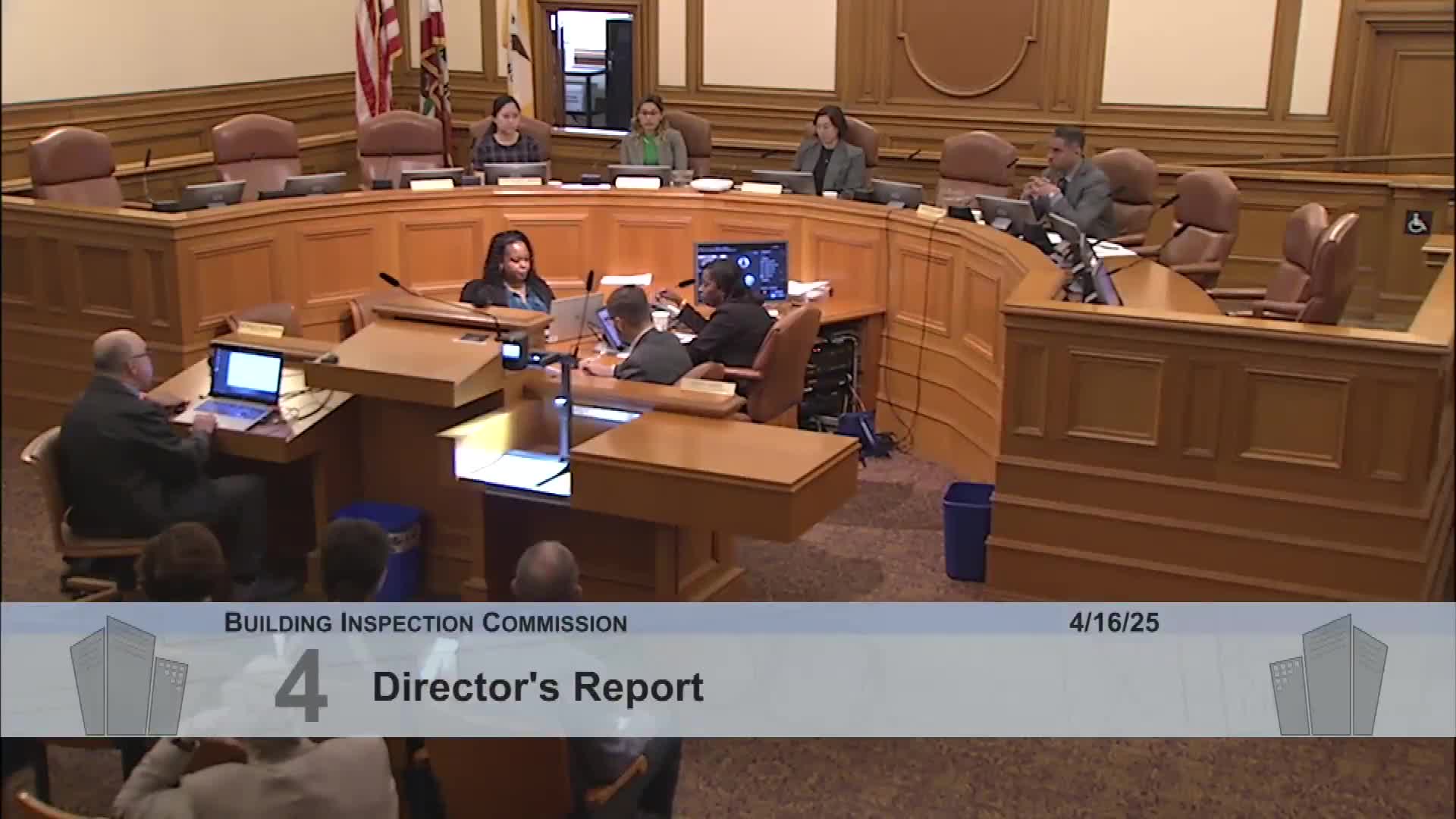
The Building Inspection Commission on April 16 heard a presentation on Board of Supervisors file 250211, legislation that would require owner‑submitted engineer screening for thousands of buildings and add voluntary seismic retrofit standards for concrete and rigid‑wall/flexible‑diaphragm buildings.
The Building Inspection Commission on April 16 heard a presentation on Board of Supervisors file 250211, legislation sponsored by Supervisor Myrna Melgar (District 7) that would require screening of roughly 4,000 buildings and add voluntary seismic retrofit standards for certain concrete and rigid‑wall/flexible‑diaphragm buildings.
"When the next major earthquake hits, we must be certain that reinforced concrete buildings throughout San Francisco, regardless of age, live up to their promise of earthquake resistant safety," Supervisor Myrna Melgar said, linking the proposal to the city’s long history of seismic risk.
Laurel Matthews of the Office of Resilience and Capital Planning described the measure as twofold: create a more accurate inventory of possible concrete and tilt‑up buildings by requiring a licensed engineer screening checklist, and add voluntary retrofit standards in the building code so owners who choose to retrofit have clear guidance. "I asked here today to ask you to approve recommend approval of the legislation that supervisor Melgar proposed under file number 250211," Matthews said. She told commissioners the screening checklist is intended to be low‑friction and estimated engineering fees at about $300 to $3,200 per building.
Presenters and several members of a stakeholder working group said the inventory and new retrofit standard are intended to address uncertainty about which buildings actually contain concrete structural systems and to provide an efficient retrofit option that reduces tenant displacement and cost. Ned Fenny, chair of the Code Advisory Committee, said the committee reviewed the proposal multiple times and "unanimously approved the legislation before you today," citing three elements: a reliable inventory, consistent engineering criteria, and a 20‑year incentive for voluntary retrofits.
Speakers from industry and preservation groups described concerns and tradeoffs. Don Libby, a licensed civil engineer and general contractor who also serves on San Francisco Heritage’s board, said comprehensive retrofits of concrete buildings can be "very expensive and involve work in lots of portions of buildings" and urged planning for financing, tenant protections and preservation of historic structures if a future mandatory program were considered.
Public commenters pushed the commission both to act and to make inventory data accessible. David Osgood of the Rincon Point Neighbors Association said the city’s Resilience Office holds a database of tall buildings with structural flags and told commissioners "there are 43 tall buildings in San Francisco with the same kind of risky MAT, MAT foundations" and that 25 of those are on soils with high liquefaction risk. He urged DBI action to prioritize safety evaluations.
Presenters emphasized the proposal does not mandate retrofits: the legislation would establish voluntary standards and provide a 20‑year assurance that buildings retrofitted to the voluntary levels would not be re‑required to retrofit to a different standard if a future mandatory program were adopted. Matthews said the program would also include city outreach, a web page, staff training, and a mailing campaign to owners.
Commissioners asked technical and policy questions about whether the screening form could support later risk‑ranking, whether costs could be passed through to tenants, and how financial hardship accommodations could be handled if the program were expanded into a mandatory retrofit later. Matthews said a screening checklist would not provide the same detail as a full seismic evaluation and that more detailed evaluations can cost tens of thousands of dollars; she and others suggested risk‑rating could be a future step after the inventory is complete.
No formal vote on file 250211 was recorded in the transcript during this meeting; the item concluded with commissioners’ questions and discussion. The commission asked staff and the Office of Resilience and Capital Planning to return with additional details on screening form design, outreach plans and how the inventory might support future prioritization.
Tight coordination between DBI, the Office of Resilience and stakeholders and clear communication to owners were repeatedly cited as priorities by presenters and commissioners. The presenters said the inventory and voluntary standards aim to give owners clarity and an option for retrofitting while the city improves its understanding of the stock of concrete and tilt‑up buildings.