Get Full Government Meeting Transcripts, Videos, & Alerts Forever!
Get email alerts on the Early Learning Budget topic
No spam. Unsubscribe anytime.
DCYF warns early-learning growth may be delayed as legislature proposes mixed reductions and delays
Summary
Secretary Tana Senn told ELAC that proposed 2025–27 budgets would slow growth for early learning after the agency was asked to cut roughly 6% from its overall budget, and DCYF staff outlined multiple House and Senate proposals that delay or reduce expansions while attempting to protect base provider rates.
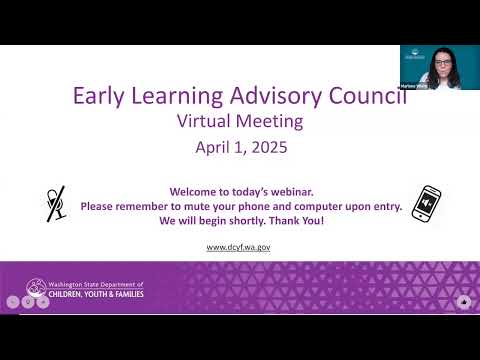
Secretary Tana Senn, head of the Department of Children, Youth, and Families (DCYF), told the Early Learning Advisory Council on April 1 that the agency faces a directive to cut about 6% from its budget and that most unavoidable reductions fell on early learning programs.
Senn said the cuts were “a total gut punch,” but added she was “optimistic” because much of the proposed change appeared to be a slowdown in planned growth rather than outright elimination of baseline services. “We can't cut child welfare or juvenile justice because you just have to serve those kids,” she said, and that many early-learning reductions showed up as delays to planned increases rather than permanent cuts.
Why it matters: The council heard a detailed briefing from DCYF staff on bills and proposed budget actions that would affect the Early Childhood Education and Assistance Program (ECAP), Working Connections Child Care (the state subsidy), provider rates and hold‑harmless policies, and a portfolio of targeted grants and enhancements for providers.
Key points from DCYF officials
- Budget posture and intent: Nicole Rose, assistant secretary of early learning, and Courtney Parker, a government affairs policy adviser, presented a line‑by‑line comparison of House and Senate budget proposals. Both chambers propose maintaining or prioritizing base subsidy rates for providers while reducing or delaying many enhancements funded under the Fair Start for Kids Act (FSKA). Rose summarized the approach as an attempt to “maintain the base or foundational funding for child care providers.”
- ECAP slots and school‑day conversions: The Senate proposal would cut roughly 3,000 part‑day ECAP slots while increasing school‑day slots by about 1,200, for a net reduction slightly over 2,000 slots. The House would convert some part‑day slots to school‑day slots and reduce roughly 2,350 part‑day slots in fiscal 2026, with conversion of a subset in fiscal 2027.
- Early ECAP and eligibility: Both chambers proposed eliminating funding for “early ECAP” (about 78 slots) and delaying an expansion of Working Connections eligibility from 60% of State Median Income (SMI) to 75% of SMI until fiscal year 2030 in some proposals. Several of the House and Senate approaches make expanded eligibility categories or certain provider supports subject to appropriation.
- Provider rates and hold‑harmless: Both chambers proposed delaying the increase to base center rates (the 85th or 80th percentile reference point from the 2024 market rate survey) until July 1, 2026. The House proposed removing a hold‑harmless provision in fiscal 2027 for providers whose current subsidy rates exceed the target percentile.
- Grants and targeted enhancements: The Senate mostly retained funding for some funds and proposed eliminating non‑CBA (collective bargaining agreement) equity grants and some enhancements for center‑based providers; the House proposed smaller but still substantial reductions to trauma‑informed care payments, dual‑language enhancements and certain professional development contracts. The child‑care complex needs fund and licensing supports saw differing reductions between chambers.
- Capital vs. operating and facilities: If capital gains tax revenues exceed thresholds, statute directs excess to capital. DCYF staff said additional capital gains revenue historically flows to the Early Learning Facilities (ELF) fund in the capital budget; if revenue materializes it is likelier to increase early‑learning capital grants than operating expansions.
Public safety, immigration concerns and provider responses
Council members and providers raised acute concerns about immigration enforcement and its chilling effect on child‑care enrollment, particularly in family child‑care homes. DCYF staff acknowledged heightened anxiety among families and said agency guidance emphasizes confidentiality and the requirement that agencies not cooperate with immigration enforcement without a judicial warrant. Colleen (a provider/advocate) said therapists can now continue to provide services in child‑care settings up to age six after a rule change earlier in 2025, but she warned many therapists and providers are not yet aware of the change.
Formal actions and committee business
ELAC called for a vote to approve minutes from the previous meeting. The motion to approve the minutes was put to the membership, but the recorded transcript does not state the vote tally or the final outcome. (Motion text and vote result not recorded in the provided transcript.)
What council members asked DCYF to do
Council members pressed DCYF for clearer communications about budget changes and for outreach to providers and families about eligibility and supports if cuts or delays become law. DCYF said it is preparing a communications plan and will post recorded webinars and explanatory materials on its government‑affairs web page.
Context and next steps
DCYF emphasized the proposals seen at this stage are draft legislative budgets; final outcomes depend on negotiations before the Legislature completes its work and the governor signs a final budget. DCYF also noted that several proposals convert previously planned expansions into items “subject to appropriation,” meaning the programs could be restored if funding is later identified.
Ending note: Council members were directed to a mid‑session DCYF webinar and to agency web pages for ongoing updates; DCYF said it will follow with more detailed communications after the Legislature completes negotiations.