Get Full Government Meeting Transcripts, Videos, & Alerts Forever!
Get email alerts on the Tot Policy topic
No spam. Unsubscribe anytime.
Council reviews transient-occupancy tax uses and asks staff for strategic plan
Summary
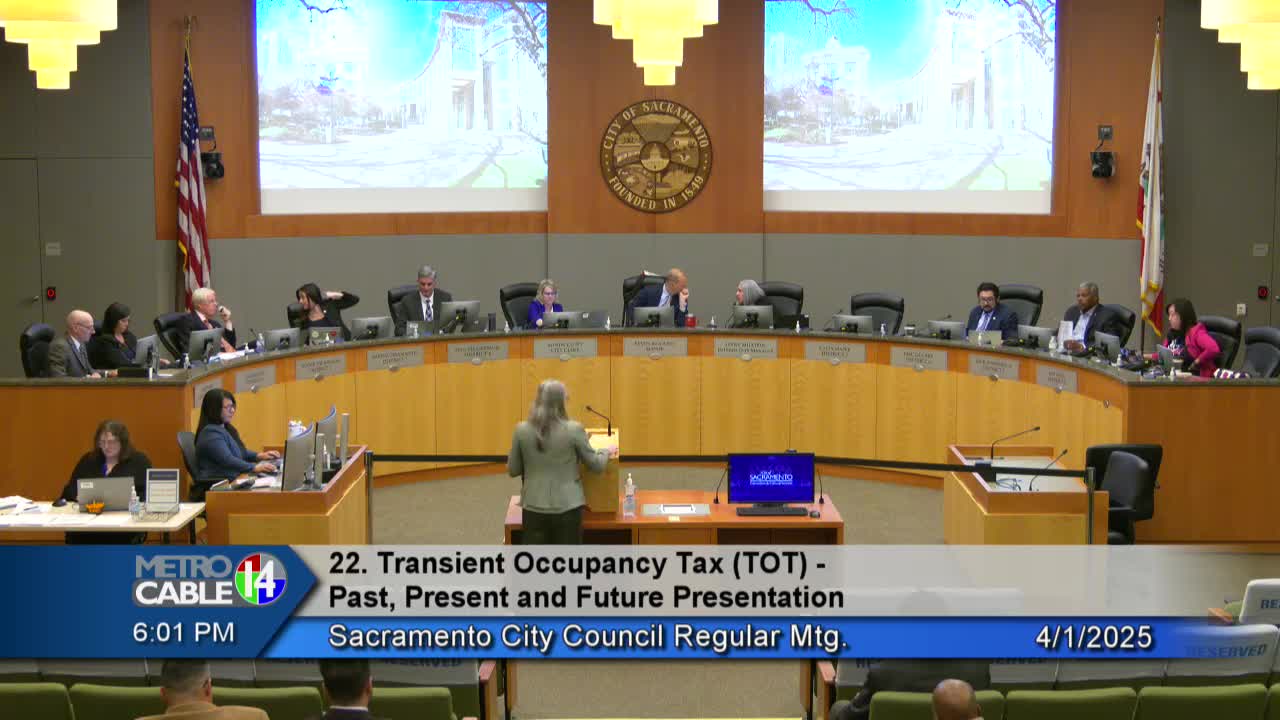
The Sacramento City Council received an informational briefing on the city’s transient-occupancy tax (TOT), discussed Measure N (2022) changes to allowable uses, and directed staff to return with a strategic 2/5/10-year framework to prioritize TOT investments that maximize overnight visitation.
The Sacramento City Council received an informational briefing and extensive discussion Tuesday on the city’s transient-occupancy tax (TOT), its current uses after Measure N (2022), revenue trends since the pandemic, and the constraints those factors place on future bonding and projects funded by TOT. No final policy change was adopted; instead councilmembers offered multiple directions for staff to return with a prioritized plan.
Megan Van Voorhis, director of Convention and Cultural Services, summarized the code and history: the uniform TOT is codified in Sacramento City Code §3.28, is a voter-approved tax on short-term rent for stays under 30 days, and currently totals 12 percent. Van Voorhis said the tax is split into a 2 percent general-tax component (general fund) and a 10 percent special-use community center fund, noting that the special-use component remains restricted to visitor-serving and tourism-supporting activities even after Measure N’s 2022 changes. “The uniform transient occupancy tax is section 3.28 of the city code,” Van Voorhis said.
Measure N broadened allowable expenditures for the community center fund to include certain economic-development projects, visitor-serving facilities that promote tourism and economic development, and theater and arts venues that the city possesses or controls. Van Voorhis said staff interpret some additions—such as theater and arts venues—to apply primarily where the city has a possessory interest in the facility. She also described the long-running relationship between TOT and Visit Sacramento, whose annually defined payment is part of the code.
Staff presented revenue trends that show a COVID-era decline followed by a rebound and stabilization; Van Voorhis and staff cautioned that growth has slowed from earlier post-pandemic levels and that economic conditions could reduce visitation and TOT collections in the near term. The briefing also reviewed fund obligations: debt service tied to the 2019 convention-center renovation and related obligations, recurring contributions to cultural partners where the city has possessory interest (for example, the Crocker Art Museum), and operations of convention and performing-arts facilities. Van Voorhis emphasized that some prior general-fund obligations were moved to the community center fund as part of the FY 2024–25 budget, which complicates simple estimates of future bonding capacity.
City Treasurer Mr. Covell told the council that prior estimates of future bonding capacity have depended on 12 months of past revenues; using that approach, a rough estimate of bonding capacity could be in the range of $90 million to $130 million, but he warned that the expanded universe of allowable TOT uses and the shift of certain obligations into the community center fund reduce unconstrained capacity. "There's a 90 to $130,000,000," the treasurer said when asked about high-level capacity ranges, and he emphasized the need to account for new ongoing obligations when modeling future debt capacity.
Visit Sacramento President and CEO Mike Testa said that tourism investments should be measured by total economic impact—not only by direct TOT receipts—and argued that investments that produce substantial overnight stays create the best return for TOT. “For every dollar that goes out we should be getting 2 or 3 dollars in,” Testa said, urging investment in activities and facilities that will generate hotel room nights and other visitor spending. Testa and staff identified indoor and flat-field youth and amateur sports complexes, which generate consistent weekend room-night demand, as an example of visitor-serving investments that also yield community benefits when they host local events on non-peak weekends.
Councilmembers pressed staff and Visit Sacramento on priorities and recommended multiple next steps. Vice Mayor Talamantes asked that the city treasurer be included in follow-up budget and planning conversations; several councilmembers, including Talamantes, Vang, Guerra and Dickinson, asked staff to prepare a strategic framework with 2-, 5- and 10-year priorities and measurable metrics, a five-year review of TOT investments to date, and an annual reporting cadence on TOT performance. Councilmember Vang asked staff to consider thresholds or reserves that would preserve funding for future projects and to ensure distribution of projects across the city—particularly to underserved neighborhoods that have not historically captured tourism-driven investment.
Staff and Visit Sacramento said next steps would include further analysis of projected TOT growth scenarios, stress testing bonding capacity under different revenue assumptions, and a collaborative process with Visit Sacramento and other stakeholders to identify projects that are most likely to stimulate overnight visits. The treasurer and staff cautioned that final determinations about bonding capacity and funding for major projects will depend on the outcome of budget choices, the final set of permanent obligations assigned to the community center fund, and external economic conditions.
Public commenters urged attention to hotel projects (one speaker said a shovel-ready hotel could add hundreds of rooms), more arts and experiential tourism in Old Sacramento, and scrutiny of how some publicly funded housing conversions have affected motel inventory. Councilmembers closed the discussion by instructing staff to return with the requested strategic framework and evaluation materials.