Get Full Government Meeting Transcripts, Videos, & Alerts Forever!
Get email alerts on the Nightlife Permitting topic
No spam. Unsubscribe anytime.
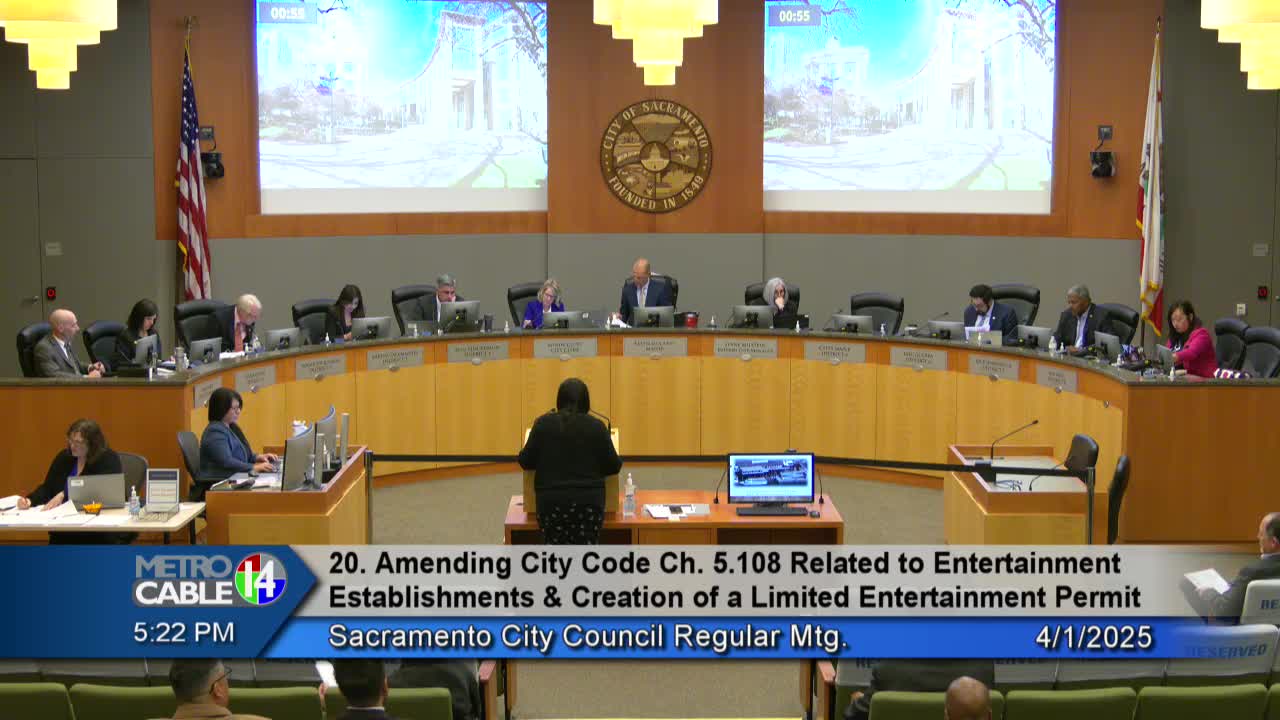
Sacramento council creates Limited Entertainment Permit to ease rules for small venues
Summary
The City Council approved an amendment to Sacramento City Code Chapter 5.108 creating a Limited Entertainment Permit (LEP) aimed at lowering costs and operational burdens for smaller venues that host entertainment as a secondary activity.
The Sacramento City Council on Tuesday approved an amendment to Chapter 5.108 of the Sacramento City Code to create a Limited Entertainment Permit, a lower-cost permit for smaller businesses that occasionally host entertainment.
The change, presented by Tina LeVotte, nighttime-economy manager in the Office of Innovation and Economic Development, creates a new tier of permit for venues with a total occupancy of 299 or fewer where entertainment is a secondary operation. LeVotte said the LEP is intended to address an inequity in the current code that “does not differentiate between different business sizes and activities,” forcing a small café that wants to host occasional live music to meet the same requirements as a large nightclub.
The LEP’s primary criteria include a maximum occupancy of 299, restrictions that entertainment be secondary to the primary business, and hours that end at 10 p.m. on weeknights and 11 p.m. on weekends (with special extension for New Year’s Eve). LeVotte said both the existing general entertainment permit and the LEP will continue to be reviewed by the city entertainment team—including police, code and fire departments—and letters will be mailed to property owners within 500 feet of applicants so neighbors can comment. “Applications are reviewed and approved by the city entertainment team, including police code and fire,” LeVotte said during her presentation.
Although the LEP will have fewer application requirements and operational conditions than the general entertainment permit, it will still require a manager on-site whenever entertainment occurs, fire approval, conditions addressing sound and crowd control, and two-year permit terms with eligibility for a no-cost two-year extension if there are no significant violations. The code amendments also rename the existing permit tiers — the previous entertainment permit becomes the general entertainment permit, and the special entertainment permit will be renamed “temporary entertainment permit” to avoid confusion with special-event permits. Trivia nights were added as an explicit exemption.
Councilmembers asked about the occupancy thresholds and program administration during discussion. Councilmember Dickinson asked how the 49/50 and 299 thresholds were chosen; LeVotte said the numbers align with fire code practices (49 and under is not an assembly use; 50 and above is; 300 or more triggers additional fire-suppression requirements) and with staff experience about when entertainment tends to be a primary business activity. Dickinson said she supported the direction: “I do think this is a step in the right direction.”
Councilmembers also pressed staff on implementation outside the central city and on how the program will address venues adjacent to residences. LeVotte described the permit’s customized operational conditions—such as earlier end times or closed doors/windows for venues near sensitive uses—and said staff will work with council offices, sector command captains and neighborhoods during implementation to tailor conditions where needed.
The Council approved the ordinance amendment after a motion and second. Staff said fees for the new permit were not set in the code change; the Convention and Cultural Services (CCS) department will return to the council to adopt fee amounts during a separate fee-setting process. LeVotte told councilmembers applications are expected to be available by June and that CCS will conduct outreach and provide application guidance to help small businesses determine whether an LEP or a general entertainment permit is right for them.
Implementation details and fee levels remain subject to the follow-up fee-setting action; staff said they hope to return with proposed fees within approximately 30 days so the program can become operational.