Get Full Government Meeting Transcripts, Videos, & Alerts Forever!
Get email alerts on the County Budget Taxes topic
No spam. Unsubscribe anytime.
Allegany County commissioners agree to 2¢ property tax increase, raise local income tax to 3.2% to close FY26 gap
Summary
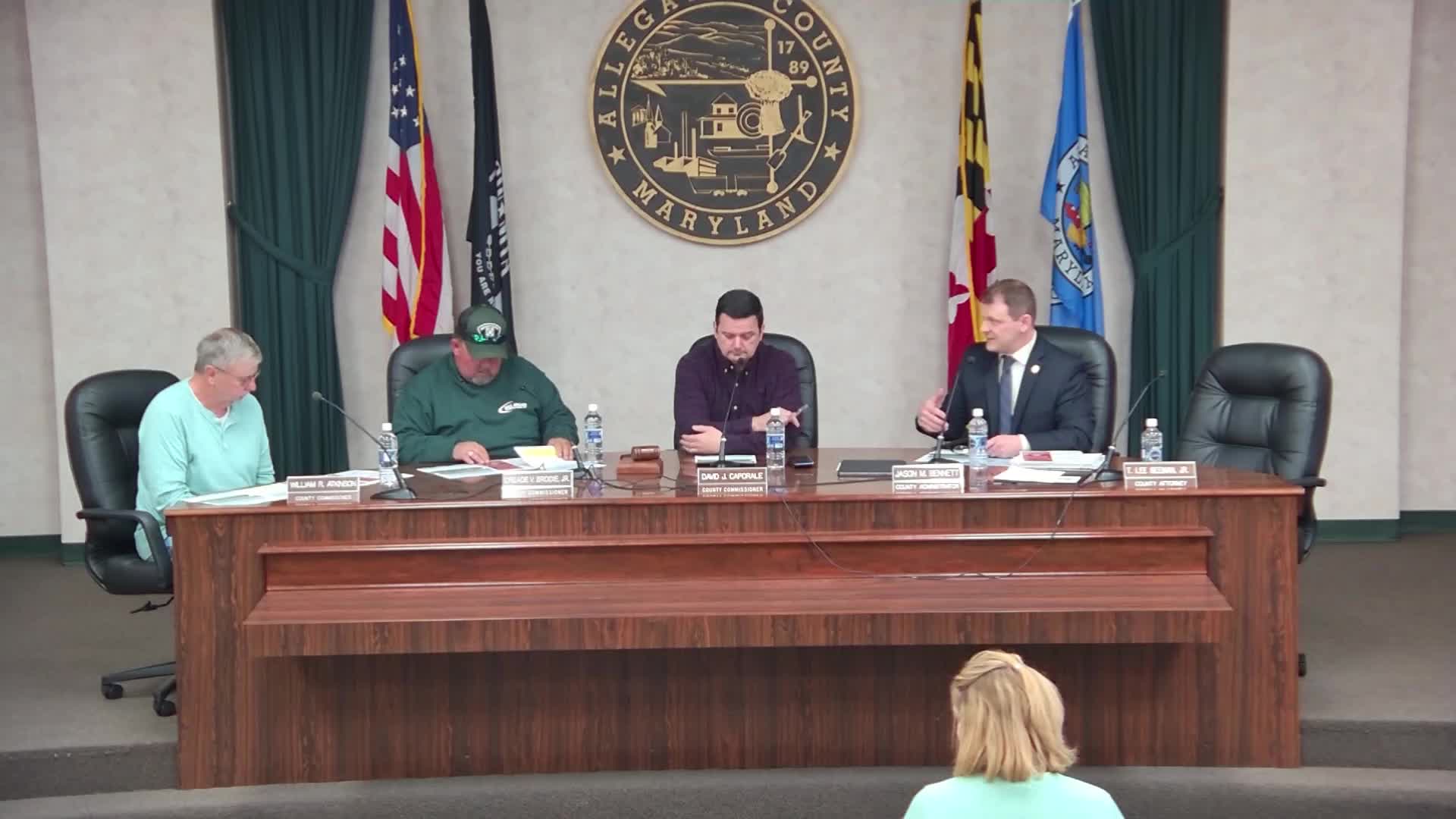
Allegany County Commissioners on Thursday directed staff to advertise a 2¢ increase in the county property tax rate and to move the local income tax to the statutory maximum of 3.2% for calendar-year 2026 to help close a roughly $1.1 million FY26 budget shortfall.
Allegany County Commissioners on Thursday directed staff to advertise a 2¢ increase in the county property tax rate and to move the local income tax to the maximum allowable 3.2% for calendar-year 2026, measures county staff said are intended to close a roughly $1.1 million gap in the fiscal 2026 budget.
County staff told commissioners that current FY26 revenue projections total $112,387,112 against $113,499,732 in expenditures, producing about a $1.1 million deficit. The draft budget already includes several state-driven changes and cost increases, including a projected $825,000 in pilot revenue from wind-turbine operations (pending those facilities reaching operation), a $754,000 teacher-pension shift and an increase in health insurance and retirement costs (staff said health insurance is up about 16% and Maryland retirement costs roughly 11%). Staff also noted a roughly $816,000 reduction this year in the county—s supplemental disparity grant and further cuts expected next year.
To address the shortfall, commissioners approved a package of measures to be advertised for public hearing: raise property taxes by 2¢, push the local income tax to the 3.2% cap, level-fund the library (eliminating an $87,000 request for additional county funding), eliminate 10 county positions (estimated to reduce costs by roughly $775,000), and use a mix of lottery funds and fund balance to bridge the remaining gap. County staff said they would begin the legal advertisement immediately and hold a public hearing on May 1.
Why it matters: staff advised the board that increasing the income tax to the maximum rate would qualify Allegany County for a materially larger state disparity grant in FY27. Under the staff—s analysis, the county—s disparity grant could move from about $7.29 million to roughly $13 million in the next year if the income tax is set to the maximum during the current budget cycle—an increase staff estimated at approximately $5.7 million. Staff cautioned, however, that portions of the state adjustments were temporary or subject to change and that relying on future state action carries risk.
Discussion highlights and constraints
- Staff presentation and guidance: a county finance staff member opened the discussion by summarizing the revenue and expenditure totals and asked the commissioners for guidance on balancing the budget. The presenter noted several items baked into the draft: the pilot wind-turbine revenue estimate of $825,000 (conditional on operations starting before July 1) and reductions tied to state actions, including loss of supplemental disparity grant dollars.
- Disparity grant mechanics: staff explained that disparity grant calculations are retrospective and that the county could not affect its FY26 disparity allocation at this point; to qualify for a larger allocation in FY27 the county must change its income tax rate during the current budget process. Staff said DLS and county consultants had confirmed that raising the local income tax to the 3.2% maximum would materially increase the county—s disparity grant in the following year, but that the increase is not guaranteed beyond the current written guidance from state analysts.
- Trade-offs considered: commissioners discussed alternative ways to close the gap, including eliminating the 1% early-payment property tax discount (some commissioners opposed removing it because banks and mortgage escrows sometimes already incorporate that payment timing), cutting positions, drawing on the lottery fund, or using fund balance. Commissioners repeatedly cautioned that using fund balance creates a two-year obligation to restore it and could affect the county—s bond ratings if carried too far.
- Operating pressures: staff reiterated that most county departments returned flat budgets during public hearings and that most further cuts would fall to personnel. Staff quantified some cost pressures: a one-time reduction in income-tax revenue estimates tied to a federal/standard-deduction change (approximately $640,000), health insurance up roughly 16%, and retirement costs up about 11%.
Decisions and next steps
The board summarized and approved the following package of actions (no roll-call vote appears in the transcript): increase the county property tax rate by 2¢; raise the local income tax to the statutory maximum of 3.2%; level-fund the county library (remove the $87,000 additional request); eliminate 10 county positions (preliminary estimate ~$775,000); use approximately $1.5 million from lottery funds with the remainder from fund balance to cover the FY26 deficit; instruct staff to advertise the proposed property tax change and schedule a public hearing for May 1. Staff said they would return with precise numbers within a few days as revenue and accounting entries are finalized.
What the board did not do
The board did not record a formal roll-call vote in the provided transcript. Commissioners discussed, then rejected for now, removing the 1% early-payment discount. Staff cautioned that moving aggressively into fund balance or lottery funds to avoid tax increases would be a gamble should the state—s projected disparity funds not materialize in the next fiscal year.
Context and local economic notes
Commissioners and staff discussed economic development projects that could affect future revenues, including several private-sector investments and facility openings mentioned in the meeting transcript as "in the pipeline." Staff said those projects could improve the county—s revenue position in coming years but emphasized timing and uncertainty.
Ending
County staff will publish the legal notice, and the commissioners scheduled the May 1 public hearing to consider the property tax change and related budget adjustments. Staff said they would refine final numbers and return to the board with updated figures within days.