Get Full Government Meeting Transcripts, Videos, & Alerts Forever!
Get email alerts on the Transit Service Changes topic
No spam. Unsubscribe anytime.
CapMetro proposes Night Owl extension to airport and UT shuttle consolidation in August service change
Summary
Staff proposed extending Night Owl Route 483 to Austin–Bergstrom Airport and combining UT shuttle routes 670/671 to improve frequency; staff conducted a Title VI analysis and received public comment raising equity and sidewalk/shelter gaps in Northeast Austin.
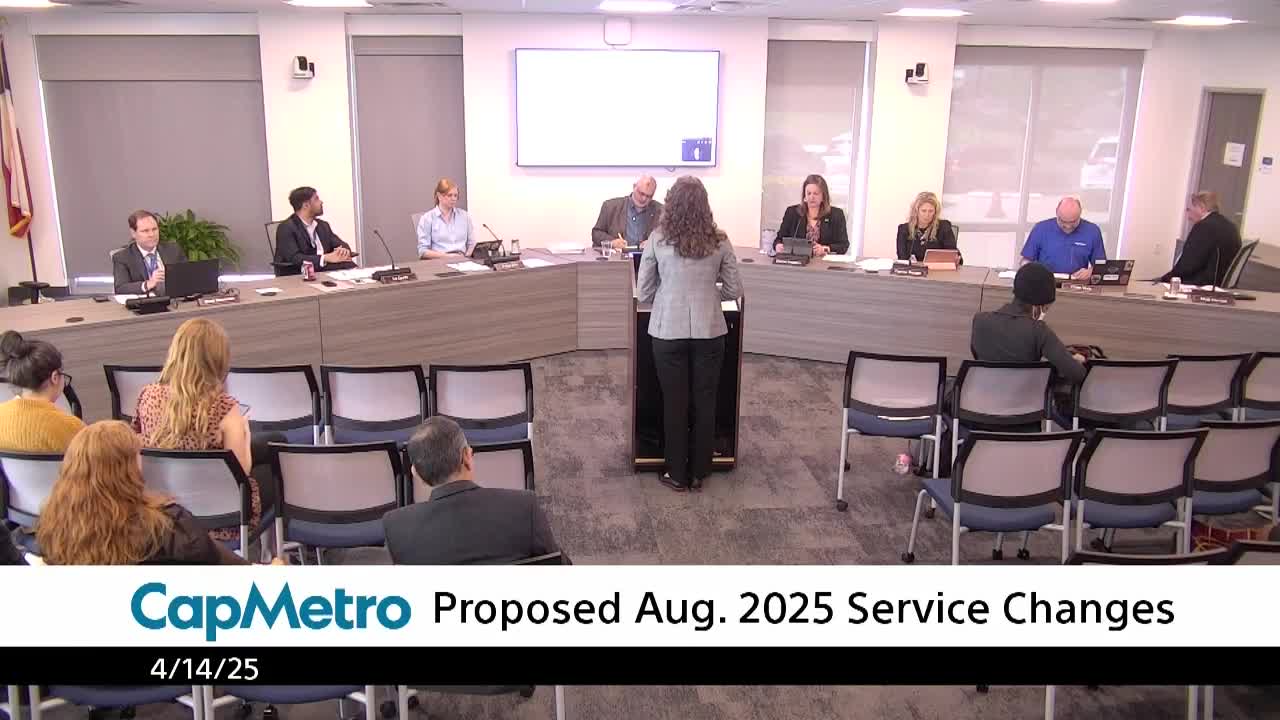
Jordan McGee, senior planner in CapMetro’s planning department, presented proposed August 2025 service changes at the April 14 public hearing, saying the changes aim to match service with demand and improve connections for late‑night and student riders.
McGee said CapMetro proposes to extend Route 483 Night Owl (Riverside) to Austin–Bergstrom International Airport to provide late‑night connections where none exist between about midnight and 5 a.m. Staff said the extension would keep the Night Owl’s current frequency and span (midnight to 3 a.m., Monday through Saturday) and would add roughly 21,000 annual revenue miles. McGee cited community comments noting late arrivals and departures and said the extension “provides a near term opportunity to help close that gap for late night travelers, employer employees, and customers.”
The presentation also proposed combining two UT shuttle routes, Route 670 (Crossing Place) and 671 (North Riverside), into one route to maintain full stop coverage while providing more consistent bidirectional service and higher frequency — McGee said the combined route would operate about every 10 minutes during much of the day. Staff said the change would maintain service to all existing stops, reduce delays caused by a one‑way loop on the 671 alignment, and would produce a roughly three‑minute end‑to‑end travel‑time change for some riders. McGee told the board that the three UT shuttle routes in the Riverside area constitute 40% of UT shuttle service hours while serving an area with only about 1% of the estimated student population and 16% of UT shuttle ridership, indicating a resource‑matching opportunity.
Because the 483 extension and the 670/671 combination meet CapMetro’s threshold for major service changes, staff conducted a Title VI service equity analysis. McGee said the 483 Night Owl extension showed no disparate impact or disproportionate burden and would expand late‑night service for Riverside, including minority and low‑income communities. The 670/671 combination showed an approximate decrease of 84,000 annual revenue miles in the Riverside UT shuttle group and “demonstrated a potential disparate impact and a potential disparate burden,” McGee said, but staff concluded the effect on current customers is minimal because full connectivity and all existing stops would be retained and many riders would see improved frequency.
Public comment echoed both praise and concern. Board member Veil expressed support for the Night Owl extension, saying staff had found system efficiencies. Public commenter Zenobia Joseph praised the Night Owl idea as “a game changer” but urged CapMetro to address sidewalk, lighting and shelter gaps in Northeast Austin and warned of continuing safety issues on North Lamar. Joseph also raised Title VI and equity concerns and asked CapMetro to restore Northeast–West connectivity on routes she named.
McGee said the proposed changes would be implemented starting Sunday, Aug. 17 if approved, and that CapMetro had shared the proposals through online outreach, at‑stop signage, a virtual public meeting and direct emails to more than 10,000 customers. Staff said engagement included conversations with operators and students and that the UT shuttle bus committee had formally and unanimously approved the recommended UT shuttle adjustments. The board did not vote at the April 14 hearing; staff will bring the proposals to the board for approval later in April.