Get Full Government Meeting Transcripts, Videos, & Alerts Forever!
Get email alerts on the Climate Energy topic
No spam. Unsubscribe anytime.
Residents discuss dark‑sky protections, rooftop reflectivity, solar and EV charging as Oro Valley updates its 10‑year plan
Summary
At a workshop for the Town of Oro Valley’s 10‑year plan, participants discussed LEED for Cities, dark‑sky lighting, reflective roofs and expanded solar and electric vehicle charging options as possible policies to reduce heat and emissions.
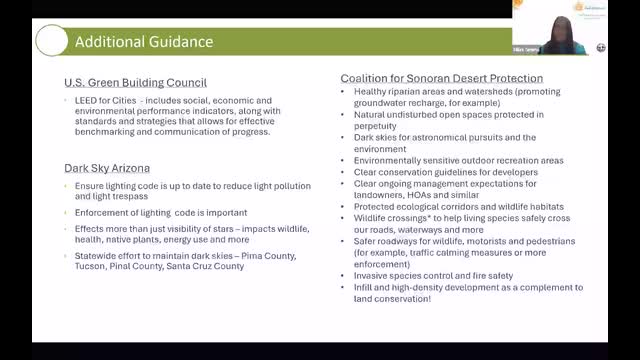
Malini Sims, principal planner, told the working group the town had reached out to the U.S. Green Building Council and other subject‑matter groups; the council’s LEED for Cities standard and dark‑sky advocates were among those offering guidance.
Dark‑sky and lighting: Participants supported updating Oro Valley’s lighting code. Malini Sims said the town’s lighting code is “very outdated” and staff is watching Pima County/Tucson and other nearby jurisdictions as they revise standards. Rose Piero asked whether the town enforces lighting requirements; Sims said new developments submit lighting plans and commercial lighting is inspected at night on a routine basis, while residential issues are primarily handled through complaints.
Rooftops and heat mitigation: Residents debated trade‑offs between desert‑compatible building colors and energy performance of light‑reflective roofs. Malini Sims explained the town’s current design standards include a light‑reflective value that generally does not permit very bright white roofs for model homes and commercial areas, though custom homes may be treated differently. Several residents recommended allowing reflective roofing where it isn’t visually prominent; Rosa Daley and others noted lighter roof materials can reduce indoor cooling demand. Participants also suggested expanding tree cover along trails and streets and adding mulching and basins to improve landscape water retention.
Solar and incentives: Sims said the town can research incentives and rebates; several residents recommended town support for solar via education, rebates or partnerships with local installers. Residents raised community solar as an option to spread benefit where full rooftop systems are cost‑prohibitive.
Electric vehicles: Participants discussed the convenience of home charging versus the visibility and role of public chargers in commercial areas. Sims said the building code does not currently require EV‑ready infrastructure for single‑family homes but that the town could consider how to support garage charging and more public chargers in shopping centers and municipal properties. Keith Mermin and others noted installing a home charger typically requires only simple additional circuitry.
Sims told participants staff will take comments into account as they draft goals and policies for the plan and will present a draft for review at the next meeting.