Get Full Government Meeting Transcripts, Videos, & Alerts Forever!
Get email alerts on the Criminal Justice topic
No spam. Unsubscribe anytime.
Committee advances bill allowing judicially ordered cognitive‑behavioral training for certain misdemeanor offenders
Summary
Senate Bill 300, as amended, would make cognitive‑behavioral training a possible condition of probation for people convicted of certain Class A misdemeanors; the committee recommended passage after debate about local costs and discretionary judicial application.
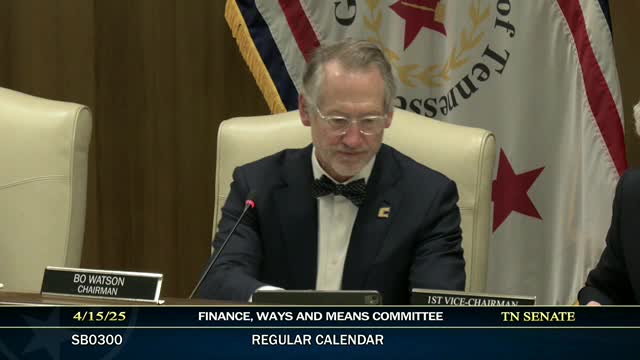
The Senate Finance, Ways and Means Committee recommended Senate Bill 300 for passage to the calendar after considering a judiciary amendment that makes judicial referral to cognitive‑behavioral training discretionary.
What the bill does: Under the bill as amended, judges could order a person convicted of a Class A misdemeanor to complete a cognitive‑behavioral training program as a condition of probation unless the judge determines the program is not appropriate in the particular case. The sponsor said the programs — which are provided by private vendors in some Tennessee counties — have produced positive outcomes in counties that have used them.
Local costs and program operations: The sponsor acknowledged the fiscal note contains multiple unknown variables and that some fiscal‑review assumptions flagged potential increases in local expenditures related to incarceration and program operations. Senator Roberts and other supporters said counties currently using the programs, including Robertson County, have not experienced the “significant mandatory increases” suggested in the fiscal note and described the programs as administered by private providers under local arrangements.
Records and discretion: The amendment clarifies the judicial role and makes participation discretionary — a judge could decline to order the training if it is not appropriate in a particular case.
Vote: The committee recommended Senate Bill 300 as amended by a recorded vote. The clerk recorded 6 ayes and 3 noes; the chair announced the bill was recommended for passage to the calendar.
Speakers quoted
"There has not been significant mandatory increases in local expenditures" — Senator Roberts, sponsor, describing local experience in counties that have used the programs.
Next steps: The bill moves to the Senate calendar for consideration by the full Senate.