Get Full Government Meeting Transcripts, Videos, & Alerts Forever!
Get email alerts on the Hemp Cannabinoid Regulation topic
No spam. Unsubscribe anytime.
Committee moves bill to shift hemp‑derived cannabinoid enforcement to ABC, adds wholesale tax, licensing and sales tax changes
Summary
Senate Bill 1413 as amended was recommended for passage to the calendar committee after the Finance Committee adopted an amendment that shifts enforcement to the Alcoholic Beverage Commission and adjusts taxes and licensing revenues.
Senate Bill 1413 as amended was recommended for passage to the calendar committee after the Senate Finance, Ways and Means Committee adopted a finance amendment that reallocates tax and licensing revenue and sets enforcement responsibilities with the Alcoholic Beverage Commission (ABC).
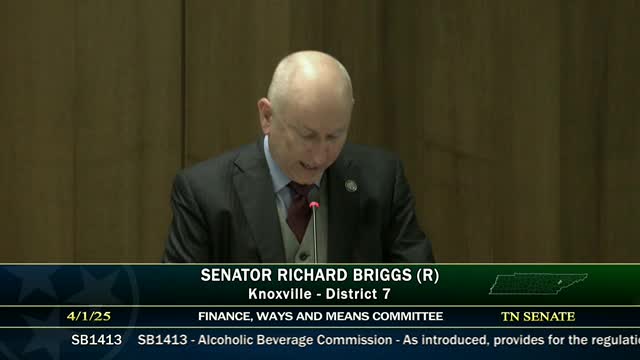
Sponsor Senator Briggs told the committee the bill moves post‑harvest compliance, wholesale and retail enforcement from the Department of Agriculture to the ABC, which the sponsor and proponents argued has more experience enforcing age‑restricted, intoxicating products. The amendment creates licensing and fee structures, adds a wholesale tax and an additional sales tax on specified cannabinoid products and redirects revenue streams to fund ABC enforcement and other state needs.
Key fiscal and regulatory provisions discussed in the hearing include: - Licensing: $500 application fee; annual licenses of $1,000 per retail location, $2,500 for suppliers (manufacturers) and $5,000 for wholesalers, with the $500 application fee paid at filing; application fee one‑time, license annual. - Wholesale tax: a per‑milligram wholesale tax (described in committee as 1¢ per milligram) with half the revenue directed to the ABC for enforcement and half to the general fund. Fiscal Review estimated roughly $6 million annual to each entity from this wholesale tax in a full year projection. - Additional sales tax: a 6% additional sales tax on affected products; Fiscal Review estimated current collections on the 6% at about $13.6 million next fiscal year and anticipated reallocation effects between ABC and Department of Agriculture. - Licensing and enforcement expenditures: fiscal staff estimated ABC would need additional positions (28 positions across ABC and other agencies) and recurring costs for enforcement; Department of Agriculture would reduce positions (13 positions assumed surplus to its needs under the new regime).
Sponsor Briggs and proponents argued for public safety and consumer protection, citing past unregulated products that resembled candy and caused pediatric exposures. “We're regulating it very well,” Briggs said, emphasizing consumer protections, testing requirements and limits on sales to children.
Opponents and questions from the committee focused on regulatory stability for businesses that had relied on Department of Agriculture rules recently finalized, the removal or treatment of certain cannabinoid measures (THCA), and whether the ABC is technically equipped to perform laboratory oversight and product testing. Senator Wally and others raised concerns about changing regulatory regimes shortly after prior rule‑making and the practical impact on operators who had invested under prior expectations.
Fiscal Review representative Boyan Savage provided revenue and expenditure estimates during the recess; the fiscal memo cited an estimated shift of about $7 million annually to ABC from the current 6% collections, licensing revenue averaging about $5 million to ABC per year, and a wholesale tax expected to generate approximately $12 million total annually split between ABC and the general fund (subject to an assumption about THCA being excluded under current law). The fiscal note also reflected a projected decrease in Department of Agriculture expenditures of roughly $1 million if positions move to the ABC and other efficiencies occur.
After debate the clerk recorded the committee’s recommendation of the bill to the calendar committee; committee members were divided on the policy and timing but moved the bill forward with the finance amendment that reallocated revenues to cover ABC enforcement costs.