Get email alerts on the Public Comment Rules topic
No spam. Unsubscribe anytime.
Committee rejects bill that would have guided public-comment practices for appointed local boards
Summary
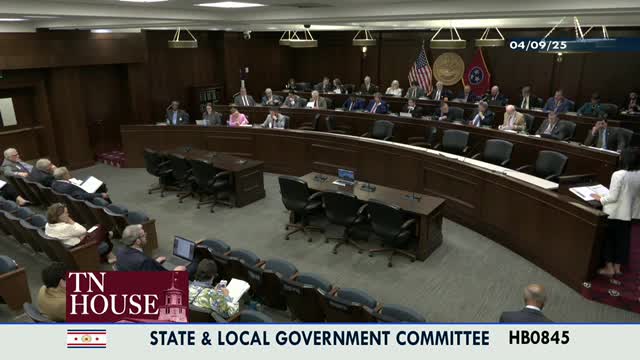
House Bill 845, which would have offered permissive guidance to local governments and appointed boards on accommodating large groups of public commenters and adding written comment periods, failed in committee 7-9 with three present not voting after debate on aims and wording.
House Bill 845, introduced by Representative Renaud, sought to provide permissive guidance to local governments and appointed boards on handling large groups of public commenters and to establish a formal written public-comment option. The measure failed in the State and Local Government Committee by a vote of 7 ayes, 9 nays and 3 present not voting.
Representative Renaud, explaining the bill and an untimely-filed amendment that was accepted, said the measure was “absolutely a permissive bill that is aimed at strengthening public trust in our local governments.” Renaud said the bill did not mandate any specific procedure but would ask governing bodies to “reconsider, when these situations arise… that they might allow for 1 or 2 or 3 or whoever, number of people to be able to speak on the issue.” She also said an alternative would be “a formal written public comment period” to allow broader participation.
Supporters and some committee members praised the sponsor’s willingness to work with stakeholders and to remove language that raised concerns about allowing disruptive in-person behavior. Representative Rudd thanked the sponsor for working with stakeholders and noted that the bill remained permissive. Other members raised concerns about the unintended consequences of the language; after debate the committee voted and the bill failed to advance.
Action: HB 845 failed in committee (7 ayes, 9 nays, 3 present not voting) and will not move forward from this committee unless reintroduced or reconsidered.
AI generated
The text on this page is AI generated. Summaries, highlights, analysis, and video transcripts are all produced from the original source material.
AI can make mistakes, so if you spot one, and we will fix it for everyone.
Note: the source content is unaltered by us. Any content source we link to, be it a video, an audio recording, or a document, is presented exactly as its publisher released it. That publisher is usually a government body, sometimes an individual official or another organisation.