Get Full Government Meeting Transcripts, Videos, & Alerts Forever!
Get email alerts on the Education Enrollment Documentation topic
No spam. Unsubscribe anytime.
Senate finance panel advances bill letting schools require immigration documentation, creates 21‑day appeal and possible tuition charge
Summary
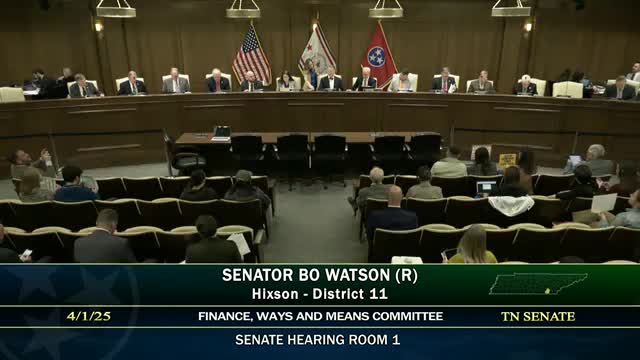
Chairman Watson moved Senate Bill 836 as amended and the Senate Finance, Ways and Means Committee recommended the bill for passage to the calendar committee after a 7‑4 vote.
Chairman Watson moved Senate Bill 836 as amended and the Senate Finance, Ways and Means Committee recommended the bill for passage to the calendar committee after a 7‑4 vote.
The bill would permit a local education agency (LEA) or public charter school to require a student seeking enrollment to provide documentation showing the student is a U.S. citizen, is in the process of obtaining citizenship, or holds legal immigration or visa status. If the documentation is not provided, the local school may elect to charge tuition. Families may appeal a negative documentation finding to the Tennessee State Department of Education; an appeal must be filed within 21 days, and the student may remain enrolled during the 21‑day appeal and any expedited hearing.
Proponents, led by Chairman Watson, said the amendment (69‑47) removed redundant language and that the bill relies on registration documents schools already request. “If that documentation provides that they are a US citizen, they're in the process of obtaining citizenship, or they hold legal immigration or visa status, then the answer is yes and they are enrolled,” Watson said in explaining how the enrollment and appeal process would work.
Opponents on the committee raised legal, logistical and cost concerns. Senator Yarbrough questioned using English-language learner (ELL) spending as a proxy for undocumented enrollment, saying, “I don't think the math tracks at all,” and noting many ELL students are documented U.S. citizens. Several members raised questions about FERPA compliance and whether schools have the capacity or training to review immigration documents and make legal determinations. Senator Lamar asked whether schools or staff would be required to contact federal immigration authorities, a question Chairman Watson said would be addressed in rules and regulations promulgated by the Department of Education, not in the bill’s text.
Members also debated practical impacts: the bill directs that if a student is denied enrollment for lack of documentation and the family declines to pay tuition, the LEA may decline to enroll the student. The bill requires any tuition charged to be at least the base funding amount for the school year and not to exceed the average per‑pupil funding for the LEA for that year; the tuition must be paid in full before enrollment if charged.
The committee adopted amendment 69‑47 (which struck a redundant paragraph from the education amendment) before voting on the bill. After debate focused largely on the financial and procedural burdens of verifying documentation and potential constitutional concerns raised by members citing case law, the clerk recorded the vote and the committee forwarded the bill to the calendar committee as amended.
The debate highlighted divergent views on the fiscal and moral effects of limiting enrollment for students without specified documentation and left several implementation details to the department rule‑making process specified in the bill.