Get Full Government Meeting Transcripts, Videos, & Alerts Forever!
Get email alerts on the K12 Education topic
No spam. Unsubscribe anytime.
Subcommittee advances bill to create oversight board for Memphis-Shelby County Schools
Summary
The Finance, Ways and Means subcommittee voted to add an amendment and advance House Bill 662, which would establish a nine-member oversight board to review the budget, contracts and facilities of Memphis-Shelby County Schools, to full finance.
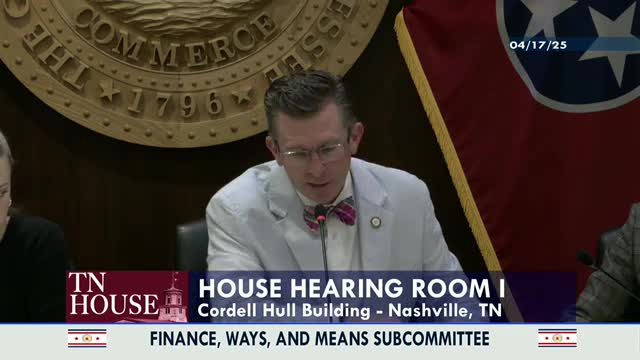
The Finance, Ways and Means subcommittee on April 17 approved an amendment and voted to advance House Bill 662 as amended to full finance, moving forward legislation that would create an oversight board to work with the locally elected Memphis-Shelby County School Board.
The bill, as amended by Amendment Drafting Code 7487, would establish a nine-member oversight board appointed by the governor and the two legislative speakers. The oversight board would review the LEA’s budget, contracts and facilities; require local board submission of lists of vacant or underutilized properties; and have authority to require reconsideration of certain budget and contract decisions.
Chairman White, who sponsored the bill, described the measure as “a local intervention” aimed at addressing long-running performance and fiscal concerns in Memphis-Shelby County Schools. “We will appoint 9 members on the oversight board that will be appointed by the governor and the 2 speakers,” White said, adding the members would be “highly qualified people from the district of Memphis Shelby County” and that the board would be put in place for at least three years with an optional additional three years.
Vice Chairman Gillespie urged support, saying he had lived in Memphis his entire life and that “there has been needed oversight for a very long, long time,” and that he “could not support this bill anymore” was read in context as strong endorsement during committee remarks. Committee discussion focused on the scope of authority, whether the measure applied only to Shelby County, and whether the bill would be retroactive to conditions identified before enactment.
Representative Parkinson asked whether qualifying conditions in the bill would apply only going forward or retroactively; Chairman White said the criteria in the bill reflect conditions that exist now, listing several triggers discussed in committee: 50% or more of students not meeting grade-level expectations; 30% or more of schools assigned a D or F; 25% or more of students chronically absent; at least one school identified as a priority school; and a majority vote by the local legislative body expressing no confidence in the local school board. White said the bill was drafted to apply specifically to Memphis-Shelby County and not broadly to other districts.
White described other provisions in the amendment: the local board should not approve any contract over $50,000 without oversight-board approval; the oversight board can request lists of vacant or unutilized properties; and denials of charter applications by the local board could be reviewed by the oversight board.
Committee members pressed practical questions about finding qualified members and why qualified people had not previously run for local board positions. Representative Shaw and others noted frustration with local governance and the difficulty of recruiting and retaining people willing to serve in what members described as a contentious environment.
The committee approved Amendment Drafting Code 7487 by voice vote, put the amendment on the bill, and then, after a motion for previous question, voted to advance House Bill 662 as amended to full finance. The clerk reported a recorded vote with the ayes prevailing; a committee member noted there was one no vote. The committee chair announced full finance would convene in five minutes.
Background discussed in committee included a forensic audit by the Comptroller’s Office and budget figures cited by Chairman White: an approximately $1.8 billion annual budget for Memphis-Shelby County Schools, with about $900 million attributed to state funding and roughly $500 million from Shelby County, plus federal funds. White and others said reading and math proficiency in the district remained low (the transcript references third-grade reading proficiency in Memphis at about 30.5% and the statewide rate at about 35.6%).
The bill’s formal text, any fiscal notes, and the committee roll call will determine exact vote counts and next steps when the measure appears on the full finance committee agenda.