Get Full Government Meeting Transcripts, Videos, & Alerts Forever!
Get email alerts on the Finance topic
No spam. Unsubscribe anytime.
Finance director outlines city fiscal functions, special districts and budget pressures
Summary
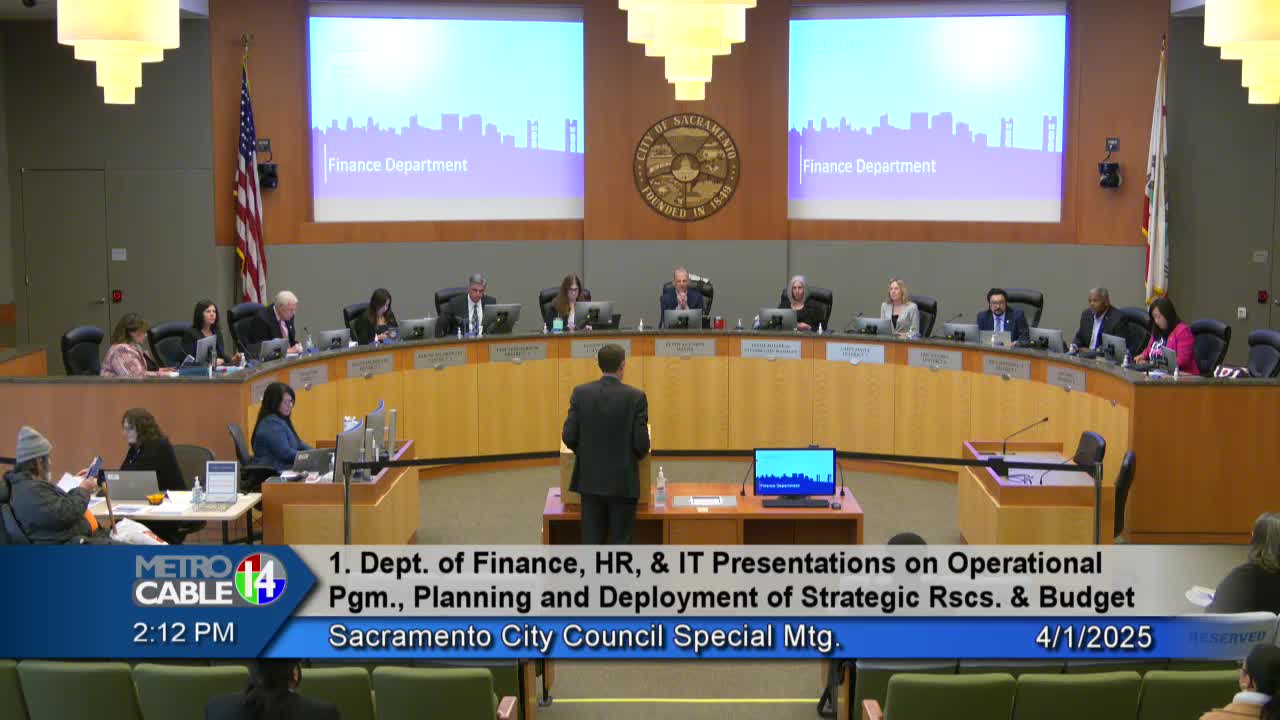
Finance Director Pete Cletto briefed the Sacramento City Council on April 1 about the finance department’s role, divisions, a $10.3 million general fund operating budget and the department’s work on procurement, special districts and fiscal transparency.
Pete Cletto, Sacramento’s finance director, presented an overview of the finance department’s structure and responsibilities to the City Council on April 1, describing finance as the foundation that supports program conception, delivery and mandated reporting.
Cletto said the department’s general fund operating budget for the year is $10,300,000 and that it has 94 full‑time equivalent positions. He emphasized that many finance functions are mandated by law and by charter, including producing the annual comprehensive financial report and providing accounting services for the city’s legacy pension plan.
Why it matters: The finance department administers revenues, issues payments to vendors and employees, manages procurement, and administers financing mechanisms such as enhanced infrastructure financing districts (EIFDs) and community facilities districts (CFDs), tools the presentation said were key to development in areas such as Natomas and the Railyards.
Cletto reviewed six operating divisions: accounting, budget policy and strategic planning, infrastructure finance (IFF), procurement, payroll and revenue. He said the infrastructure finance team helps form and administer financing plans for special districts and that IFF’s work in EIFDs supported major projects including the Railyards and Aggie Square. Cletto said procurement modernization approved last year was the first comprehensive update to the procurement code in over a decade and aimed to create citywide efficiencies.
On audit and compliance, Cletto said the department conducts reconciliations for roughly 318 active funds, supports mandatory external audits and enforces procurement and tax programs established by voters.
Cletto framed finance as the public steward of taxpayer dollars and said the department’s mission is to “educate, inform and provide internal and external customer service with integrity, efficiency and quality,” emphasizing accountability and transparency in financial reporting.
He said the office of cannabis management will move back to finance on July 1 and that revenue division staff administer utility user taxes, transient occupancy taxes, business operations taxes and short‑term rental programs.
The presentation was informational; council members thanked finance staff for their work but took no formal action during the session.