Get Full Government Meeting Transcripts, Videos, & Alerts Forever!
Get email alerts on the Information Technology topic
No spam. Unsubscribe anytime.
Sacramento IT department cites 3-1-1 improvements, rising cyber costs and $14M ERP replacement need
Summary
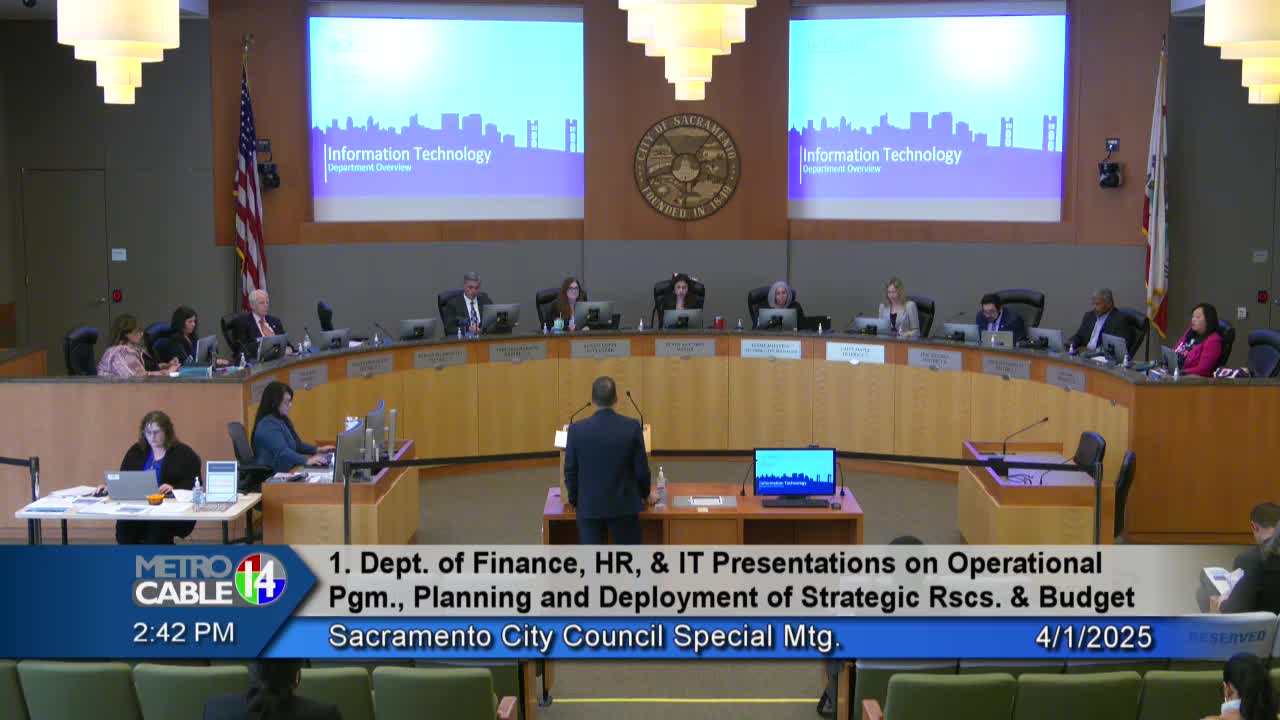
Chief Information Officer Darren Arcolino told the Sacramento City Council on April 1 that IT has cut 3-1-1 wait times, expanded digital-equity work and faces rising cybersecurity costs and an approaching $14 million ERP replacement.
Darren Arcolino, the City of Sacramento chief information officer, told the City Council on April 1 that the Information Technology Department has cut average 3-1-1 call wait times from nearly 14 minutes in 2023 to about 1 minute 10 seconds through staffing and technology changes and is working on digital-equity projects and AI governance while warning of rising cybersecurity costs and a looming enterprise resource planning (ERP) replacement that could cost as much as $14 million.
Arcolino said IT now manages about 202.5 full-time-equivalent positions, supports some 7,500 computing devices and 4.9 petabytes of city data, and administers 190 miles of city-owned fiber and 3-1-1 operations. “Through the use of technology we engage, empower and improve the lives of the citizens of Sacramento,” he said.
Why it matters: IT supports payroll, public safety, utility billing and many other core services. Arcolino told council members that deferred IT investment and staff reductions increase operational and cybersecurity risk and can raise costs later if services must be outsourced.
Arcolino said IT’s operating budget is funded from both the general fund and an interdepartmental service fund and that 97% of the department’s budget is allocated to employee services. He described specific cost-savings and grant wins, including $38.9 million in grants last year—much of it tied to a last-mile connectivity project that the presentation said will benefit roughly 43,000 residents—and a negotiated state agreement that avoids about $23 million annually in third-party lease costs by exchanging city fiber for internet services and security coverage.
On 3-1-1, Arcolino said the call center’s hours were adjusted to concentrate staffing on peak periods—7 a.m. to 7 p.m.—and a virtual agent was improved to handle routine inquiries. He said the changes reduced average wait time to 1 minute 10 seconds and cut abandoned calls to 4.6% from 23%.
Arcolino highlighted cybersecurity as a growing mandatory cost. He said the city handles millions of emails and files monthly, blocks hundreds of malicious payloads, and detected employee-impersonation and phishing attempts. The presentation cited industry breach-cost figures as context and noted a $250,000 cybersecurity grant approved by council last week to support training and program enhancements.
On artificial intelligence, Arcolino said the city has developed an AI policy, created a cross-department working group, joined the Gov AI Coalition and launched an internal assistant, Sac GPT, on the city intranet. “We focused on integrating AI into the city responsibly, building a strong foundation first,” he said.
Arcolino warned that the city’s ERP, implemented in 2008 (PeopleSoft/ECAPS), is nearing the end of vendor support for major new releases and that replacing it would be a significant one-time investment—he cited an estimate of up to $14,000,000. Council members discussed the need to bake the replacement into forecasts or use one-time funding when available.
Council questions acknowledged the improvements and raised concerns about cybersecurity and deferred maintenance. Council member Kaplan asked about rising cybersecurity costs; Arcolino described the city’s partnership with the state and a security operations center that provides 24/7 monitoring. Another council member praised the 3-1-1 improvements and called out Ivan Casanellos, the 3-1-1 manager, by name during remarks to the chamber.
The presentation also noted staffing pressures: workloads have grown about 30% since 2020 while technical staffing has fallen, and the department said a 15% budget reduction would equate to $3.2 million and 22 positions—measures that, IT warned, could increase cybersecurity risk and push departments to more-expensive outsourcing.
Public comment during the same agenda item included a resident, Mac Worthy, who criticized city management and oversight of 3-1-1 operations; his remarks were critical of the department’s performance and oversight.
Looking ahead, Arcolino outlined planned rollouts: free Wi-Fi for two public housing communities in partnership with the Sacramento Housing and Redevelopment Agency; distribution of laptops and Wi-Fi devices in partnership with Dell and T-Mobile aimed at digital-equity recipients and Pell-eligible Sacramento State students; a new digital permitting platform for entertainment and events; and a new customer-service platform for multi-channel contact including web chat and automatic language translation by mid-2026.
Council did not take formal action during the informational presentation.