Get Full Government Meeting Transcripts, Videos, & Alerts Forever!
Get email alerts on the Environmental Health topic
No spam. Unsubscribe anytime.
Health department steps up outreach on Hunters Point shipyard dust; community urges faster action
Summary
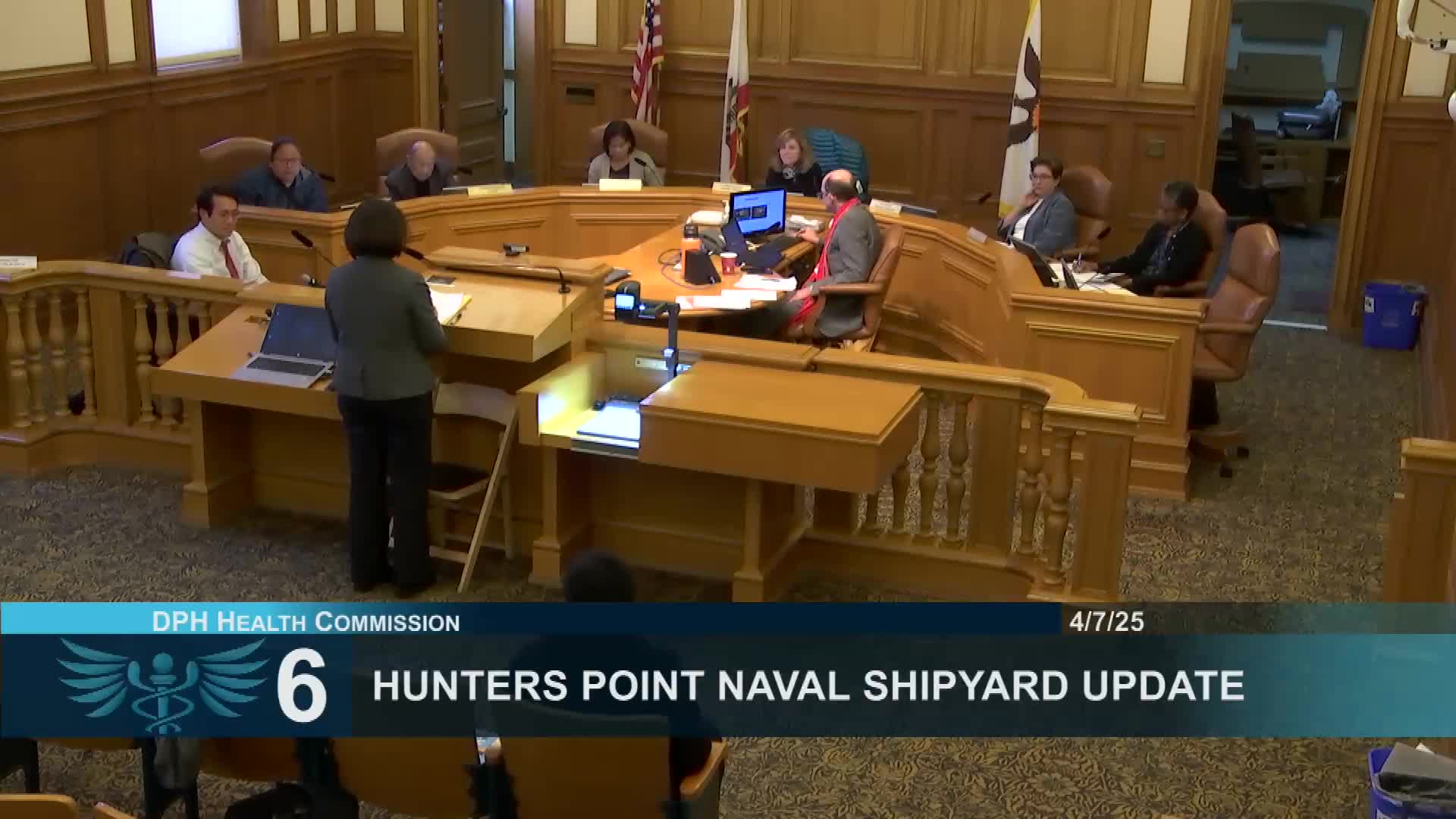
San Francisco Department of Public Health staff told the Health Commission they are increasing engagement with community members and regulatory partners over dust and air‑quality concerns tied to cleanup work at the former Hunters Point Naval Shipyard.
San Francisco Department of Public Health staff told the Health Commission they are increasing engagement with community members and regulatory partners over dust and air‑quality concerns tied to cleanup work at the former Hunters Point Naval Shipyard.
Health Officer Dr. Susan Phillip and medical director Dr. Nena Okoye described DPH’s interdisciplinary team, the federal and state regulatory framework under CERCLA (the federal Comprehensive Environmental Response, Compensation, and Liability Act), and ongoing activities that include radiological retesting, soil excavation, building demolition and groundwater treatment. DPH noted the Navy projects cleanup work in different shipyard areas to extend for years and has supplied completion timelines; the department said it continues to press for faster public reporting of air monitoring results, which the department says are currently posted with months of delay.
DPH said it does not have direct regulatory authority over work inside the shipyard while parcels remain federal property and that local health code authority applies only after land is transferred. Nonetheless, Phillip said the department is advocating with the Navy, EPA and other regulators to ensure dust control measures — such as watering and stabilizers, covers for exposed soil, reduced vehicle speeds and air monitoring — are implemented and communicated promptly. She said DPH maintains recommended dust‑control guidance on its website and that the city has asked the Navy to speed up its reporting cadence to the public. DPH staff also said they attend regional air district meetings and are supporting a Bayview Hunters Point Community Emissions Reduction Plan being developed with the Bay Area Air District and local community organizations.
Community members who spoke during public comment described ongoing exposures near parcels and recent demolition or excavation activities. Ramona Maayan, who identified herself as a tenant representative from the “Candlestick 35,” said occupants of a recently closed vehicle triage center and nearby RV encampments were exposed to dust and have experienced serious health problems, including cancer and lung ailments, and asked for advocacy and help finding housing and health services. Physician Dr. Palmer urged DPH to take immediate, tangible protective steps where residents are living, including direct mitigation at fence lines near the former landfill and more surveillance for encampments.
Commissioners pressed DPH for specifics: whether DPH can independently validate air‑monitoring data from Navy subcontractors, whether DPH can require physical mitigations on city‑side parcels (for example, fences with tarps), and how DPH will measure the effectiveness of interventions. DPH said EPA receives subcontractor monitoring data under CERCLA, and DPH is seeking greater transparency and earlier release of results. The department said it is running parallel assessments of (a) whether physical barriers would be scientifically justified and (b) what steps the city could take in the near term to reduce off‑site dust impacts.
DPH staff also announced ongoing clinical and community supports, including work to expand access to environmental‑health physicians at Southeast Family Health Center and participation in neighborhood meetings and SF Climate Week. DPH emphasized it is coordinating with the Bay Area Air District, the Marie Harrison Community Foundation, Bayview Hunters Point Community Advocates, and OCII (Office of Community Investment and Infrastructure).
Ending: The commission asked DPH to return with further specifics and to continue outreach. Community members urged faster, tangible mitigations for residents they say were exposed to dust during demolition and excavation; DPH committed to pursue greater transparency from the Navy and EPA and to explore local mitigations while continuing to press federal partners under CERCLA.