Get Full Government Meeting Transcripts, Videos, & Alerts Forever!
Get email alerts on the Harm Reduction Policy topic
No spam. Unsubscribe anytime.
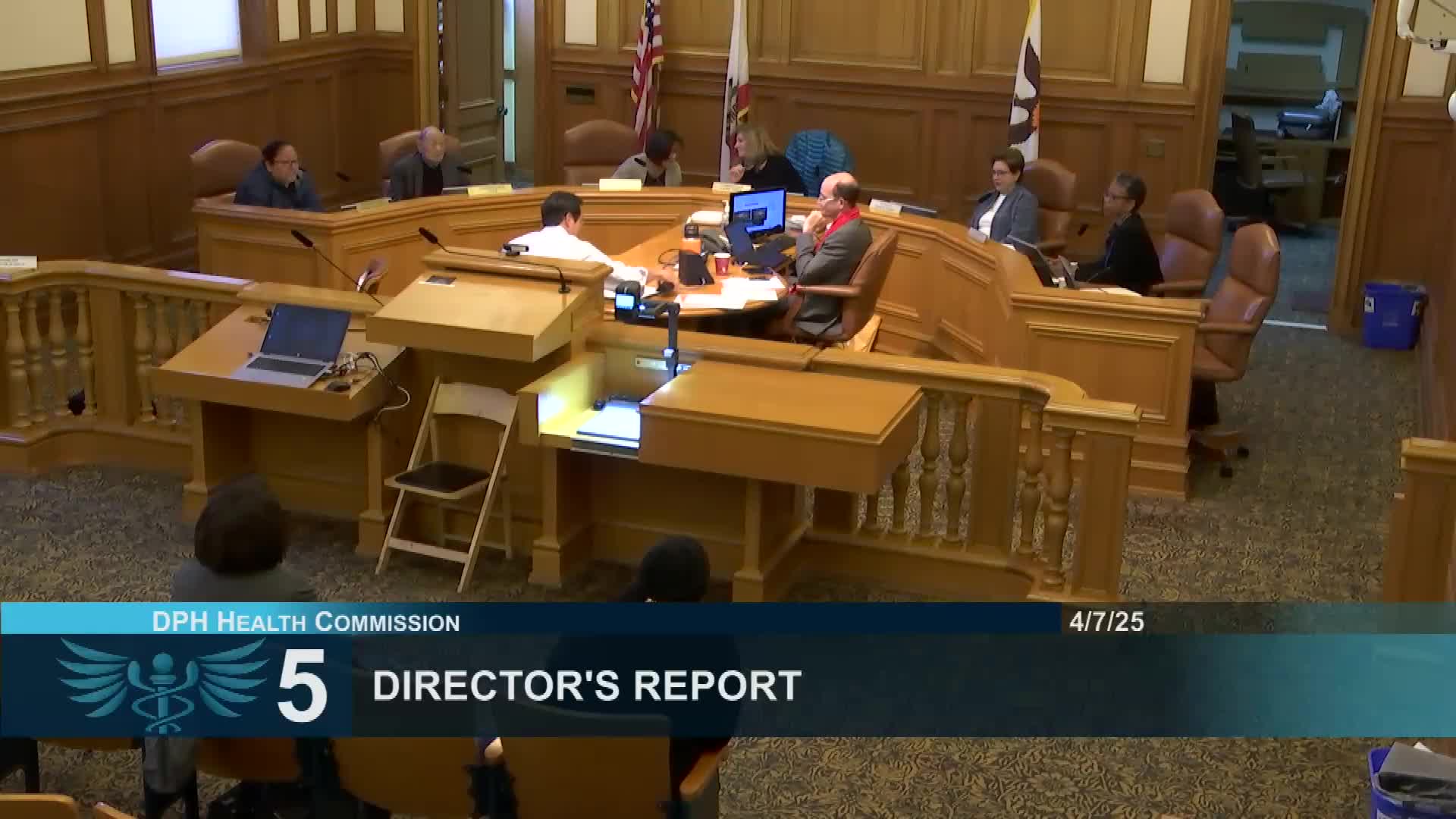
San Francisco health director narrows safer‑use supply distribution, requires treatment linkage
Summary
Department of Public Health announced new rules for nonprofit distributors of safer‑use supplies: smoking supplies will be limited to controlled/indoor settings and all distribution must include proactive treatment linkage and data reporting; most changes effective April 30 with some elements due May 30.
The San Francisco Department of Public Health announced a policy change that restricts distribution of certain safer‑use smoking supplies in public spaces and requires contracted community‑based organizations to pair any handed‑out safer‑use supplies with active treatment linkage and data reporting.
Director of Health Tsai said the department will continue sterile syringe access but will limit distribution of foil pipes and similar smoking supplies to indoor or DPH‑approved controlled settings rather than sidewalks, parks or other public spaces. The policy requires contracted nonprofits to offer intentional, skills‑based counseling and make direct connections to treatment when individuals express willingness to engage. Tsai said parts of the policy became effective April 30, with a few elements requiring compliance by May 30, and that DPH will reallocate some funding to support expanded workforce at partner organizations.
The policy change reflects DPH’s review of peer‑reviewed evidence: sterile syringe programs have decades of robust evidence, the director said, while the evidence base for safer smoking supplies is more emergent. Because of that difference, DPH concluded smoking supplies should be distributed in more controlled environments where staff can pair supplies with higher‑quality engagement and rapid referrals to treatment.
Public commenters and some commissioners urged caution. Harm‑reduction worker Michael Scarce said he opposes the policy because it reduces low‑barrier access to supplies and lacks a clear, time‑bounded evaluation: “If this was truly a pilot policy, there would be an expiration date for it, and there would also be a formal method of evaluation to measure its potential successes and failures,” he told the commission. Physician Dr. Palmer urged routine updates on progress at Laguna Honda and said she disagrees with restricting smoking supplies.
Commissioners asked whether contracts will require follow‑up to confirm a referred person actually accessed treatment. Director Tsai said DPH expects partners to report a set of data points, including volumes of supplies distributed and counts of people engaged and linked to treatment, and that the department is encouraging models that include “treatment navigators” who accompany people to intake when appropriate. Tsai said DPH will provide training (for example, motivational interviewing) and additional funding to support the workforce needed for those connections.
The department said most of the non‑profit partners receive supplies from a state clearinghouse and that historically only a few hundred thousand dollars of City funds supported syringe supplies; the new contract expectations will be paired with reallocated DPH funding to support implementation and reporting.
DPH staff said they will monitor indicators such as overdose, HIV and hepatitis C infection rates and are prepared to adjust the approach based on data.
Ending: The policy was announced by Director Tsai during the commission’s director’s report; the Health Commission did not take a formal vote on the policy during the meeting. DPH staff said they plan regular updates and will present more detailed implementation and clinical specifics at future commission meetings.