Get Full Government Meeting Transcripts, Videos, & Alerts Forever!
Get email alerts on the Ems Community Paramedicine topic
No spam. Unsubscribe anytime.
EMS report: ambulance volumes, hospital offload delays and mobile triage center results
Summary
Deputy Chief Simon Pang reported rising ambulance call volumes, continued ambulance patient off‑load (APOD) delays despite improvement, clinical interventions including needle decompression, and outcomes from the Sixth Street Mobile Triage Center during the April 9 Fire Commission meeting.
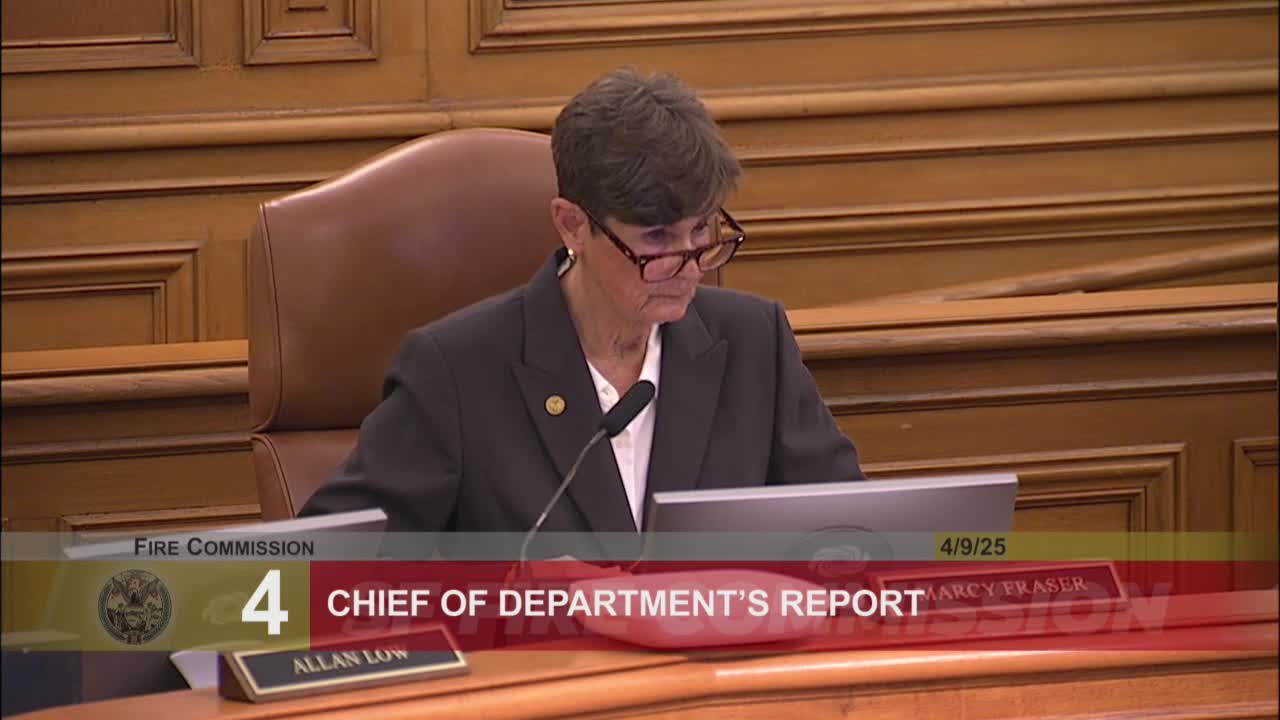
Deputy Chief Simon Pang delivered the San Francisco Fire Department’s March EMS and Community Paramedicine report at the Fire Commission meeting on April 9, 2025, detailing daily ambulance volumes, hospital off‑load delays, advanced field interventions and early outcomes from the Sixth Street Mobile Triage Center.
Pang said ambulances ran about 270 incidents per day in March and that the SFFD handled roughly 8,359 of the system’s 11,640 transports (about 72 percent). He described a modest improvement in average ambulance patient off‑load times—an average of 42.5 minutes in March against a statewide 30‑minute standard—but noted there were still “occasions when our members were delayed at the hospital for over 2 hours.” He tied many ambulance shortages to hospital off‑load delays and said reductions in APOD delays correlated with fewer “medic‑to‑follow” events (when no transport ambulance is immediately available): “In February there was approximately 14 per day. In March, there was an average of 4.5 per day.”
Pang presented Narcan administration as a proxy for opioid/fentanyl‑related calls and said Narcan use was concentrated in Battalions 2 and 3 (Tenderloin and SoMa). He said the department will refine reporting to show how many unique individuals receive Narcan and their dispositions.
On advanced interventions, Pang described needle decompression for tension pneumothorax as an infrequently used but lifesaving procedure, and demonstrated its clinical purpose. He said the procedure is “a very invasive maneuver, but one that is life threatening, one that is life saving.” He also summarized cardiac arrest data for March: of 152 cardiac arrests, providers attempted resuscitation on 36 patients; 13 of those arrived at hospital with pulses. Pang noted only one case presented a shockable rhythm and said bystander CPR rates were low (eight instances reported).
Pang highlighted tactical EMS (TEMS) paramedics and multi‑agency training: nine TEMS paramedics completed a 40‑hour technician course and a San Francisco Police Department orientation; TEMS are activated for high‑risk warrants and some deployments and assisted at a two‑day active‑attacker drill at Oracle Park in March.
The report covered community paramedicine and outreach: the Sixth Street Mobile Triage Center (started Feb. 5) showed early indicators of reduced emergency utilization. Pang said in March the mobile triage model produced lower counts for outside fires, overdoses and mental‑health emergencies compared with the six months before the center’s start. He gave case examples of successful interventions, including transporting a 24‑year‑old trafficking survivor to the sobering center, then to a navigation center and a longer‑term support program; and placing frequent 911 users into more appropriate housing or treatment, producing substantial decreases in their subsequent 911 usage.
Pang also summarized workforce wellbeing work, noting a forthcoming report on moral injury from San Jose State University and UCSF that found about 19 percent of surveyed members had symptoms of moral injury affecting work and home life; the study proposes resiliency interventions.
Commissioners asked follow‑up questions about APOD drivers, rescue captain staffing, and how ketamine is being integrated into field care for patients with substance‑use disorders. Pang and his staff responded that APOD delays were a major driver of ambulance shortages and that the department is engaging hospital partners and public agencies to reduce delays. He closed by thanking members for training participation and noting the department’s continuing focus on alternative destinations for appropriate patients.
Ending
Commissioners called the EMS report “rich” and thanked staff for both operational detail and the case examples that illustrated how mobile triage and community paramedicine can reduce repeat 911 use; commissioners asked for continued tracking of APOD improvements and TEMS integration.