Get Full Government Meeting Transcripts, Videos, & Alerts Forever!
Get email alerts on the Fire Department Operations topic
No spam. Unsubscribe anytime.
San Francisco Fire Department outlines staffing, training and facility needs; approves minutes
Summary
At its April 9 meeting the San Francisco Fire Commission heard a wide-ranging report from Chief of Department Dean Crispin on staffing, recruit training, disaster exercises and capital needs; commissioners approved the March 26 minutes. Chief Crispin also announced a new recruit training captain and remembered a fallen firefighter.
The San Francisco Fire Commission heard a broad operational update from Chief of Department Dean Crispin on April 9, 2025, covering recruit selection and training, recent disaster exercises, capital-planning needs for aging stations, and community outreach. The commission also approved minutes from its March 26 regular meeting.
Chief Crispin opened his report by honoring “firefighter Tila Fuego Teape the third, who passed away on 04/04/2025,” and described Teape as a seven‑year member assigned to Station 3. He said department leadership is selecting the next recruit academy class (referred to as the “130 fifth probationary class”), and described recent boot camps and management training intended to improve consistency across ranks: “During this boot camp ... they are evaluated on not only their individual performance, but also on their ability to work ... within a team.”
The chief described a March 31 large‑scale earthquake exercise that focused on water supply and multi‑fire scenarios and credited staff for bringing training down into divisional branches. He noted the department’s work with Public Works and Parks and Recreation on access to the Great Highway and beach areas for apparatus and aerial ladders, saying Parks Director Ginsburg had assured the department of at least 14‑foot access widths where needed.
Crispin told commissioners the department is raising concerns with the city’s capital planning committee about aging, seismically vulnerable facilities. “We have aging facilities ... determined to be of the highest level of earthquake unsafety,” he said, adding that limited citywide capital funds mean the department’s requests were modestly funded last year. He said the department will continue follow‑up with the mayor’s office and bond committees.
On staffing and training, the chief and command staff highlighted a recent high‑level management training for deputy and assistant chiefs and captains, and credited the United Fire Service Women and other recruitment partnerships with supporting outreach and boot camps. Chief Crispin announced the department’s new recruit training captain: Captain Dustin Novo from Engine 43, Excelsior.
Operations Deputy Chief Patrick Rabban provided an operations overview that included summaries of recent significant fires and after‑action work. He previewed a greater alarm and after‑action review of the April 4 fourth‑alarm fire at 1664 Larkin Street, saying the initial companies’ response and chief officers’ direction limited the incident’s scope. Rabban also reported on a February rescue at 1301 Shafter in which members rescued an elderly occupant.
Fire Marshal Chad Law briefed the commission on prevention and permitting changes, including extended hours at the permit center at 49 South Van Ness (now 8:00 a.m.–5:00 p.m., last intake 4:30 p.m.) and participation in Perma SF, the mayoral initiative to speed approvals for housing and businesses. Law said he and the city attorney are finalizing a memorandum of understanding to use Brycer compliance software to track fire alarm and five‑year sprinkler certifications; he said the MOU will be “at no cost to the department.”
Chief Crispin and division chiefs also described new equipment and training: a hose tender rated at 5,500 gallons per minute when drafting and 3,000 gpm when supplied by its submersible pump, submersible pump training at Twin Peaks Reservoir, and other evolutions to improve water delivery in large‑scale incidents.
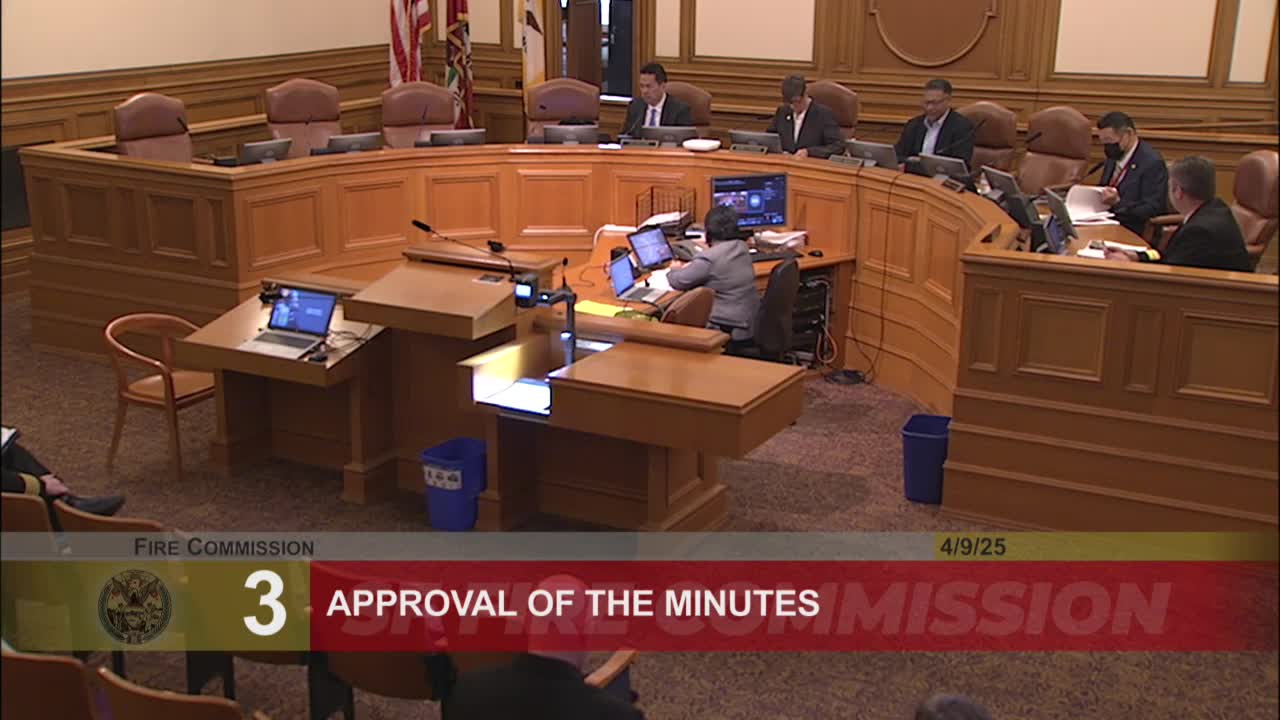
The commission handled routine business as well: a motion to approve the minutes from the March 26 meeting was made and seconded and the motion passed. Commissioners did not record a full roll‑call tally in the verbal record; the clerk announced, “The motion passes.”
The commission did not take formal votes on capital funding or personnel appointments at the April 9 meeting; the announcement of Captain Dustin Novo’s new role was made as an administrative appointment by command staff.
Chief Crispin closed by asking commissioners if they had questions; commissioners thanked staff for the depth of the report and for outreach efforts such as station visits and community events. The next commission meeting items referenced included after‑action reporting and continued capital planning discussions.
Ending
The commission’s April 9 agenda emphasized preparedness and internal capacity building: recruiting and training, after‑action reviews of recent large fires, and presenting capital needs for seismically vulnerable facilities. Commissioners requested additional detail when available and flagged continued coordination with the mayor’s office and the capital planning process.