Get Full Government Meeting Transcripts, Videos, & Alerts Forever!
Get email alerts on the Mission Rock Infrastructure topic
No spam. Unsubscribe anytime.
Committee recommends acceptance of Mission Rock Phase 1A infrastructure and several encroachment permits
Summary
The committee voted 3-0 to forward four related measures that accept public infrastructure in Mission Rock Phase 1A, amend permitting responsibilities for sidewalk uses, and approve multiple encroachment permits including monitoring of lightweight cellular concrete.
The Land Use and Transportation Committee unanimously voted on April 7, 2025, to send to the full Board four pieces of legislation related to Mission Rock Phase 1A: (1) acceptance and dedication of new public infrastructure, (2) an amendment to designate the Port of San Francisco as the permitting authority for minor sidewalk encroachments in specified redevelopment areas, (3) a master encroachment permit for Mission Rock utilities to maintain subsurface and utility encroachments, and (4) a resolution granting revocable permission for the Port to maintain nonstandard public-right-of-way improvements and authorizing a major encroachment permit for monitoring instruments tied to lightweight cellular concrete (LCC) used in the project.
Shauna Gates, project manager with Public Works, explained that Phase 1A includes four new buildings (two housing and two commercial), public infrastructure on five new city blocks, and that Public Works has overseen design, subdivision mapping, permitting and construction inspection of improvements that are complete and ready for acceptance. Gates said the Mission Rock project received approval of a development agreement in February 2018 and at full build-out is anticipated to include 11 lots with commercial, residential, parks, retail and public art. Public Works told the committee that the ordinances would dedicate the completed infrastructure for public use, designate it for street and roadway purposes as applicable, accept it for city maintenance and liability (subject to specified limitations), and amend Public Works code Article 2.4 to require excavation permits for all excavation in the Mission Rock Special Use District.
The second ordinance would amend Article 15 of the Public Works Code to designate the Port of San Francisco, rather than the Department of Public Works, as the permitting agency for minor sidewalk encroachments (tables, seating and similar uses) in Mission Rock, Pier 70 and the Potrero Power Station areas, with Public Works retaining permitting responsibility for major or permanently affixed encroachments.
The third ordinance would grant a revocable master encroachment permit to Mission Rock Utilities Inc. to maintain encroachments that include non-potable water systems, private sewers, heating and chilled water systems, and conduits for fiber optic cable; the permit allows Public Works to collect annual payments from the permittee to cover potential city costs if encroachments are abandoned.
The resolution (item 6) includes an interdepartmental master encroachment permit granting the Port permission to maintain nonstandard roadway and sidewalk treatments, public art installations and other features, and it authorizes a major encroachment permit for monitoring instruments that measure ground movement and groundwater levels where lightweight cellular concrete (LCC) fill was used. Gates said LCC was used to raise the Mission Rock site approximately five feet to mitigate sea-level rise and to reduce ground settlement; a monitoring plan and performance criteria were established through city Order 207782.
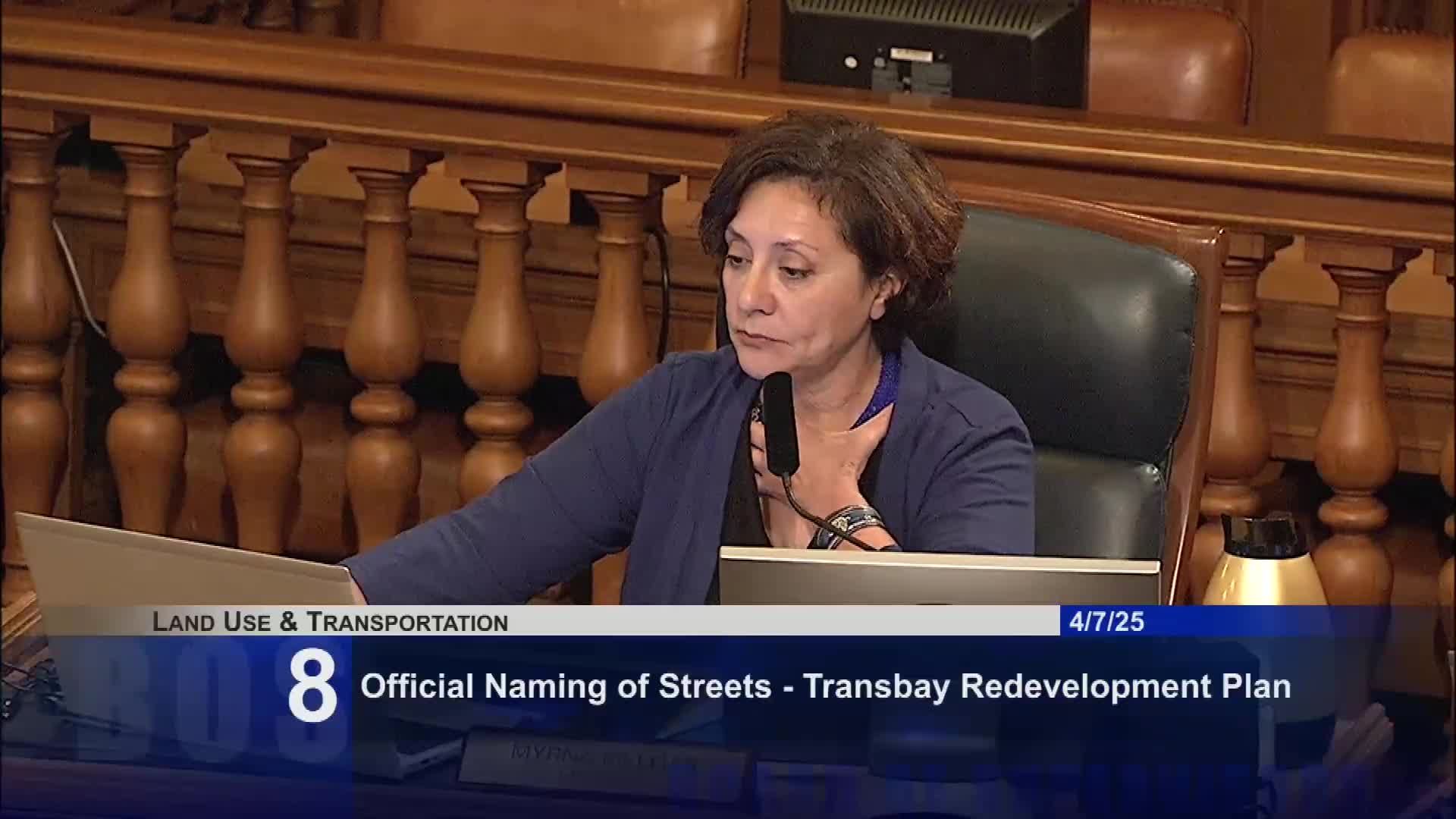
Chair Supervisor Mirna Melgar moved to send the four items to the full Board with a positive recommendation; Vice Chair Supervisor Cheyenne Chen and Supervisor Bilal Mahmood voted aye. There were no public speakers on the grouped items at the committee hearing.