Indianapolis expands City Connects rollout; Connect Indy dashboard maps student needs and providers
Loading...
Summary
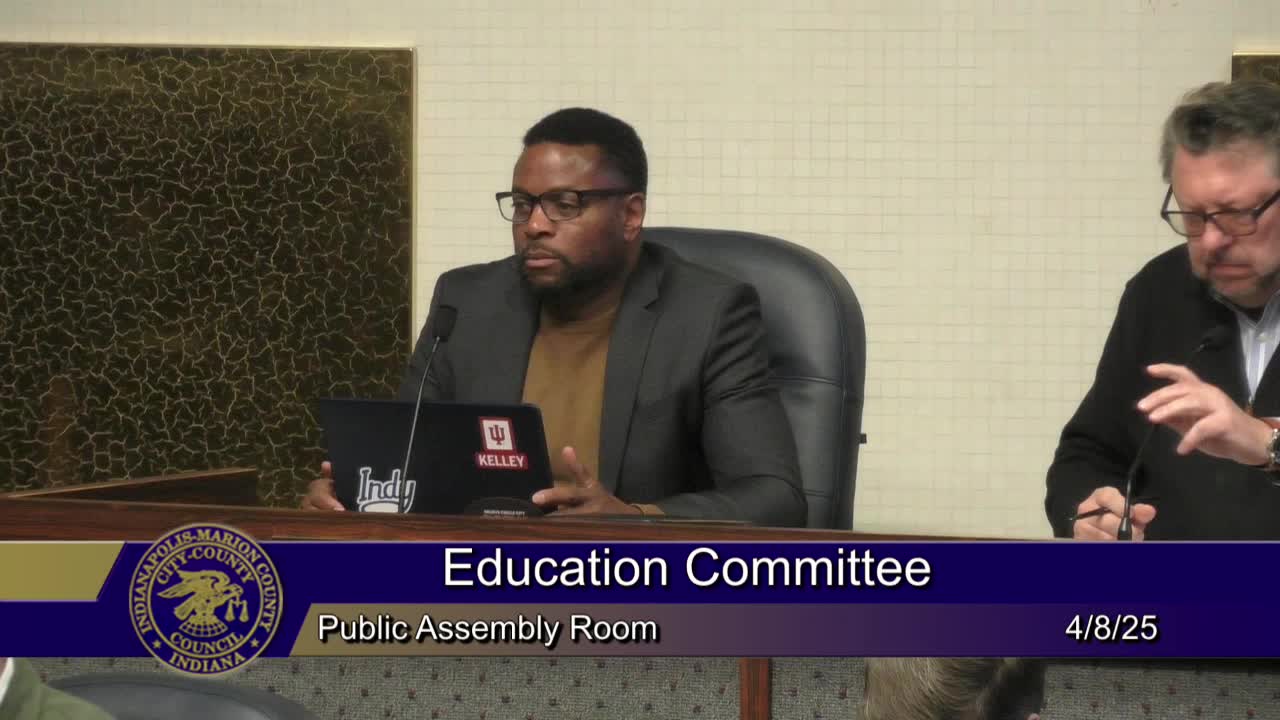
The Indianapolis City-County Council Education Committee on April 7 heard a presentation on City Connects, a school‑based integrated student‑support model and the public Connect Indy dashboard that map student needs and community providers, officials said.
Jillian Lane, executive director of integrated student support and center strategy for the Marian University Center for Vibrant Schools, told the committee City Connects is an evidence‑based model developed at Boston College about 25 years ago and now implemented in Indianapolis with local partners and ARPA funding. "Students spend most of their time outside of school," Lane said, and City Connects builds individualized support plans that address academic, social‑emotional/behavioral, health and family needs.
The program model and why it matters
Lane described City Connects as a systematic, school‑level practice that assigns a full‑time site coordinator—typically a master's‑level social worker or school counselor—to meet with each teacher about every student, combine those classroom insights with student information system data, and create individualized support plans. Plans are reviewed every six to eight weeks and use tiered interventions (tier 1 prevention/enrichment, tier 2 early intervention, tier 3 crisis response). Lane said site coordinators also connect families to community services to leverage existing resources.
"It's all based in developmental science," Lane said, and the model emphasizes strengths as well as needs when crafting supports.
Connect Indy dashboard and public data
Sheena Cavazos, director of the Office of Education Innovation, credited the city and mayor for allocating American Rescue Plan (ARPA) funding to bring City Connects to Indianapolis and to build the Connect Indy dashboard. Lane said the dashboard is "the first of its kind" for City Connects: a publicly accessible, annually updated platform that displays aggregated data on student strengths, needs, interests, and community providers and includes an interactive heat map of partner agencies.
Lane said the dashboard currently contains two years of data (school years 2022–23 and 2023–24) and that the 2024–25 data will be uploaded in the summer. The online tool is intended to inform philanthropy, community agencies and school or district leaders about gaps and interests so partners can align programming and resources.
Scope, schools and partners
Lane said City Connects currently serves about "25 to 30 schools in Indianapolis" across public, charter and a small share of private/nonpublic schools; she noted roughly a dozen Far East Side schools received ARPA‑supported implementation and that several of those schools have sustainability funding through the local partnership. Lane said Marian University is serving as the local technical assistance provider while Boston College remains the intellectual owner and coach to ensure fidelity to the model.
Funding, costs and sustainability
Lane outlined implementation costs that include a licensing fee (for professional development, implementation tools and the cloud‑based system that stores student support plans), a technical assistance center to coach coordinators and the full‑time site coordinator salary. She said upfront launch costs were the largest expense, and ongoing annual maintenance for the website and Power BI hosting is substantially lower.
On broader funding sources she said the Indianapolis expansion began with U.S. Department of Education learning‑loss funds and ARPA support; additional potential funding mentioned includes Eli Lilly Foundation opportunities, federal grants, philanthropy and school cost‑sharing. Lane described a step‑down model in which the program funds initial years and schools gradually assume more of the cost; she said the upcoming school year is expected to be roughly a 50/50 split between external support and school contributions.
Early outcomes and evaluation timeline
Lane said the local implementation remains early and that a formal outcomes evaluation by Boston College is underway; she told the committee the evaluation should conclude in 2026. As preliminary indicators, Lane said City Connects schools that had implemented the model for two years saw an average 13 percent decrease in chronic absenteeism, compared with a roughly 3 percent average change across the state over the same period.
Provider network and vetting questions
Committee members asked about the 93 providers listed on the dashboard and how providers are vetted. Lane said the provider categorizations follow rules in the program manual and that coordinators—who are school clinicians—identify individualized community matches for families. "It's not our decision to decide who is partnering with us," she said, describing the match as based on a provider's fit for a family's needs and the coordinator's clinical judgment. Lane said the dashboard includes a public list of the providers shown on the heat map.
On whether City Connects requires providers to confirm background checks, Lane said that is not managed or overseen by City Connects; background‑check verification is not an element of the core practice the program enforces.
Implementation notes and council questions
Council members asked for examples of what an individualized student plan looks like. Lane said coordinators meet briefly with each teacher to gather qualitative classroom observations that are combined with grades and behavior data; more complex situations bring together a multidisciplinary team (for example, principal, site coordinator, counselor, teacher or coach) to produce SMART goals and measurable outcomes.
Several council members asked to see results again later in the year; Lane accepted an invitation to return in June to share progress and evaluation steps.
Ending
Committee members thanked Lane and the local partners; no formal policy action or vote on City Connects was recorded during the meeting. The committee adjourned after the presentation.