Get Full Government Meeting Transcripts, Videos, & Alerts Forever!
Get email alerts on the Land Use Hubbard Apartments topic
No spam. Unsubscribe anytime.
Chico council denies Hubbard Apartments code and rezone requests amid airport safety concerns
Summary
After hours of testimony and discussion, the City Council voted 5-2 to deny a package of land-use changes for a proposed 39-unit Hubbard Apartments project at Ceres and Lassen, citing airport overflight overlay restrictions and consistency with the Butte County Airport Land Use Compatibility Plan.
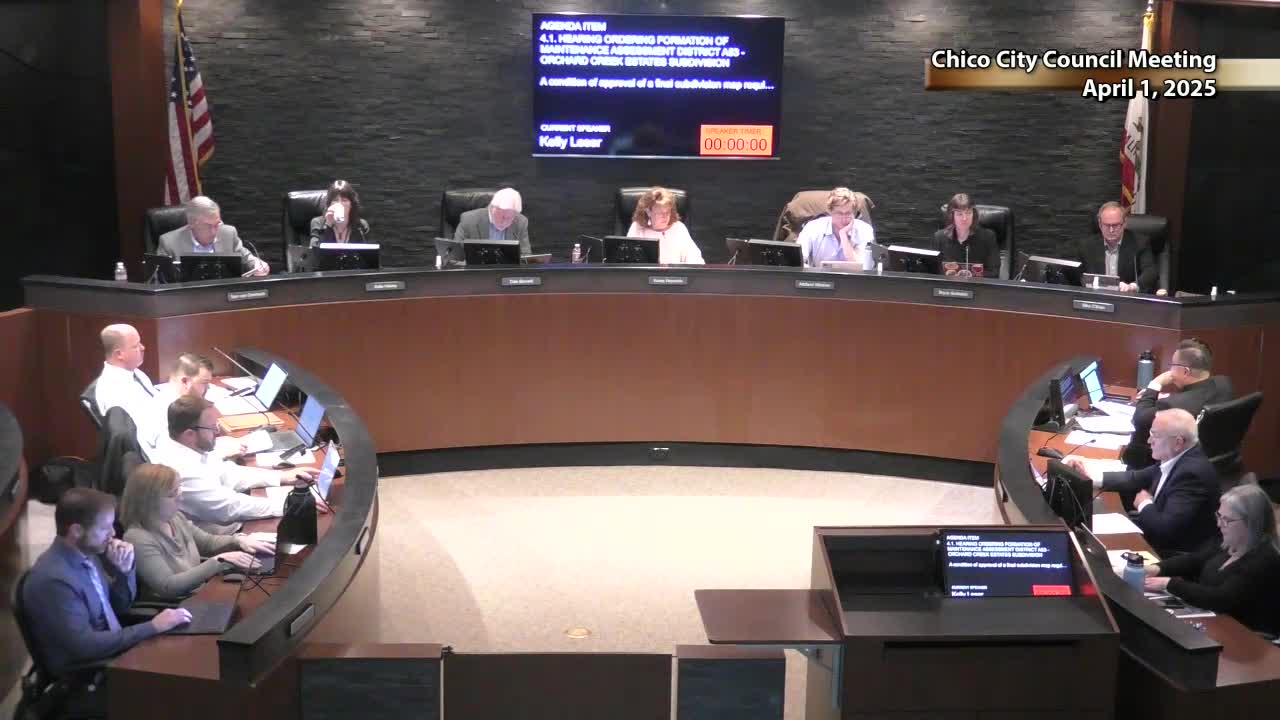
The Chico City Council voted 5-2 on April 1 to deny a package of land-use applications for the proposed Hubbard Apartments project at the southwest corner of Ceres and Lassen, citing airport overflight compatibility and long-term airport safety concerns.
Associate Planner Tina Wilson told the council she and planning staff recommended denial. “It’s with a bit of sadness, honestly, that I find myself here,” Wilson said, summarizing staff findings that the site sits in approach/arrival overlay zones (AOB 1 and B2) tied to Chico Regional Airport safety and consistency with the Butte County airport land use compatibility plan.
Why it matters: Council members who opposed the project said allowing a multifamily development at the site would set a precedent that could erode the airport overlay protections that the city and county adopted to preserve airport operations and limit residential encroachment. Supporters of the project argued the parcel is surrounded on multiple sides by higher-density development and that Chico faces a shortage of housing.
What staff presented - Wilson said the 2-acre site lies a little over a mile from the runway end and falls within overlay zones intended to reduce risk from crash scatter and protect airport compatibility. She told council the applicant initially proposed code and general plan amendments that would remove the city’s airport overflight overlay language; staff and multiple advisory bodies opposed that approach. - Wilson recited that the airport overlays (AOB 1/B2) severely limit residential density (for example, one unit per 5–10 acres in parts of the overlay), which makes the applicant’s requested multifamily density inconsistent with the overlay standards.
Public testimony and technical briefing - Applicant Tom Hubbard argued the overlay contours were calibrated to historical flight volumes and that the city needs infill housing. “I’m not opposed to flight zones,” Hubbard said; “what I oppose is flight zones that prevent me from adding high density housing when we need it.” - Norm Rosin (chair of the ALUC at the time the overlay was created) and other airport-affiliated speakers explained the overlays were drawn based on national statistical models of noise and safety contours and remained important to long-term airport viability. “The accident scatter is right off the end of the runway,” Rosin said, adding the overlay approach helps prevent residential encroachment that can jeopardize airports.
Council debate and vote - Several council members urged deference to technical recommendations from the airport manager, the City of Chico Airport Commission, the city’s planning staff, the Chico Planning Commission and the Butte County Airport Land Use Commission. Councilmember O’Brien said the technical bodies “left no room for approval.” Councilmember Rennert said he supported the project, arguing the site is surrounded by development and the city needs housing. - The motion to deny the code amendment, general plan amendment, rezone and architectural review passed 5-2 (Yes: Goldstein, Hawley, O’Brien, Winslow, Vice Mayor Bennett; No: Van Overbeck, Mayor Reynolds).
What the denial means: The council’s vote keeps in place the airport overflight overlay limits for the site and rejects the applicant’s requested code and plan amendments. Staff and commissioners said the overlay could be revisited in a broader, formal plan update process, but the council declined a one-off change to allow this project.
Next steps: The denial concluded this application. Councilmembers and staff suggested the applicant and staff could work on alternative, compatible uses or return with a different proposal that does not require eliminating airport overlay protections.