Get Full Government Meeting Transcripts, Videos, & Alerts Forever!
Get email alerts on the Reentry And Transitional Housing topic
No spam. Unsubscribe anytime.
Faith-based groups expand reentry, recovery and transitional housing services in Indianapolis
Summary
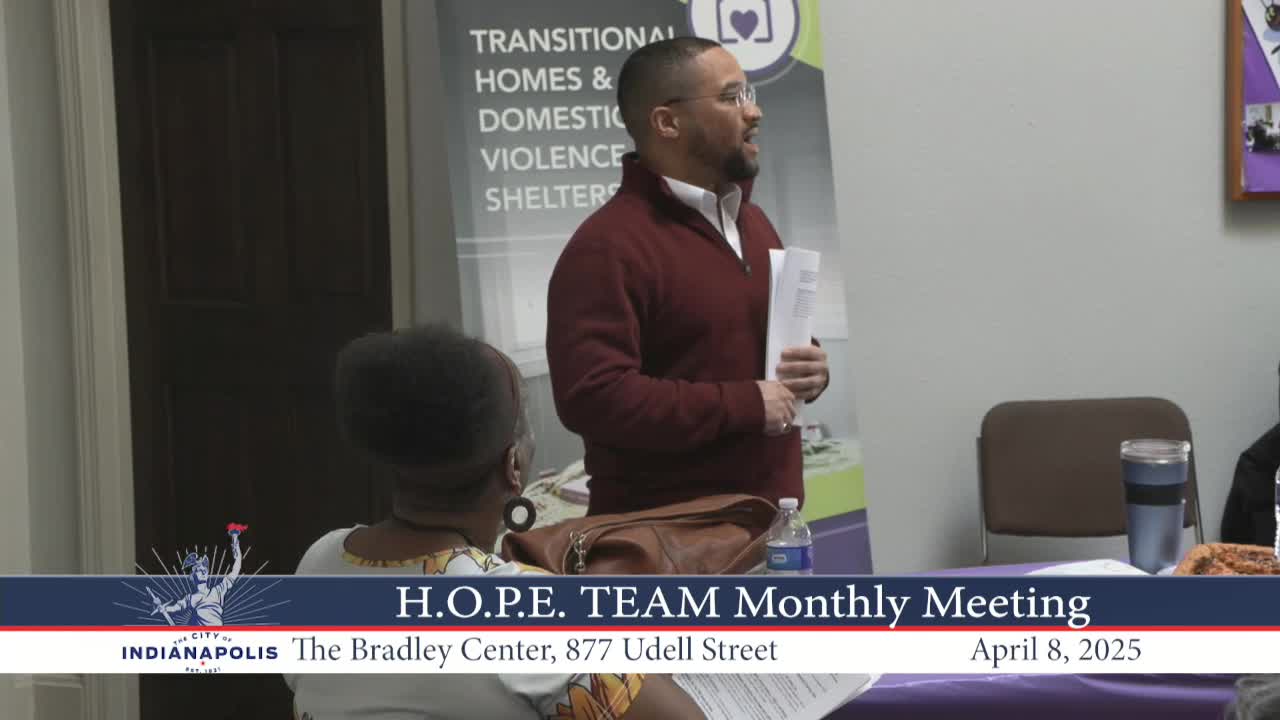
Speakers at the HOPE Team meeting described local reentry and recovery services, available slots and funding streams for justice-involved residents, and a new Muslim women—s transitional house that aims to provide culturally specific wraparound care.
Julius Mansa, board president of Movement Community Development Corporation and a professor of finance and accounting, told attendees at a HOPE Team meeting that his mosque-based nonprofit is expanding reentry and recovery services for justice-involved residents in central Indianapolis and surrounding counties.
"It was a fentanyl overdose," Mansa said, describing a video from one block north of Keystone that prompted the presentation. He said his organization is now "keeping score" of outcomes and collecting data to inform public-health partners and funders.
The presentation listed multiple program elements: case management, peer recovery coaching, skill-development training that includes boxing and mental-health work, and licensed mental-health therapy. Mansa said Movement CDC can draw on several funding buckets, including a $400,000 grant from the Office of Public Health and Safety for case management and a roughly $5 million pool (described in the meeting as an EMHA bucket) for mental-health services.
Mansa asked community partners for referrals and said, "we have about 15 slots left in our next program" and requested that any referrals for that intake be submitted "by the fifteenth of this month." He provided a phone number and website for referrals (movementcommunitydevelopmentcorporation.org / 545-42522) and said the program serves Marion County and adjacent counties.
Following that presentation, Sarah Algany, a board member at the Community Development Corporation and director of women—s transitional housing at ECNA Relief, described Amber House, a newly opened Muslim women—s transitional house run by her organization.
"After two years in the making, we opened our first Muslim women's transitional house; it's called the Amber House," Algany said. She said ECNA Relief—s Amber House provides licensed mental-health counseling, full wraparound case management, job training and education supports, and a savings requirement intended to help residents leave with housing stability.
Algany said the Amber House program is designed for women and children: girls from newborns up to 18 are served, and boys are accepted up to age 11 because of program religious privacy rules. She said residents must demonstrate an ability to save and meet screening criteria; application requirements highlighted in the meeting included no recent (within six months) domestic-violence incidents and no unresolved serious mental-health concerns. The program is time-limited—Algany said the intended stay is generally six months—and requires participants to engage in work, training or education during daytime hours.
Speakers emphasized that the programs are faith-based but open to people of different backgrounds. Mansa framed the work as part of the wider opioid and overdose crisis in central Indianapolis and asked local groups to send referrals to ensure the program money is spent on local residents, noting unspent funds would revert to the state.
The meeting also included a brief description of a 10-week "mini MBA" workforce program called Hustle and Build, described by a Movement presenter as a certificate program supported by a $75,000 grant from the Central Indiana Community Foundation.
The presentation closed with a request that agencies and neighborhood groups send referrals and information to Movement CDC and ECNA Relief; presenters gave contact details and said certain funding streams are limited to specific intake windows.