Get Full Government Meeting Transcripts, Videos, & Alerts Forever!
Get email alerts on the Capital Planning topic
No spam. Unsubscribe anytime.
Guadalupe County weighs capital improvement plan, construction manager and debt strategy ahead of heavy project slate
Summary
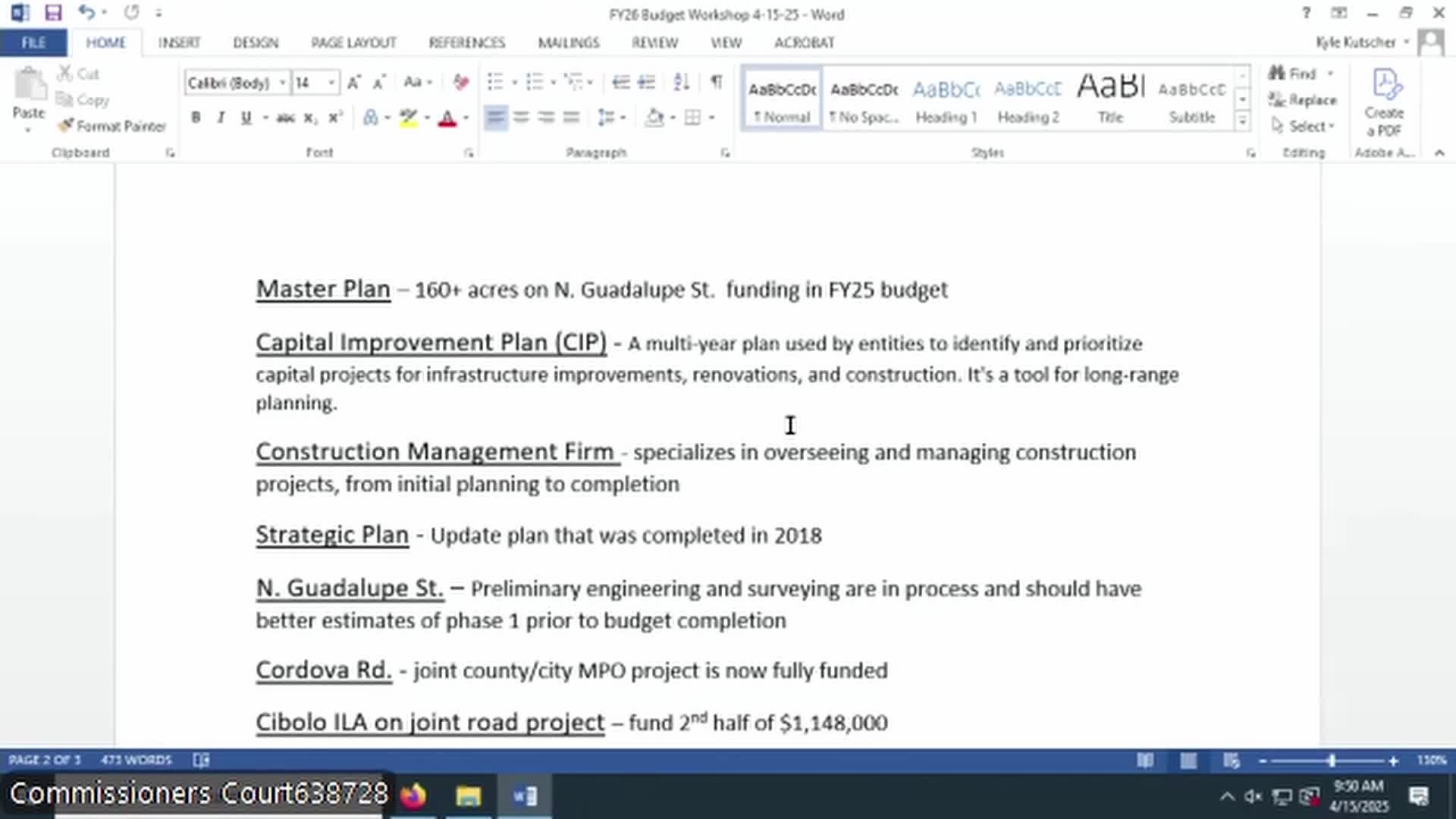
Facing multiple large projects, commissioners discussed hiring a construction management firm or owner's representative, developing a capital improvement plan tied to a strategic plan update, and managing debt/tax‑rate implications to smooth funding for major future projects.
Guadalupe County commissioners signaled support for formalizing capital planning and bringing on outside construction management expertise to help manage a growing list of major projects, and they asked staff to begin work modeling potential borrowing and tax‑rate scenarios.
Why it matters: Commissioners said the county has moved from occasional projects to a pipeline of many large undertakings (roads, jail planning, ARPA projects, a possible government center) and that the court lacks the staff bandwidth and institutional experience to manage all of them simultaneously. Several members argued a construction management firm or owner's representative and a formal capital improvement plan (CIP) would lower procurement, scheduling and cost risk.
Key points from the workshop - Construction management/owner's rep: Multiple commissioners supported issuing an RFQ/RFP to hire a firm that can manage large vertical and horizontal projects, provide construction oversight and help with scheduling; the firm could also advise on road projects and ARPA timelines. - Capital improvement plan and master plan: Commissioners discussed creating a CIP tied to a strategic plan update and a master plan for the county property where future detention and government facilities may be sited. They noted the county may need to change organizational structure or hire additional staff to oversee a program of projects. - $10 million in committed funds: Court members said the county has $10 million committed for capital work but those funds are not yet budgeted to specific projects; the court requested a plan to match committed funds to projects or to determine the county's capacity to manage that spending in FY26. - Roads and road study: Commissioners said a road condition study is imminent and that study results should inform how the county deploys the committed funds and any contractor selection. The court discussed the tradeoffs of different roadway construction standards and the complications of coordinating projects with neighboring cities. - Debt, tax rate and borrowing tools: The court debated how to minimize future tax‑rate shocks if the county borrows for large projects. Commissioners asked the auditor and staff to model tax‑rate scenarios, debt service schedules and the impacts of potential state legislative changes that could limit certain borrowing instruments (for example, tax anticipation notes). One commissioner urged phasing debt service so it grows with the tax base and avoids sudden increases for taxpayers.
Next steps Staff were asked to: - Prepare an RFQ/RFP scope and timeline for a construction management firm or owner's rep; - Produce a capital improvement plan framework and options for staffing and oversight (including an ad hoc committee recommendation); - Model tax‑rate and debt‑service scenarios tied to potential bond or note issuances and report back before the next budget workshops.
Ending: Commissioners acknowledged the county must prioritize and sequence projects because demands exceed current capacity; several said hiring external program management support should be an early step so the county can move multiple projects in parallel without losing control of timelines and budgets.