Get Full Government Meeting Transcripts, Videos, & Alerts Forever!
Get email alerts on the Elections topic
No spam. Unsubscribe anytime.
City attorney reviews campaign rules for employees, elected officials; residents raise concerns about early signage
Summary
City Attorney Lynn Pace briefed the council on legal limits for city resources and employee political activity, and members of the public questioned whether early campaign signs and the city’s voluntary fair-campaign pledge follow its intent.
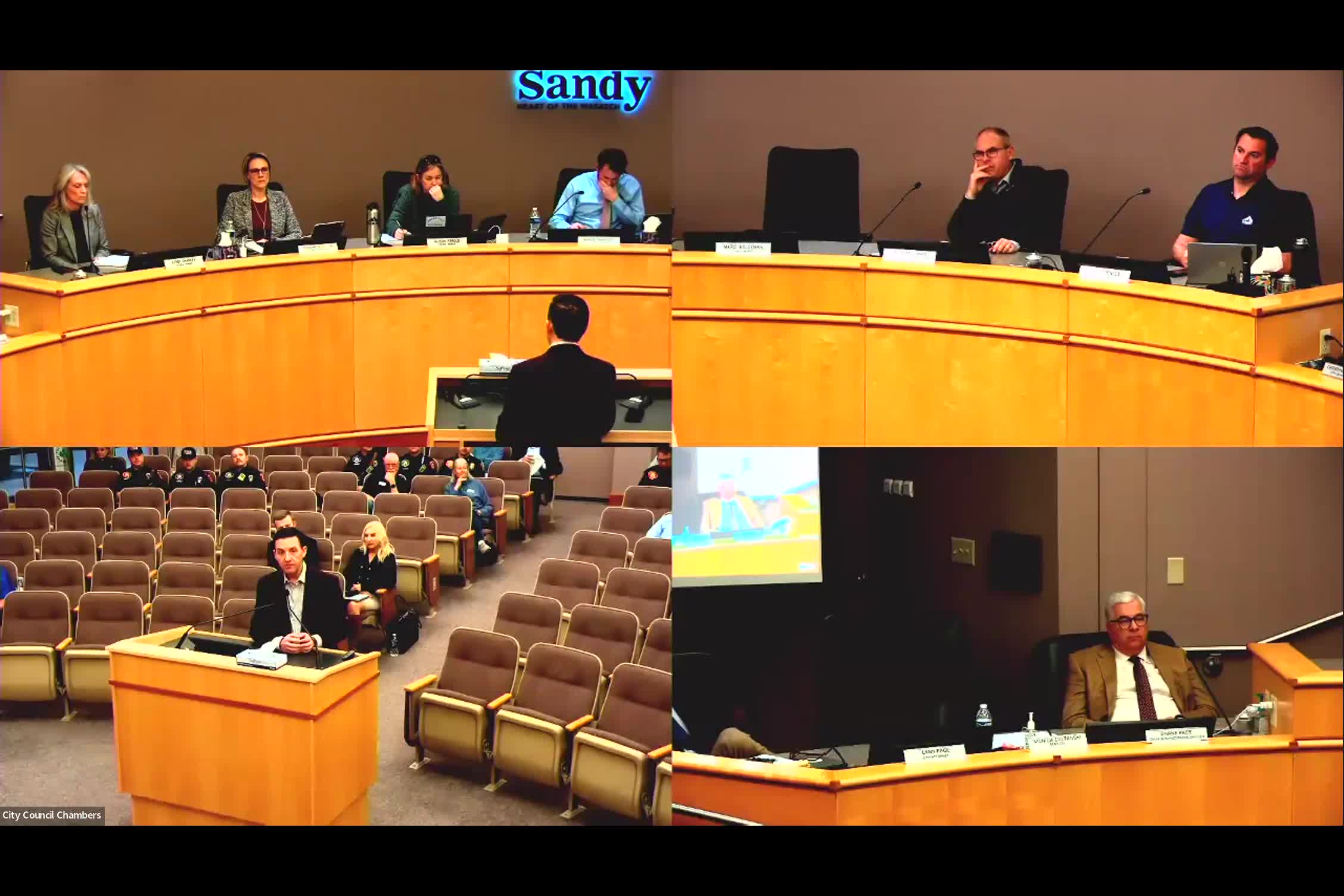
City Attorney Lynn Pace briefed the Sandy City Council on April 1 about legal boundaries for political activity by city employees and elected officials, summarizing restrictions on the use of city equipment, staff time and public funds during an election season and responding to questions about the city’s voluntary fair-campaign pledge.
Pace said Utah law bars use of city equipment or property for campaign purposes and advised city employees and candidates not to use city computers, phones, email, offices or staff for campaign work. “If you’re running for office, don’t use any city equipment, and don’t use any city office space, and don’t use any city employees,” he said.
He also described a recently enacted state law (house bill 551) that prohibits certain mass communications within 60 days of a primary or general election — specifically, billboards or mass mailings that feature a candidate’s photo or a name printed in a font larger than other message text — and explained how that statute interacts with city newsletters and mailings. Pace said mailed mass communications to more than 500 recipients in a calendar year may fall under the restriction; a newsletter posted only online would not trigger the same rule.
Pace told staff to treat candidate requests for city information consistently: if a candidate asks for city data, the city should provide the same information to other known candidates (for example, via a GRAMA request) so no person receives preferential access. He emphasized the distinction between personal political speech and the appearance of official endorsement: city employees may express personal political views, but they should not appear to speak for or be endorsed by the city, and employees should avoid campaign activity while wearing city uniforms.
The briefing followed public comments from residents concerned about campaign behavior. Resident Craig Ulrich asked what “campaigning unofficially now” means on the city’s election information graphic and suggested the voluntary Resolution 23.05c — Sandy’s pledge for fair campaign practices — should be enforced or show an explicit “declined” note next to someone who does not sign. Patricia Jones, a resident, offered a nationally oriented view supporting reciprocal tariffs and a more optimistic economic outlook; she told the council she believed the president’s trade policies would benefit Utah.
Pace walked the council through other practical points: employees cannot use city time for campaigns (except off-site during personal time), candidates cannot coerce or promise jobs, and requests for city data that are campaign-related should be processed formally so staff are not asked to perform campaign work on city time. He also reviewed the ballot-name affidavit process for candidates who want a display name other than their legal name.
Council members asked clarifying questions about mass-mailing thresholds and whether group photos in city mailings must be removed during the 60-day window before an election; Pace advised removing photos or using careful formatting in the pre-election window to avoid the appearance of promotion. The council took no formal action; the briefing was advisory and intended to inform city staff and elected members as the municipal election season approaches.