Get Full Government Meeting Transcripts, Videos, & Alerts Forever!
Get email alerts on the Economy topic
No spam. Unsubscribe anytime.
Zions Bank economist warns tariffs and fiscal shifts raise uncertainty; Utah fundamentals remain strong
Summary
Robert Spendlove, senior economist at Zions Bank, told the Sandy City Council that proposed federal tariffs and large federal budget changes raise the risk of an economic downturn while Utah's job growth and population gains leave the state better positioned than much of the nation.
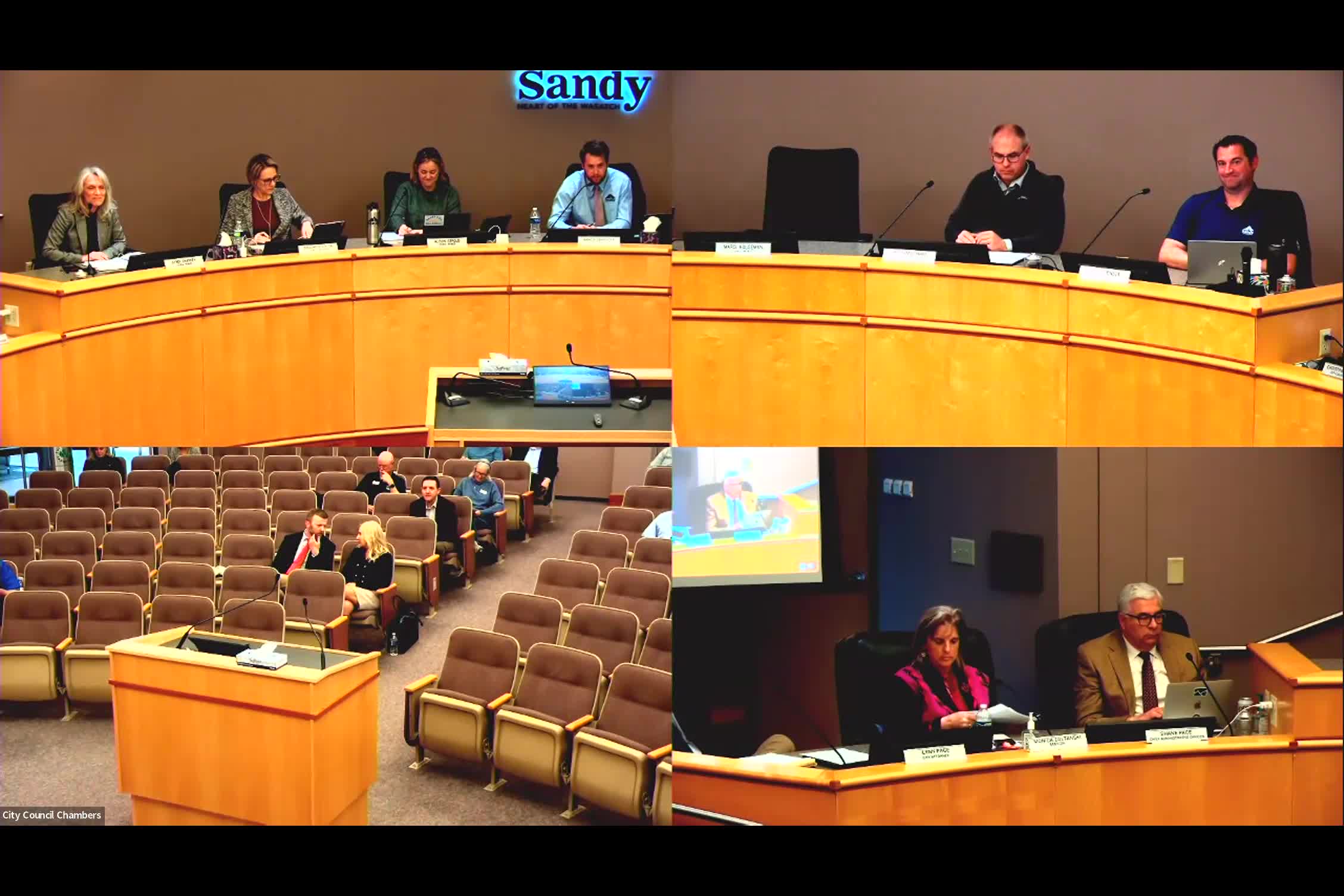
Robert Spendlove, senior economist at Zions Bank and a former state representative, told the Sandy City Council on April 1 that proposed federal tariffs and big changes to fiscal policy are creating “heightened uncertainty” for the national economy while Utah’s economy remains comparatively strong. “It feels like we’re back in the spring of 2020,” Spendlove said, adding that the elevated uncertainty is the reason the Federal Reserve has kept its policy rate steady.
Spendlove said the administration’s announced tariff plans — including sizable levies on several trading partners and additional duties on some Chinese imports — could raise the U.S. average tariff rate to levels not seen since the mid-20th century. “A lot of this is gonna change tomorrow,” he told the council, referring to near-term policy rollouts. He described three possible approaches to how tariffs could be implemented and stressed that markets react most negatively to uncertainty about details rather than to a fixed new tariff level.
The economist walked through several national indicators he watches closely. He said markets and surveys show rising volatility, falling consumer confidence and mixed soft indicators, while hard data such as GDP, employment and inflation are “unreliable” in the near term because they lag and are subject to revision. Spendlove noted the 10-year Treasury yield’s swings and the close relationship between that yield and mortgage rates, saying mortgage rates are more likely to fall than rise in the near term because of market uncertainty.
Despite national worries, Spendlove told council members Utah’s fundamentals are “really strong.” He cited population growth — Utah ranked among the fastest-growing states — strong employment growth (nearly twice the national rate), continued construction activity, higher median household income and the state’s low poverty rate. He said housing price appreciation in Utah has slowed to a more sustainable pace and that the state still needs additional housing supply — an estimated 30,000 units, he said.
Council members pressed Spendlove on local fiscal implications and budgeting. When asked about municipal revenue risk tied to weaker retail spending, Spendlove said retailers will feel pressure but may adjust by shifting product mix or pricing; he advised jurisdictions to identify and set aside “high risk” revenue to cover volatility. He recommended that city budget staff consult state revenue forecasting offices and the legislative fiscal analysts to model downside scenarios.
Spendlove also described indicators he monitors weekly — such as initial unemployment claims and consumer loans — and highlighted the difference between “hard” data (GDP, official employment, inflation measures) and “soft” data (consumer sentiment, market volatility). “When you’re in this big of an economic period of turmoil, you have to disregard the hard data and move to soft data,” he said, while cautioning that soft data can be difficult to interpret.
Council members thanked Spendlove for the presentation and for the local perspective. The economist said his baseline did not assume a recession but that the probability of a downturn had increased because of the combined policy shocks and uncertainty.
Spendlove concluded by identifying the policy areas he expects will dominate the year — trade, immigration, taxes, debt and deregulation — and invited questions from the council.