Get Full Government Meeting Transcripts, Videos, & Alerts Forever!
Get email alerts on the Nonprofits Funding topic
No spam. Unsubscribe anytime.
Lexington nonprofit coalition urges two‑year grants, upfront payments for opioid‑settlement program
Summary
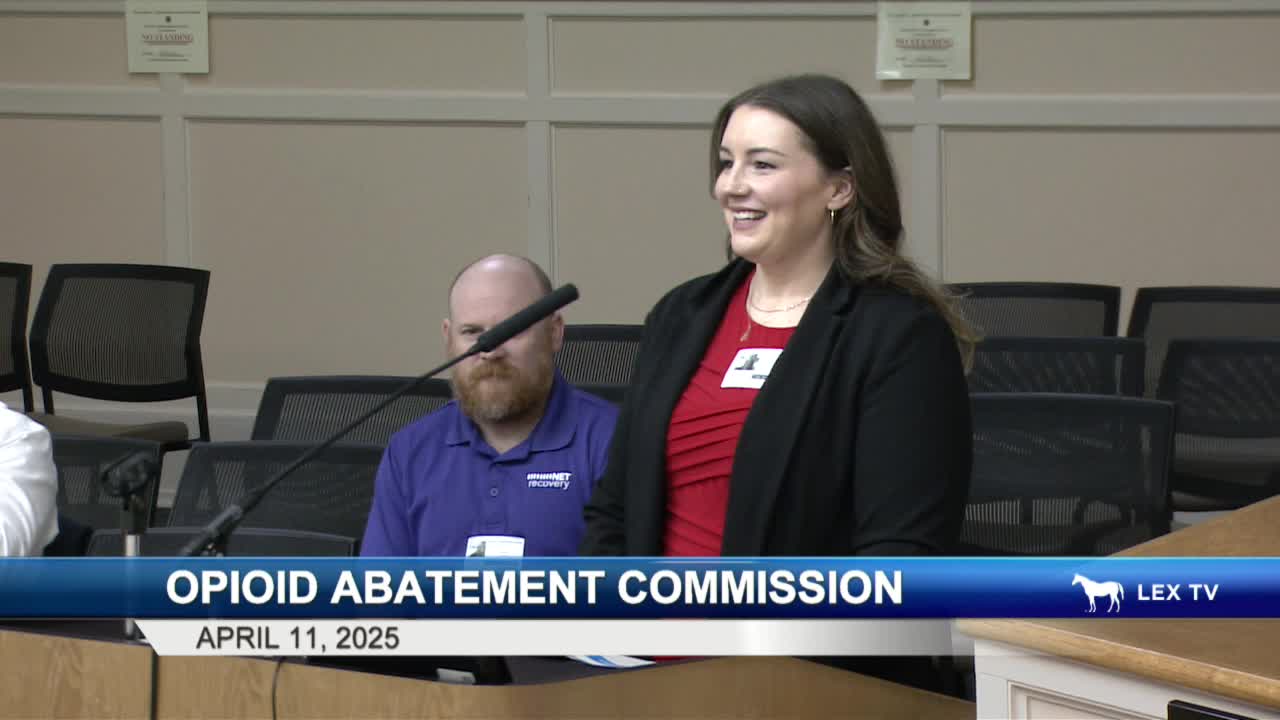
At a meeting of the Lexington Opioid Abatement Commission, Ashley Dunsmore of the Kentucky Nonprofit Network presented recommendations from the Lexington Nonprofit Coalition urging multi‑year grant cycles, up‑front payments, and allowance for operating costs when city opioid‑settlement funds are disbursed.
Ashley Dunsmore, director of regional advocacy and engagement for the Kentucky Nonprofit Network, told the Lexington Opioid Abatement Commission that a local coalition of 39 nonprofits reviewed the commission’s early grant recommendations and urged changes to make awards practical for community providers.
Dunsmore said the coalition — which includes organizations that do prevention and treatment work such as Chrysalis House, the Hope Center and Junior Achievement of the Bluegrass — wants the commission’s recommended grant program to prioritize multi‑year grant cycles, up‑front payments rather than reimbursements, and allowance for operating costs. “A 2‑year grant cycle is better than a 1‑year,” Dunsmore said, adding that quarterly payments and a standard indirect‑cost allowance would help nonprofits deliver services.
The coalition provided local context for the opioid settlement funds, saying Kentucky receives a split of settlement proceeds with 50% to the state and 50% to local governments. Dunsmore said the county combined government has an estimated allocation in the low millions and that “there’s 7,200,000 currently available here at the city,” figures she presented as part of the coalition’s assessment of funding scale and longevity.
Dunsmore described the Lexington Nonprofit Coalition as a membership alliance that represents organizations with shared interests in how government contracts and grants are run. She said the coalition’s members collectively serve hundreds of thousands of clients annually in the Bluegrass region and that about 72% of the coalition’s members’ revenue comes from government grants and contracts.
Commissioners and attendees asked questions about the coalition’s own funding and how grant sizes should be set. John Moses asked whether the coalition receives state grants; Dunsmore replied the coalition and the Kentucky Nonprofit Network do not receive state grants and are funded by member dues. Commissioners also discussed whether a $50,000 ceiling would be sufficient; Dunsmore said the coalition recommended award levels above $50,000 when projects demand it and suggested the commission consider a range of award sizes to reach both small grassroots providers and larger programs.
Dunsmore also warned that state funders are increasingly directing single‑county work to local commissions. “Some of the nonprofits reported that the state is encouraging them to seek local opioid abatement funds if they only serve Fayette County,” she said, urging nonprofits to advocate to county partners where they serve multiple jurisdictions.
Commission members thanked the coalition for the feedback. Commissioners reiterated that the Opioid Abatement Commission makes recommendations to the mayor and city council and does not itself appropriate funds.
The coalition said it will continue to engage with council and with prospective grantees ahead of the commission’s final recommendations to the mayor and council.