Get Full Government Meeting Transcripts, Videos, & Alerts Forever!
Get email alerts on the Forestry topic
No spam. Unsubscribe anytime.
Planning Commission adds forest carbon language, asks for leakage language and clearer conservation‑easement rules
Summary
Skagit County planning commissioners supported adding policies on forest carbon sequestration and a new clause addressing 'leakage' while discussing rules for conservation easements and splitting residences from resource parcels.
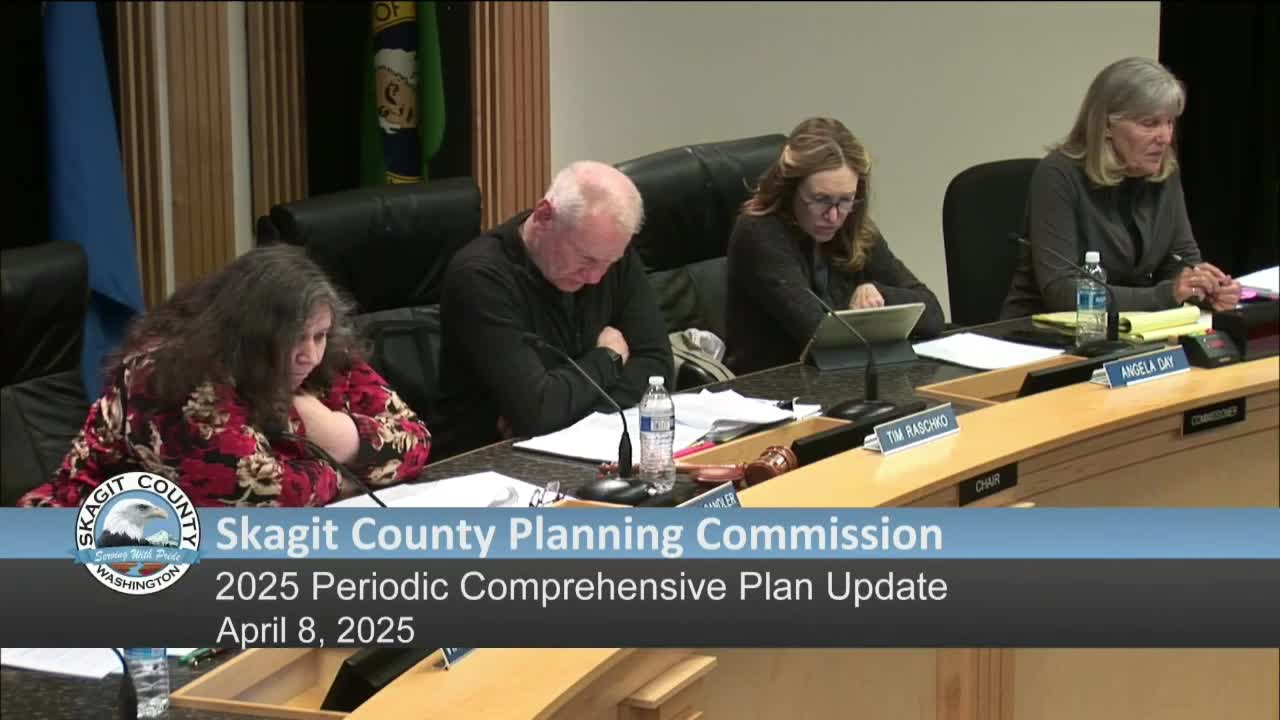
Skagit County Planning Commission members on April 8 agreed to add new language on forest carbon sequestration and storage to the draft natural resource lands element and debated additional language intended to prevent "leakage," or displacement of environmental impacts to other jurisdictions.
The commission also discussed policies that would make it easier for property owners to separate a small residential parcel from larger forest or agricultural holdings and place the remainder in conservation easement — a practice already provided for agricultural lands and now proposed for some forest lands.
Consultant Clay White explained the proposed new policies were meant to recognize carbon benefits from forests and encourage practices that preserve or increase forest carbon. A member of the Forestry Advisory Board asked that the heading be expanded to say "Forest Carbon Sequestration and Storage." Commissioners added a recommended policy aimed at preventing substitution or leakage that could offset intended sequestration benefits; one commissioner summarized the concern as preventing protections that merely shift damaging activity elsewhere.
Debate over splitting residences from forest lands Several commissioners raised concerns that allowing easy separation of a single‑family residence from a forest parcel and selling off the remaining acreage to a nonresident owner could reduce on‑site stewardship. Commissioner Wright and others said corporate ownership can produce good forest management, but some feared a pattern in which small ownerships are monetized rather than actively stewarded.
At the same time, staff noted that agricultural code already contains a process allowing separation of a residence from a farm operation, and commissioners accepted a staff recommendation to permit a similar mechanism in specified forest categories (secondary forest land), while asking staff to tighten language and preserve stewardship expectations.
Why it matters: The forestry policies intersect with climate goals and with county rules governing land division, taxation, and forest practice regulation. The commission’s decisions will shape how long‑term protections and conservation easements are used on forest land and how the county balances ownership, stewardship, and economic incentives.
Next steps: Commissioners agreed to incorporate the new forest carbon and leakage language into Attachment C and to ask staff to refine language on conservation easements and the process for separating residences from forest parcels before the commission’s next meeting on April 15.