Get Full Government Meeting Transcripts, Videos, & Alerts Forever!
Get email alerts on the Municipal Budget topic
No spam. Unsubscribe anytime.
Richmond officials outline Mayor Ulloa—Y2026 budget; council members press for more time, data
Summary
Interim Chief Administrative Officer Sabrina Joy Hogg presented Mayor Ulloa—s proposed FY2026 revenue and operating budget to the Richmond City Council, describing a $1.1 billion general-fund plan with $54.6 million in projected revenue growth while warning of constrained revenues in 2027 because of a reassessment-cycle change.
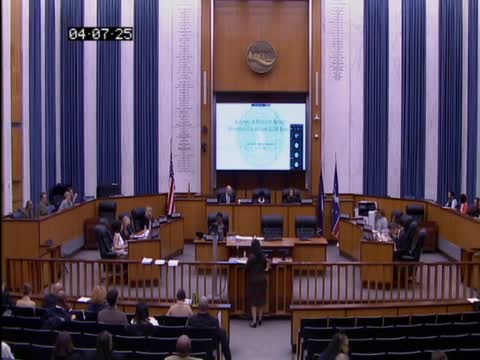
Interim Chief Administrative Officer Sabrina Joy Hogg presented Mayor Ulloa—Y2026 proposed revenue and operating budget to the Richmond City Council during a budget work session, laying out a $1.1 billion general-fund plan and a five-year forecast that, she said, shows expenditures outpacing revenues and a growing structural gap.
Hogg said the proposed budget depends on projected general-fund revenue growth of $54.6 million (5.5 percent), driven primarily by real-estate tax revenue. She warned the council that a change in the city—s assessment cycle means a de facto assessment "freeze" for tax year 2027 and urged strategic planning now to prepare for constrained revenue in that year. "This year's budget is a budget built on resiliency," Hogg said.
Council members responded with repeated requests for more time, clearer detail and public access to supporting documents. Council member Gibson said the timing and distribution of materials left members and residents without adequate time to review and scrutinize the mayor's proposals: "This is not how we govern," she said, urging earlier presentation and public posting of Q&A and supporting data.
Why it matters: Hogg described near-term budget choices (raise revenue, increase efficiencies, reduce expenditures) as necessary to preserve core services. She highlighted constraints unique to Richmond, including a high share of tax-exempt property (state buildings, universities, hospitals) that she said reduces local taxing capacity and a misalignment of the reassessment calendar with the fiscal year that the city is correcting by moving to a biennial assessment cycle. "One penny of the dollar in the tax rate is equal to about $4,200,000 in general fund revenue," Hogg said, pointing to the fiscal leverage of small tax-rate changes.
Key details from the presentation and council discussion
- Revenues and forecast: Hogg said general-fund revenues are projected to grow by about $54.6 million in FY2026, producing a $1.1 billion general fund. Real-estate tax increases account for roughly 76 percent of that projected growth (about $41.3 million). Other revenue changes cited included business-license tax +3.7 percent, meals tax +4.6 percent, sales/use tax +1.2 percent, lodging tax +7.3 percent and charges for service rising largely because of sanitation and waste removal (+14.1 percent).
- Assessment-cycle change and "freeze": The administration described a plan approved last spring to shift the reassessment cycle so it aligns with the fiscal year. Hogg explained that to realign the calendar the city will use a biennial assessment for tax years 2026 and 2027, producing what she called an "assessment freeze" effect for the 2027 budget and creating revenue pressure the city should plan for now.
- Spending, personnel and collective bargaining: The FY2026 all-funds proposal totals roughly $3.0 billion with net expenditures (net of transfers) about $2.6 billion, and the general-fund increase is driven primarily by personnel costs. Hogg said $37.9 million of the $54.6 million growth is for personnel (about 69 percent), with a 3.25 percent salary increase for general employees, a 3 percent increase for constitutional officers and an average 10.3 percent increase for sworn police and fire employees (the latter reflecting step increases and a market adjustment tied to nearby jurisdictions). Hogg also said three collective bargaining agreements have already been adopted and two remaining contracts were assumed in the FY2026 numbers.
- Schools and partner agencies: The budget proposes a $9.6 million increase in the city—s contribution to Richmond Public Schools. Hogg noted that state funding (the SOQ model) and local required effort are part of the calculus and that Richmond's local contribution has grown faster than state support over the past decade. The administration proposed reclassifying what had been called "charitable organizations" to "outside agencies," reducing partner-agency contributions by roughly $4.1 million from FY2025 levels while promising a redesign of the process for selecting and monitoring those contracts.
- Housing and homelessness: The proposed FY2026 budget includes about $49 million for housing services, continued support for shelter beds and the eviction diversion program (Hogg said the city has diverted over 1,600 evictions). The five-year capital plan includes continued investment in affordable housing and performance grants; Hogg said the council has already approved 23 affordable-housing performance grants since 2022, covering more than 3,000 units across five council districts.
- Public safety and grants: Hogg said the city accepted a SAFER grant for fire staffing in 2023 that required the city to assume 72 firefighter positions and the associated $6.6 million in ongoing costs. She described inclusion of certain positions previously funded by special funds into the general fund (for example, emergency communications positions) and clarified these represent funding reallocations rather than net new positions.
- Utilities and fees: The presentation proposed modest rate adjustments for solid-waste, recycling and parking fees and a set of planned utility rate increases to support multi-year capital investments. Hogg said the utilities plan includes planned five-year investments of roughly $200 million for the gas utility, $162 million for water distribution, $150 million for wastewater plant upgrades and an additional $340 million for sewer-pipe replacement. The administration estimated the average household impact of utility rate changes at about $12.83 per month.
Council concerns and next steps
Council members across the dais pressed the administration for more granular documentation, public posting of the Q&A, and additional work sessions. Council member Gibson described the timing of question-and-answer releases and the volume of materials as a barrier to informed review: "I called when this happens and, again, this is not a fence, but I call this the take 1, pass it down," she said, adding that residents and council members need more time to evaluate whether increases and program changes are meeting priorities.
Several members asked for: detailed line-item backup for multi-million-dollar operating changes (Council member Gibson flagged a $5 million operating increase in IT as needing clearer explanation); program metrics for youth and workforce programs (Council member Jones requested a citywide strategy and program-level details for youth investments); and shelter and family-crisis spending details (Council member Lynch asked for a report on Family Crisis Fund requests year-to-date and clarified counts for inclement-weather and year-round shelter beds).
On pensions, Hogg and finance staff described the city's recent pension-obligation bond issuance to improve the funding ratio for legacy pension liabilities and the VRS transition. Finance staff said the city sold $120 million in pension-obligation bonds last year and reported an 80.9 percent funded ratio on the latest VRS valuation after that action; council members asked for ongoing reporting and valuation documents.
Administration staff and council office staff committed to follow up. Council staff said they would collect outstanding questions and transmit them to administration; Hogg agreed to provide the specific documents requested. Council and staff scheduled another work session next Monday focused on the CIP and said additional sessions will be added to allow time for review before the May adoption deadline. "We're going to have to have at least another work session to get through those and get the answers that folks are looking for," the Council President said.
Ending
Council members and administration agreed to reconvene, with staff promising to post questions and answers publicly and to provide the program-level and contract-level details requested. In the absence of any formal votes in the session, members said the next step is a set of follow-up materials and additional work sessions to inform amendments ahead of the May budget adoption timeline.