Get email alerts on the Legislation Broadband topic
No spam. Unsubscribe anytime.
Marion County pushes back on bill language that would require counties to pay broadband relocation
Summary
Marion County’s legislative manager said staff prepared letters to state leaders opposing language in Senate Bill 818 that would require the local authority ordering a broadband relocation to pay the full expense of moving providers’ facilities.
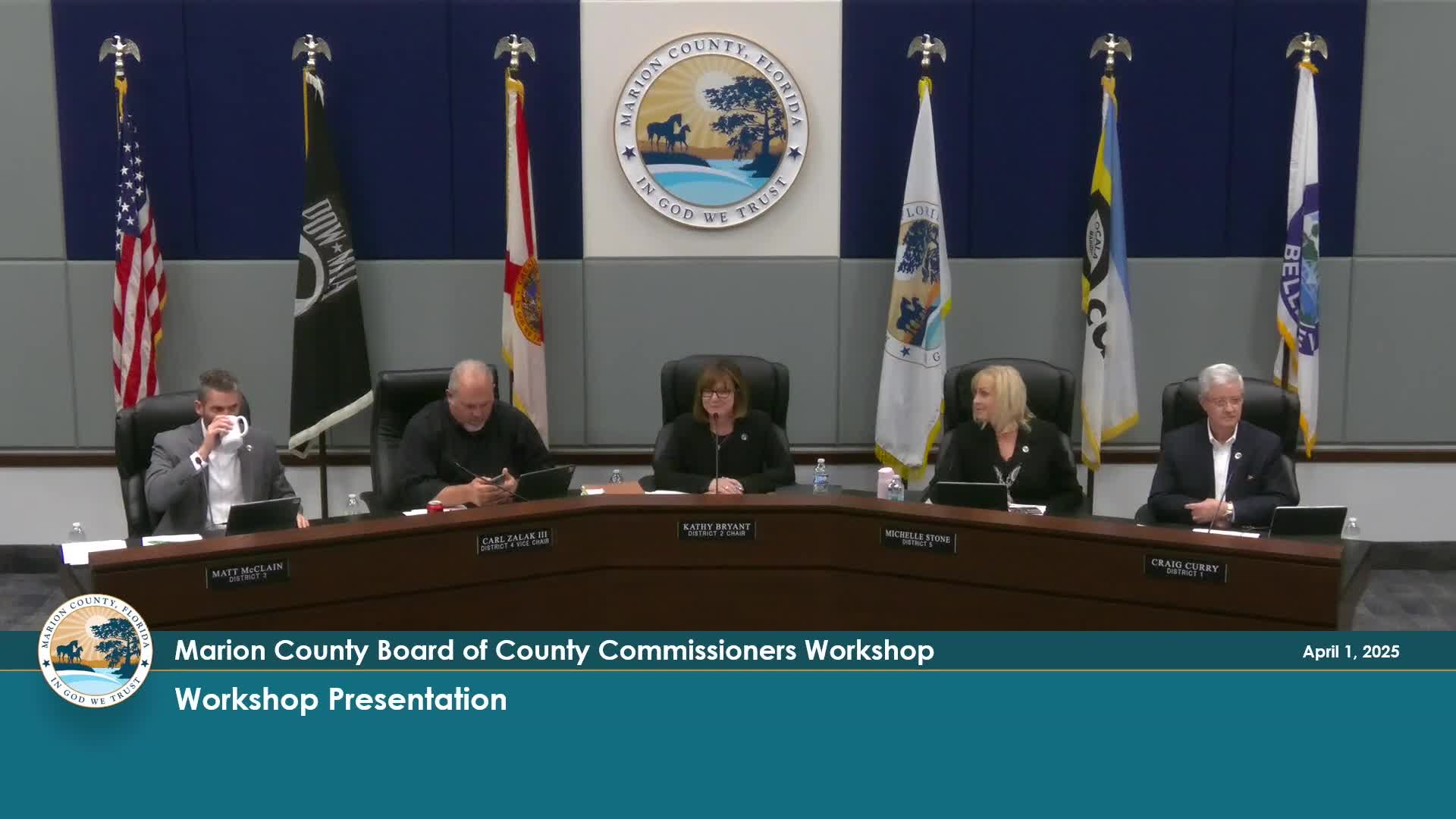
Marion County’s legislative manager told commissioners at the March workshop he had prepared letters to state leaders expressing the county’s concerns about Senate Bill 818, which includes language that would shift the cost of relocating broadband or video service facilities to the local authority that requires the move.
“...If the authority requires a provider of broadband Internet services as defined in statute 2 8 8 9 9 6 1 2 or a cable service provider or video service provider as defined in statute 6 1 0.103 to relocate a facility used to provide such service, the service provider owning or operating such facility must perform any necessary work upon notice from the authority, and the authority requiring such relocation must pay the entire expense properly attributable to such work,” Matt Cridall, the county’s legislative manager, read aloud from the bill language during the update.
Cridall said the county had prepared letters addressed to Senate Transportation Committee Chair Jay Collins and Senate President Kathleen Passidomo to convey the county’s concerns and that county lobbyist Ryan Matthews was meeting with a state senator about the bill that day. Commissioners discussed the potential fiscal impact: staff estimated relocating one mile of fiber‑optic cable could cost roughly $80,000–$100,000 to install per mile (city‑provided average for new underground fiber), with higher costs depending on whether the line is aerial or attached to poles; staff also said an 11‑mile example project could increase county construction costs by roughly 10 percent and that the county receives about $2.2 million per year in communications‑tax revenue (approximately $170,000 of that to the Transportation Maintenance Fund, with the balance to the general fund).
Commissioners instructed staff to correct an earlier body copy error in the prepared letter’s bill number, to copy both the Senate and House leadership and committee members, and to coordinate with the county’s Tallahassee lobbyist. “If you will get it corrected and send it over here, I'll sign it and you can go do your magic,” the chairman said.
The board also discussed the broader policy implications of shifting relocation costs onto local governments. Staff and commissioners noted some broadband buildout in rural areas has been funded by state and federal grants and argued county taxpayers should not be saddled with large relocation bills. An ISP estimate cited later in the meeting (submitted by a provider expanding into rural areas) put a lower per‑mile relocation figure at about $15,000 per mile for aerial lines and $44,000 per mile for underground relocation, underscoring variability by project and provider.
No formal vote was recorded; commissioners directed staff to send the letters and to coordinate with Florida Association of Counties and other county partners to ensure concerns are heard in Tallahassee.
AI generated
The text on this page is AI generated. Summaries, highlights, analysis, and video transcripts are all produced from the original source material.
AI can make mistakes, so if you spot one, and we will fix it for everyone.
Note: the source content is unaltered by us. Any content source we link to, be it a video, an audio recording, or a document, is presented exactly as its publisher released it. That publisher is usually a government body, sometimes an individual official or another organisation.