Get Full Government Meeting Transcripts, Videos, & Alerts Forever!
Get email alerts on the Broadband Funding And Deployment topic
No spam. Unsubscribe anytime.
Dane County broadband update: PSC BEAD round oversubscribed; local outreach continues
Summary
At the April 2 Dane County Broadband Task Force meeting, Supervisor Randy Udell and the county broadband coordinator summarized state BEAD application activity, local outreach with municipalities, and next steps for award rounds; staff warned program timelines may be affected by pending federal-level changes.
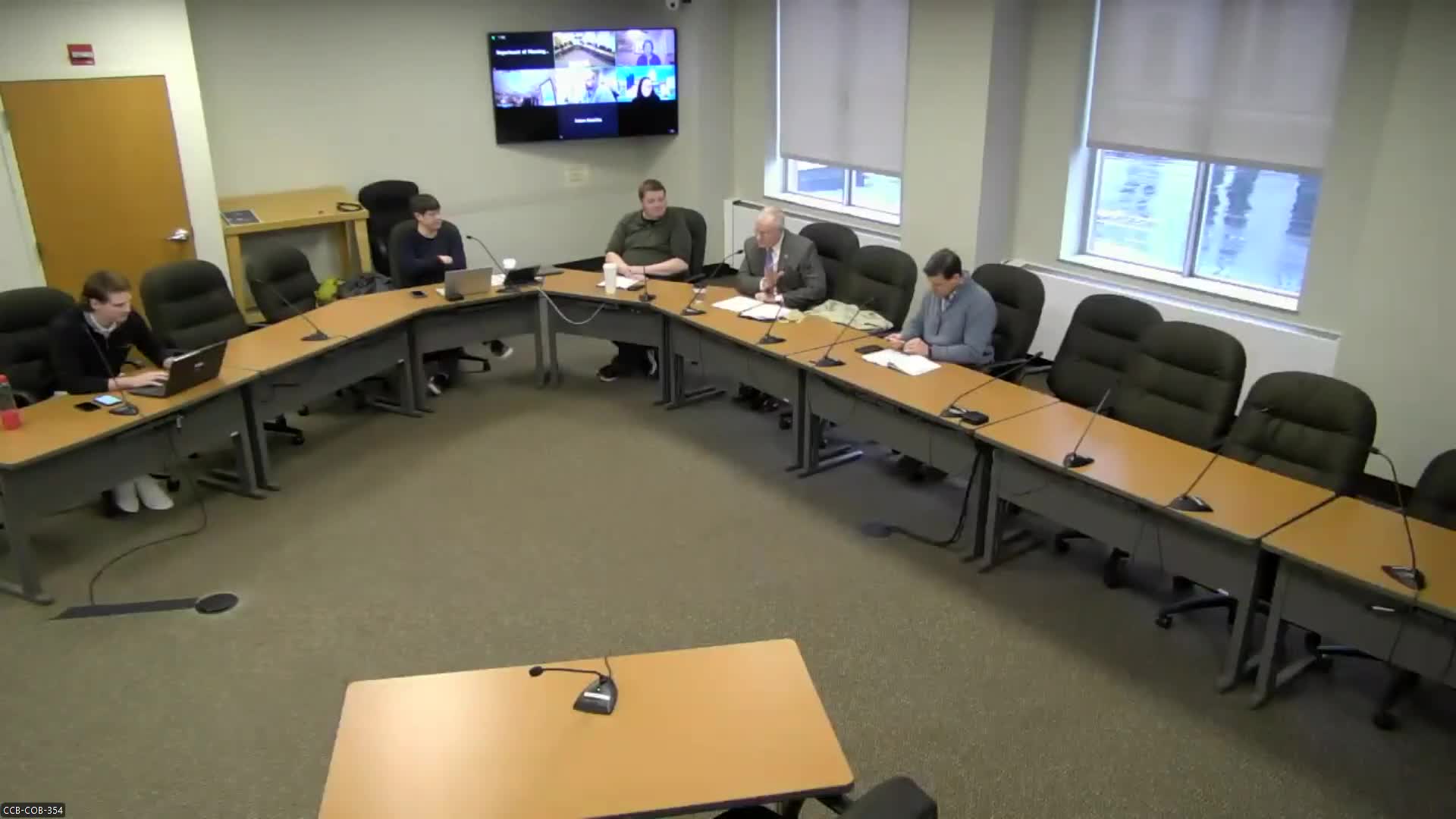
Supervisor Randy Udell (representing District 47) and Dane County broadband coordinator Jaren briefed the Dane County Broadband Task Force on state and federal broadband funding developments and local outreach on April 2.
Udell said he met with the governor shortly after taking office, and that the governor’s budget included a $400 million broadband request; Udell said the governor also appointed him to the state broadband task force. Udell summarized multi-state and national discussions about federal broadband funding, including reports that $43 billion in planned BEAD funds could be changed or reallocated and that some proposals have suggested substituting low-Earth-orbit providers such as SpaceX’s Starlink. "None of that's definite, but that is the speculation at this point," Udell said. He said a bipartisan letter opposing certain changes had gathered 109 signatures nationally and 21 in Wisconsin.
Jaren, the county broadband coordinator, provided a technical update on the state-administered BEAD (Broadband Equity, Access, and Deployment) process in Wisconsin. He said the Public Service Commission of Wisconsin (PSC), the state administering agency, closed round 1 of applications (Jan. 13–Feb. 25) and received about 425 applications requesting roughly $2.98 billion; Wisconsin is eligible for just over $1 billion in BEAD funds. Jaren cautioned that the $2.98 billion figure likely includes overlapping or multiple applications for the same locations and therefore does not equal unique-location demand.
Jaren said PSC reported that about 95% of eligible locations in Wisconsin received at least one application. He described the near-term timeline: PSC review through March and preliminary awards likely in April; a subsequent round 2 in April–May for applicants to revise or expand proposals; additional negotiations and a round 3 later in the spring and early summer; packaging of final proposals in July followed by a public-comment period and submission to the National Telecommunications and Information Administration (NTIA) for federal review.
Jaren noted the PSC plans to entertain a range of technologies — including fixed wireless and low-Earth-orbit satellite — as the process progresses. He added a caveat that program timelines and details could change if the federal BEAD program receives legislative or administrative adjustments: "They've got deadlines in a 365-day subgranting window, so they are continuing to chart their initial course," Jaren said, while also acknowledging national speculation about program changes.
Jaren and Udell described local outreach: the broadband coordinator has been meeting with municipalities and held a Quad‑Town meeting that included Pleasant Springs, Dunn, Dunkirk and Rutland; attendees focused primarily on access (last‑mile infrastructure) and asked questions about service gaps where lines stop short of homes by 100–200 feet. Jaren encouraged other towns and villages to request presentations and offered to attend local board meetings.
Ending: Task-force members discussed coordinating county-level outreach and tracking BEAD timelines; staff cautioned that the application process is competitive and that funding and program details remain subject to change at the federal level.