Get Full Government Meeting Transcripts, Videos, & Alerts Forever!
Get email alerts on the Land Use And Eminent Domain topic
No spam. Unsubscribe anytime.
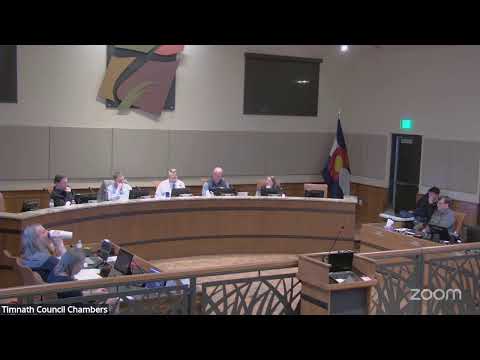
Timnath council grants Fisher Farm Metro District limited consent to pursue eminent domain for underdrain easements; 4‑1 vote
Summary
The Town of Timnath council voted 4‑1 on May 11 to approve an intergovernmental agreement allowing Fisher Farm Metropolitan District No. 1 limited authority to pursue eminent domain to obtain underdrain easements the district says are necessary to construct a planned groundwater/stormwater conveyance.
The Town of Timnath council voted 4‑1 on May 11 to approve an intergovernmental agreement that grants Fisher Farm Metropolitan District No. 1 limited authorization to pursue eminent domain to acquire specific underdrain easements needed for off‑site storm/groundwater conveyance.
Why it matters: the underdrain was listed as a public improvement in the district’s service plan and the district said it needs the permanent and temporary easement rights to complete engineered plans and allow future connections from neighboring properties; one nearby landowner, Jason Martindale, told council he opposes condemnation and raised groundwater and well‑impact concerns.
What council approved and why
- Scope of the IGA: the agreement authorizes the district to commence the statutory eminent domain process only to acquire targeted permanent and temporary easements necessary to construct the underdrain alignment presented to staff and council; it does not, and cannot, itself condemn property — any condemnation requires a separate court proceeding and proof of public purpose and compensation in that forum.
- Staff and district justification: the developer and district presented a four‑option alternatives analysis prepared by engineers and said the preferred alignment had been included in the district’s service plan and was the most practical design that coordinated existing utility easements (including a Box Elder sewer easement) and minimized additional crossings and property impacts. District counsel said one alternate that appeared cheaper was not feasible because the neighboring system would not accept outfall and another route would require costly and complex interstate bore work.
- Public comment and dissent: property owner Jason Martindale said staff and the developer have mischaracterized the need for the easement and argued the proposed underdrain is intended to lower groundwater to permit basements for the developer rather than to serve a public stormwater purpose; he submitted engineering analyses that he said show a risk of nearby irrigation wells going dry and urged council to deny use of eminent domain.
- Council deliberations and vote: council members discussed the alternatives analysis, the question of whether designs in town right‑of‑way might be used instead, and the town’s prior experience with metro districts and rights‑of‑way. After discussion, the motion to approve the IGA carried 4‑1; Councilmember Bill Jenkins voted in opposition and said he wanted more time to investigate whether an alternate option (which appears to route through town right‑of‑way in some cost estimates) was truly infeasible.
What the IGA requires of the district
- The IGA conditions the district’s authorization to permit future tie‑ins by adjacent property owners if sufficient capacity exists and if those owners pay a proportionate share of original construction costs.
- The IGA requires the district to work with the town engineer on final design specifics and incorporates standard protections so the town will not bear extraneous costs; town staff said any land development approvals and final construction plans remain subject to the town’s normal review processes.
Next steps
If the district proceeds, it must file a separate eminent domain/condemnation action in court to acquire the specific easements; in that forum the district must prove necessity, public purpose and the amount of just compensation. If the parties reach a negotiated easement agreement before a court action, condemnation will not be necessary. The council’s IGA approval only grants the district limited consent to pursue condemnation under state law and does not itself take property rights.
Provenance: council hearing, district presentations and public comment (transcript May 11, 2025).