Get Full Government Meeting Transcripts, Videos, & Alerts Forever!
Get email alerts on the Land Use Regulation topic
No spam. Unsubscribe anytime.
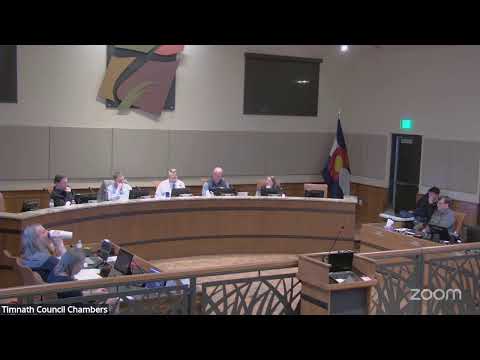
Timnath council and planning commission favor restrictive rules for cultivation and healing centers as state licensing advances
Summary
Town planners presented zoning scenarios for natural‑medicine healing centers and cultivators on May 11 and the council and planning commission signaled support for relatively restrictive local controls while acknowledging the state’s licensing authority.
Town planners presented draft zoning scenarios and regulatory options on May 11 to address how the Town of Timnath should regulate natural‑medicine cultivation facilities and supervised “healing centers” following Colorado’s voter adoption and subsequent legislation for so‑called natural medicines.
The planners described four alternative residential/commercial zoning scenarios for healing centers, and three scenarios for cultivation facilities. Staff emphasized that state law prohibits local governments from banning healing centers or cultivators outright but permits reasonable time, place and manner regulation; state statutes also impose a separate 1,000‑foot setback from schools and childcare facilities measured along direct pedestrian routes. "Local governments cannot prohibit healing centers within their boundaries, nor can they prohibit cultivation facilities. But you can regulate the time, place, and manner under your zoning and land use authority," staff said.
Why it matters: Colorado’s implementing statutes set a statewide licensing regime for licensed facilitators and cultivators, and they limit local governments to zoning‑style controls. Towns that adopt zoning rules now will influence where healing centers and cultivators may locate and whether those uses will be concentrated in commercial corridors or kept away from residential neighborhoods.
What staff proposed
- Healing centers: staff proposed treating healing centers similarly to medical or dental offices in the most permissive scenario (allowed in various mixed‑use and commercial zones). They provided three progressively restrictive alternatives; the most restrictive scenario would permit healing centers only in regional commercial zones, limiting available land to about 196.7 acres or roughly 3.9% of the town as of the current zoning map.
- Cultivation facilities: staff proposed locating cultivators primarily in the industrial zone and provided three setback scenarios from residential parcels. Under the most restrictive cultivation scenario staff modeled, approximately 80 acres (about 1.6% of the town) would be available for cultivators after a 1,000‑foot buffer from residences.
Council and commission input
- Cultivation setbacks: commissioners and council members repeatedly expressed concerns about odors, enforcement and proximity to homes and favored the most restrictive option for cultivators (the larger residential setback). Several council members said it was easier to start restrictive and relax rules later than to tighten them after uses are established; Mayor Pro Tem Luke Wagner and several council members voiced support for the most restrictive cultivation setback.
- Healing centers: council members generally supported restricting healing centers to nonresidential commercial corridors. Several councilors said they would support the most restrictive scenario (scenario 4), which largely limits healing centers to the Ladera/Gateway North/Costco commercial areas along Harmony; Councilmember Lake and others said they wanted to avoid siting these centers in residential neighborhoods. Council also asked staff to draft potential regulatory tools such as spacing (minimum distance between healing centers), limits on hours of operation (weekday/daytime preference was mentioned), and minimum separation from residential property lines if warranted.
- Enforcement and operator qualifications: commissioners raised enforcement questions including how to determine whether a participant remains “under the influence,” how the state licensing for facilitators will work, and whether low‑bar online certificates could undermine practitioner standards. Staff and several councilors noted the state’s licensing scheme (Department of Regulatory Agencies and Department of Revenue roles) already imposes facilitator training and recordkeeping requirements, and that licensed facilitators would be responsible for determining when a patron was no longer under the influence.
Next steps and staff directions
Staff said they will draft code language consistent with the council’s direction and bring it to the planning commission and then back to council for formal consideration in advance of the town’s moratorium expiration (staff referenced a moratorium expiring in July and planned next steps in May). Planners were asked specifically to: (1) prepare a draft that treats cultivation as an industrial use subject to a 1,000‑foot residential buffer (or similar), (2) draft a code option that restricts healing centers to regional commercial zones (scenario 4) with required spacing and restricted hours, and (3) return with recommended permit standards and potential spacing metrics informed by expert input on facilitator practice and typical dosing timelines.
Provenance: staff presentation and council/commission Q&A (transcript May 11, 2025).