Get Full Government Meeting Transcripts, Videos, & Alerts Forever!
Get email alerts on the Legislation topic
No spam. Unsubscribe anytime.
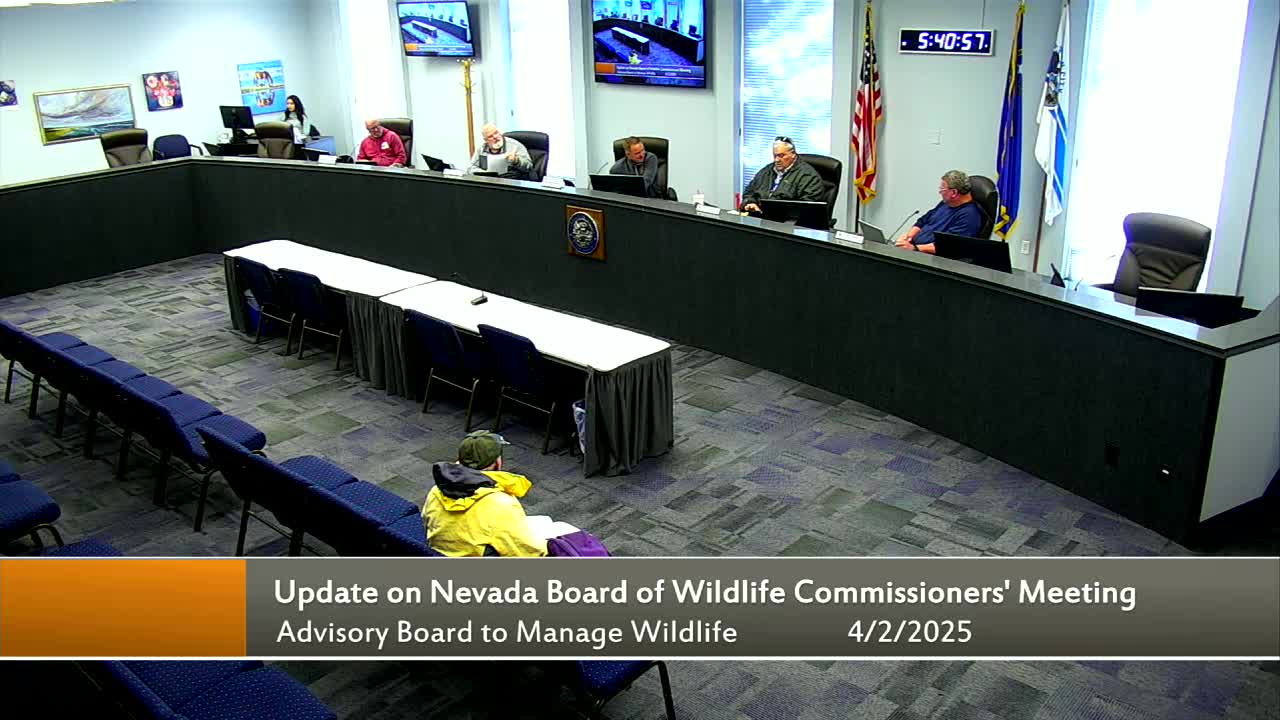
Carson City urban wildlife advisory committee backs most wildlife bills, opposes two and takes neutrals
Summary
At a meeting of the Carson City Urban Wildlife Committee, members heard staff summaries of multiple Nevada bills affecting wildlife, then voted unanimously to support eight measures, take neutral positions on two and oppose two measures (one conditionally). The committee recorded concerns about enforcement and fiscal details for several items.
The Carson City Urban Wildlife Committee voted unanimously to record positions on multiple Nevada bills after hearing a staff overview and public comment.
Committee members supported AB 59, AB 85, AB 87, AB 132, AB 242, AB 486, SB 101 and SB 215; took a neutral stance on AB 9 and AB 429; and opposed AB 245 and SB 235 (with a conditional comment that SB 235 could be supported if stripped back to a provision allowing transfer of tags to people under age 18). Chair Fleming introduced the motion and a staff member seconded it; the motion passed with all present voting yes.
The action followed an extended staff briefing that summarized the bills’ main provisions and any fiscal notes. Among highlights in the briefing, staff noted an NDOW fiscal estimate of roughly $230,000 for the bill that would add invertebrate species (referred to in discussion as the invertebrates listing and staff fiscal note), and that the proposed wildlife crossing account would be seeded with an initial appropriation discussed in testimony as roughly $5,000,000. Staff also described fiscal notes or administrative impacts for several other measures discussed during the meeting.
Committee members and members of the public asked questions or raised concerns about enforcement, fiscal transparency and unintended consequences. On AB 245 (a proposal to restrict possession or operation of certain semi-automatic firearms by people under 21, as described in the meeting), the committee chair expressed categorical opposition and urged the committee to oppose the bill; that view was reflected in the final motion. Members also raised enforcement and abuse concerns about SB 235 (the so-called “deadhead” bill) — which would change salvage and dead-animal collection rules and contains other provisions — and recommended opposing the bill unless the deadhead provisions were removed and the transfer-to-minors component remained as a standalone change.
Public commenters who spoke during the meeting expressed support for several conservation measures discussed by staff and reiterated local concerns about sagebrush habitat and wildlife corridors, which committee members said they would continue to monitor as the bills moved through the Legislature. Staff indicated they plan to attend the April 4 commission meeting and report back on any changes or amendments.
Votes at a glance
- Motion: "I'd entertain a motion to support AB 59, AB 85, AB 87, AB 132, AB 242, AB 486, SB 101, and SB 215; take a neutral stance on AB 9 and AB 429; and do not support AB 245 and SB 235 (unless SB 235 is stripped back to the transfer-to-under-18 provision)." — moved by Chair Fleming; seconded by staff member. Outcome: approved unanimously. (All present members voted yes.)
Why it matters
The committee’s positions are advisory to state-level decision-makers and reflect local concerns about wildlife management, funding for crossings and species protections. Several bills discussed would change how Nevada manages water for wildlife, defines protected species (including invertebrates), funds wildlife crossings and clarifies salvage or salvage-permit rules for big-game animals struck by vehicles.
What the committee emphasized
Members repeatedly asked for fiscal transparency and safeguards to prevent funds being reallocated away from wildlife uses. They also raised enforcement concerns for bills that could be exploited by bad actors (for example, the deadhead provisions in SB 235) and questioned whether some proposals are enforceable in practice. The committee signaled support for measures that expand conservation tools (guzzlers, wildlife crossings, invertebrate protections) provided administrative and fiscal safeguards are in place.
Background and next steps
Staff summarized multiple bills and noted fiscal notes where available; the committee directed staff to monitor amendments and attend the April 4 commission meeting for more in-depth review. The committee’s recorded positions will be transmitted as its formal recommendations to the relevant state agency and commission meetings, per the committee’s practice.
Ending
Committee members said they will continue to track the bills and report back on amendments or material changes at future meetings.