Get Full Government Meeting Transcripts, Videos, & Alerts Forever!
Get email alerts on the Prison Siting And Policy topic
No spam. Unsubscribe anytime.
Senator pitches alternatives to proposed mega prison; locals and judges warn of fiscal and infrastructure risks
Summary
Sen. Brian King urged the Judiciary Committee to reject a single mega-prison approach and instead fund regional capacity, more front-line officers and mental-health services, arguing those steps would be cheaper and more effective at reducing crime and incarceration.
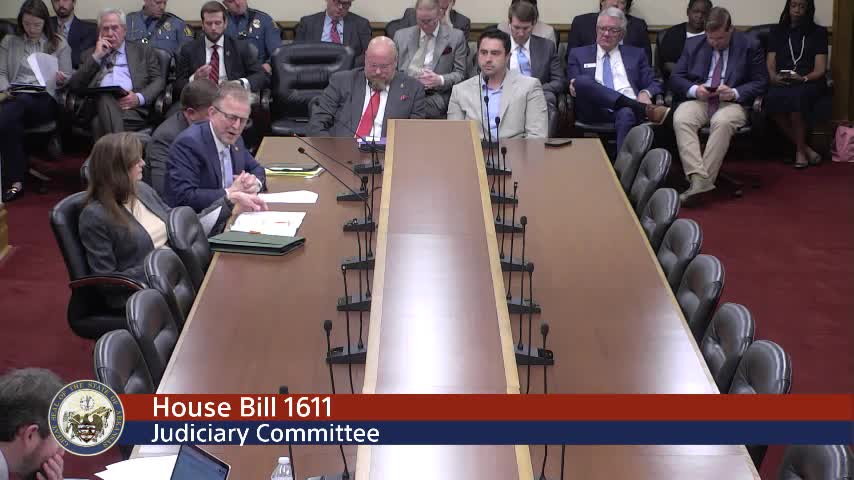
Sen. Brian King used his allotted time before the Senate Judiciary Committee to present a multi-part alternative to a proposed large prison project that state officials had floated for Franklin County. King urged lawmakers to consider a distributed approach: build diagnostic intake centers and additional capacity in or near the counties that contribute the most prison admissions, hire additional public-safety officers, and fund more mental-health and reentry services.
King said three factors drive the state's current correctional pressures: high crime, jail and court backlogs, and persistent underfunding of corrections and supervision. "You have to have money," he told the committee, saying corrections historically has been funded at roughly 8% of the state budget while he argued the system needs closer to 11'12% to address staffing, mental health and probation-parole needs.
King criticized the Franklin County site and the process by which it was selected. He said the proposed site lacks water, sewer and road infrastructure and that the board's decision to halt a smaller Calico Rock expansion earlier created additional costs. King suggested regional solutions: expand county jail capacity in jurisdictions responsible for the most prison admissions (Jefferson, Pulaski, Faulkner, Saline, Sebastian, Crawford, Washington and Benton counties), create a diagnostic intake center in Northwest Arkansas, and dedicate funding to hire 400'600 public-safety officers to reduce crime and support community supervision.
Local speakers echoed concerns about the Franklin County proposal. Cody Sosby, a former justice of the peace from Franklin County whose family owns property adjacent to the selected site, told senators the county and its courthouse staff lack the capacity to absorb impacts and that residents were given little public notice. Sosby said the project would 'decimate' the county's ability to retain and staff a sheriff's department because employees would be drawn away by private-sector or state wages tied to the prison development.
Committee members including Sen. Stubblefield and Sen. Doublefield expressed concern with siting a large prison where utilities and workforce are lacking. Stubblefield noted the importance of notifying local officials and said the proposal was sprung on some communities only days before land purchases were finalized.
King said he would not insist on an all-or-nothing choice: he urged a holistic package of investments (staffing, mental health, regional jail grants, diagnostic centers) that he said would be cheaper, faster to implement and more responsive to the counties that produce the most admissions. He also said concentrating beds far from prisoners' families undermines reentry and raises transport costs.
King did not press his measure through committee at this time; he pulled the bill for further work after the discussion, saying he would continue to refine an alternative package of proposals.