Get Full Government Meeting Transcripts, Videos, & Alerts Forever!
Get email alerts on the Social Media Regulation topic
No spam. Unsubscribe anytime.
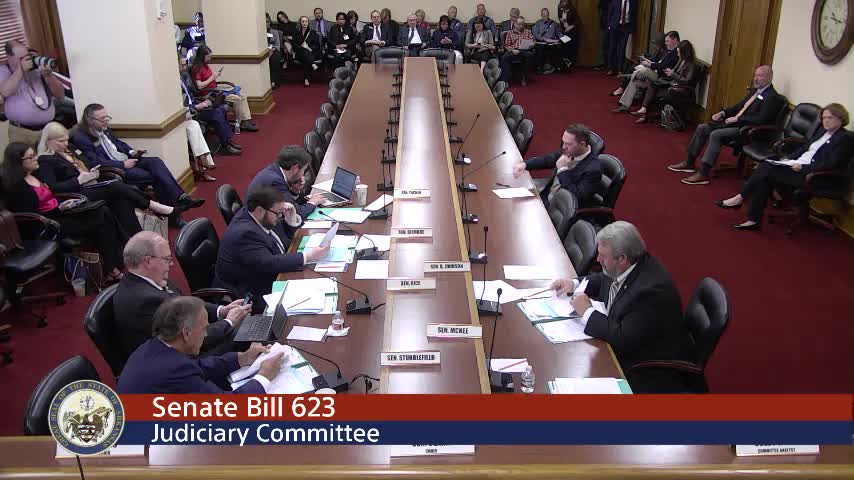
Committee advances bill creating private right of action against social media firms over harms to minors
Summary
Senators voted to advance SB612, sponsored by Senator Tyler Deese, establishing a private right of action for parents to sue social media platforms for specified harms to minors, with differing opinions voiced about proof standards and scope.
The Senate Judiciary Committee voted to advance Senate Bill 6 12, a measure that would create a private right of action enabling parents to hold social media companies civilly liable when their children suffer enumerated harms allegedly caused by platform conduct.
Senator Tyler Deese (District 35), the bill’s sponsor, told the committee the measure ‘‘builds a framework, a private right of action, related to social media’’ where parents could sue if ‘‘provable harm’’ occurs. Deese said the measure is modeled on other states’ laws and updates Arkansas’s 2023 Social Media Safety Act.
The bill lists several harms that could give rise to liability, including knowingly causing a person to purchase a controlled substance, causing or developing an eating disorder, causing or attempting suicide, and developing or sustaining an addiction to a social platform. Committee members questioned how some harms would be proven and who would carry the burden of proof. Senator Tucker pressed on damages calculations, asking whether the bill limited recoverable damages for certain harms to a $10,000 civil penalty and how potential attorney-fee provisions would apply. ‘‘Other than the attempt to commit or actually committing suicide, the only liability for the social media company is for the other three harms … is the $10,000 civil penalty,’’ Tucker summarized in questioning.
Deese acknowledged requests for amendments from companies seeking exclusions or definition changes and said ‘‘those conversations are ongoing.’’ He defended the framework as a vehicle for courts to adjudicate complex causation questions.
Committee members expressed both support and concern: some praised the effort to protect children, while others sought clarification about proof standards and legal exposure for platforms. Senator Stobelfeld and others asked whether algorithmic investigation would be necessary to link company conduct to specific harms.
After discussion the committee voted to advance the bill. The transcript records a motion to do pass, a second (Senator Gilmore), and a voice vote; the chair announced, ‘‘Motion carried. Congratulations, Centra Deese. You have passed SB612.’’