Get Full Government Meeting Transcripts, Videos, & Alerts Forever!
Get email alerts on the Human Trafficking topic
No spam. Unsubscribe anytime.
Senate committee advances package of human‑trafficking bills, creates fund and new enforcement unit
Summary
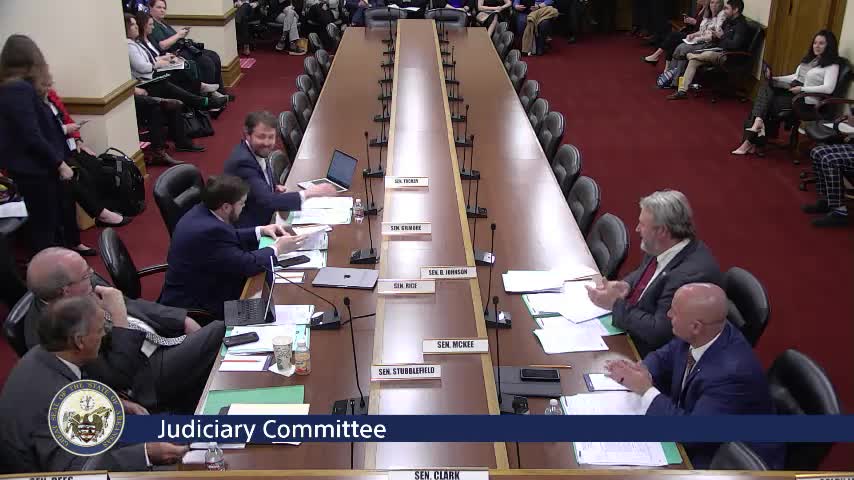
The Arkansas Senate Judiciary Committee advanced a package of bills on human trafficking that would tighten penalties for promoting prostitution, expand victim protections, create a dedicated state fund for victims and establish a human‑trafficking operations unit inside the Arkansas State Police.
The Arkansas Senate Judiciary Committee advanced a package of six bills aimed at strengthening penalties, victim protections and law‑enforcement capacity for human‑trafficking cases, sponsors told the committee on Wednesday.
Senator Joshua Bryant, sponsor of the package, told the committee the measures are rooted in a 2023 executive‑order effort to coordinate state responses and close gaps identified in a nationwide assessment of state laws and resources. "The mission is simple: to prevent trafficking, protect victims, and prosecute criminals," Bryant said.
The measures include Senate Bill 427, which reclassifies and stiffens penalties for "promoting prostitution," including new first‑, second‑ and third‑degree classifications and business liability provisions; SB 428, which creates a civil cause of action with a 10‑year limitations period counted from discovery; SB 429, which expands no‑contact orders and creates presumptions and pathways to seal prostitution convictions that resulted from trafficking; SB 430, which mandates restitution for victims and extends the time to file victim reparations claims; and SB 442, which broadens asset‑forfeiture authority for trafficking cases, creates an Arkansas Human Trafficking Council Support Fund, and establishes a human‑trafficking operations unit within the Arkansas State Police.
On SB 427, Bryant said the bill replaces prior promoting‑prostitution provisions with clearer degrees and escalated penalties. The business provisions would allow license suspension (30 days for a first violation, 60 for a second) and, on a third violation, permanent revocation and a fine up to $100,000. Bryant said fines would be deposited into a human‑trafficking victim support fund.
Sergeant Matt Foster of the Arkansas State Police described how illicit massage businesses often advertise online and said the bill would provide tools to deter those operations. "What we've seen in Arkansas is approximately we have between 40 and 60 illicit massage businesses actively posting advertisement on [classified sites], and this will help deter that," Sgt. Foster told the committee.
Victim‑service providers who testified supported the package but pushed for provisions they said would protect survivors. Kathy Bridal, CEO of Genesis Project, described "childlike sex dolls" as a tool of rehearsal for predators and urged criminalization; that provision drew organized legal opposition and was later struck from the bill package by a verbal amendment.
Jeff Rosenzweig, representing the Arkansas Association of Criminal Defense Lawyers, warned that some proposed language (notably the child‑doll prohibition) could raise constitutional questions such as vagueness and free‑speech concerns. After debate the sponsor and committee adopted verbal amendments: affirmative‑defense language was removed from SB 431 and the child‑doll prohibition was struck as a verbal amendment during the committee meeting.
SB 429 would require courts to issue no‑contact orders in charging situations under the state Human Trafficking Act and create a presumption that a person was a trafficking victim if they have documentation such as law‑enforcement certifications or immigration approvals. The bill also requires courts to grant record‑sealing petitions when a prostitution conviction is shown to have resulted from trafficking.
SB 430 expands mandatory restitution for trafficking victims to include medical, psychological, legal, relocation and necessary living‑cost expenses and extends many filing deadlines for reparations claims to five years (and for minors to five years after turning 18).
SB 442 consolidates several enforcement and funding changes: it authorizes criminal forfeiture of property used in trafficking, limits transfers of forfeited property to federal agencies without a court order, directs a portion of forfeiture proceeds and fines to the new Arkansas Human Trafficking Council Support Fund, and creates a dedicated human‑trafficking operations unit within the Arkansas State Police to investigate trafficking and high‑risk missing‑children cases. The bill also creates a new offense of knowingly harboring an endangered runaway minor and increased fines for certain trafficking and solicitation offenses; the committee adopted a verbal amendment clarifying the "harboring" element to require harboring "for a period of at least 72 hours." Bryant said the fund would pay for housing, counseling and legal services for victims and for limited training and software for investigations.
Supporters urged the committee to act quickly to give law enforcement and victim advocates more tools and stable funding. Brent Toomey of Saving Children and Reviving Souls testified in favor, describing local cases and urging more investigators and prosecutors. "We need 100 detectives and 20 prosecutors to combat crimes against children," Toomey said, recounting statements he said prosecutors had made about local resource shortfalls.
Committee members adopted multiple amendments during the hearing. On voice votes the committee moved each bill forward: SB 427 (do pass as amended), SB 428 (do pass), SB 429 (do pass), SB 430 (do pass), SB 431 (do pass as amended), and SB 442 (do pass as amended). All were advanced by voice vote with no roll‑call tally recorded in the public transcript.
What’s next: The bills now proceed to the full Senate calendar. Several committee members noted further rule‑making and stakeholder consultation will be needed for implementation details, and prosecutors and the state police said they would continue to coordinate on enforcement and constitutional issues raised by the amendments.