Get Full Government Meeting Transcripts, Videos, & Alerts Forever!
Get email alerts on the Higher Education Disability Accommodations topic
No spam. Unsubscribe anytime.
Committee approves two companion bills to improve reporting and access to disability accommodations in higher education
Summary
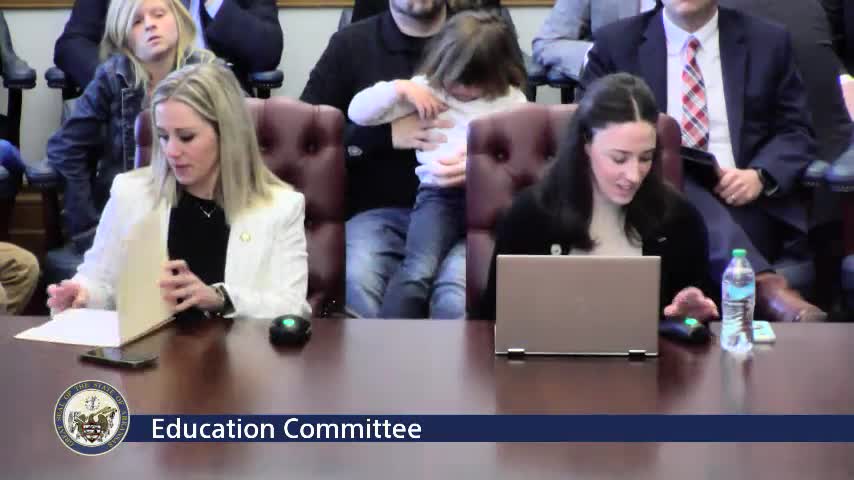
The committee passed two bills presented by Allison Guthrie and Sen. Brianne Davis: one requires Arkansas Department of Higher Education reporting on students registered to receive accommodations; the other expands acceptable documentation and transparency around accommodations and outreach during admissions and orientation.
The Education Committee approved two related measures intended to improve how colleges and universities in Arkansas record and report disability accommodations and how students obtain those services.
House Bill 17 28. Sponsored in committee presentations by Allison Guthrie and carried by Senator Brianne Davis, HB 17 28 directs the Arkansas Department of Higher Education (ADHE) to include data in its annual legislative report on the number and share of students registered to receive disability accommodations, and to report retention and graduation statistics for those cohorts. Guthrie said the state currently lacks consistent, statewide public statistics about higher-education students with disabilities and that better data could help evaluate whether services are producing intended outcomes.
House Bill 17 66. Presented by Allison Guthrie and Senator Davis as a complementary measure, HB 17 66 narrows and clarifies documentation and accessibility barriers for students seeking accommodations. The bill would allow institutions to accept prior Individualized Education Programs (IEPs), Section 504 plans or other documentation from earlier schools or military service, eliminate routine re-evaluation requirements for permanent conditions, require plain-language descriptions of how to request accommodations, and ask institutions to publish eligibility criteria and lists of typical reasonable accommodations in admissions materials, course catalogs, orientation materials and public websites. The sponsor said the bill also permits institutions to create reasonable accommodations not explicitly listed to meet student needs.
Committee members asked about the transition from K-12 to higher education and whether colleges are expected to test all students; witnesses said the bills do not require proactive screening but require institutions to begin consistent tracking once a student registers for accommodations. Sen. Sullivan asked whether higher-education departments must proactively evaluate students; witnesses and the sponsor clarified the bills require reporting and transparency and accept prior documentation rather than mandate universal re-testing.
Both bills passed the committee by voice vote. Committee action was procedural and did not identify a fiscal impact in committee discussion; sponsors said no additional cost was expected for HB 17 28 and that HB 17 66 removed administrative hurdles students face. The measures are intended to improve data-driven oversight and reduce barriers that advocates said prevent some students from receiving accommodations.
Ending: The bills advance to further legislative consideration; sponsors asked institutions and advocacy groups to work with ADHE on implementation details and timelines.