Get Full Government Meeting Transcripts, Videos, & Alerts Forever!
Get email alerts on the Committee Roundup topic
No spam. Unsubscribe anytime.
Votes at a glance: Committee advances multiple public-health and workforce bills
Summary
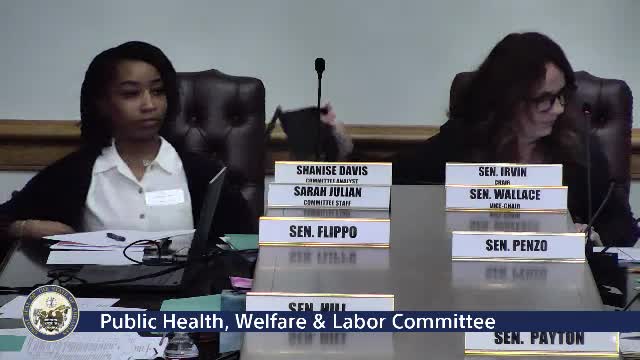
The Senate Public Health, Welfare and Labor Committee advanced a broad slate of bills, mostly by voice vote, covering health-provider administration, workforce rules, environmental remediation deducibles and other administrative and consumer-protection measures.
The Senate Public Health, Welfare and Labor Committee considered and advanced numerous bills in a single hearing. Most received brief sponsor explanations, limited technical questions and passed by voice vote. Below are the items taken up in the committee record and the outcomes recorded in the transcript.
Votes at a glance (committee action: all passed by voice vote as recorded in transcript):
- House Bill 1454 (sponsor: Representative Mary Bentley) — Allows additional expedited background-check options for industry applicants; sponsor described it as providing a faster paid option; passed by voice vote.
- House Bill 1854 / 18-54 (sponsor: Representative Mary Bentley) — Allows transferability of 40-hour home-caregiver training between employers so caregivers need not repeat training when moving between companies; passed by voice vote.
- House Bill 1677 / 16-77 (sponsor: Representative Mary Bentley) — Permits drug-detox units to keep a locked emergency medical kit on site, to be stocked by a pharmacist, for rural facilities located far from hospitals; passed by voice vote.
- House Bill 1171 / 11-71 (sponsor: Kendra Moore) — Establishes an abbreviated independent reassessment process for certain client assessments used by DHS; sponsor said DHS agreed with the approach; passed by voice vote.
- House Bill 1622 / 16-22 and House Bill 1619 (other nursing-home and administrative corrections; sponsors: multiple) — Administrative reconsideration and corrective-action-plan pathways for facility-level findings; passed by voice vote.
- House Bill 1758 / 17-58 (sponsor: Zach Gramlich) — Technical changes clarifying hearing-aid dispenser authority to order prescription hearing aids consistent with 2022 federal regulatory changes; sponsor said it does not expand scope of practice; passed by voice vote.
- House Bill 1277 / 12-77 (sponsor: Representative Gramlich) — Adjusts petroleum storage tank trust-fund deductible authority so ADEQ may set stair-step deductibles up to a $30,000 cap per occurrence; sponsor said change aims to avoid forcing small convenience-store owners to abandon remediation; passed by voice vote.
- House Bill 1456 (sponsor: Senator Hill/others) — State Kidney Disease Commission advisory council bill; passed by voice vote (sponsor asked another senator to carry it through committee proceedings).
- House Bill 1712 / 17-12 (sponsor: Senator Scott) — Implements a social-work licensure compact to facilitate multistate practice; committee discussed representation on the compact board and the ability to withdraw from compacts; passed by voice vote.
- House Bill 1782 / 17-82 (sponsor: Senator Scott) — Prohibits sale or transfer of over-the-counter diet pills to persons under 18 and requires retailer age verification, education notifications and escalating penalties for violations; sponsor said it does not affect prescribed medical weight-management treatment; passed by voice vote.
- House Bill 1582 / 15-82 (sponsor: Representative Mindy McLendon) — Strengthens work-search requirements and connects unemployment claimants to job openings via the DWS 'launch' platform; passed by voice vote.
- House Bill 1559 / 15-59 (sponsor: Senator Justin Boyd) — Directs DHS to apply for an 1115 demonstration waiver relating to the Institute for Mental Disease exclusion for substance use treatment; sponsor said 37 states have similar authority and DHS was supportive; passed by voice vote.
- House Bill 1543 / 15-43 (sponsor: Representative Kinda Underwood) — Workforce Experience Opportunities Act: allows volunteering as one option to meet SNAP (EMT) work requirements and places limited conditions on hosting state entities; sponsor said DHS indicated support in committee; passed by voice vote.
- House Bill 1751 / 17-51 (sponsor: Kinda Underwood) — Requires job-ready applicants for TANF to search for work while their applications are processed; sponsor said about a dozen states already do this; passed by voice vote.
- Senate Bill 632 / 6-32 (sponsor: Senator Love) — Requires warning labels on certain hair-relaxing products that contain chemicals alleged to raise cancer risk; sponsor said she focused the bill on hair relaxers because of community impact and opted for labeling after a ban proved impractical; passed by voice vote.
For many of these bills the committee record documents only sponsor explanations, occasional technical questions and a voice vote. Where the transcript included more detailed testimony or technical clarifications, individual articles in this package provide deeper coverage.