Get Full Government Meeting Transcripts, Videos, & Alerts Forever!
Get email alerts on the County Sales Tax Allocation topic
No spam. Unsubscribe anytime.
Senate committee debates bill to let counties, cities renegotiate countywide sales-tax splits; measure fails
Summary
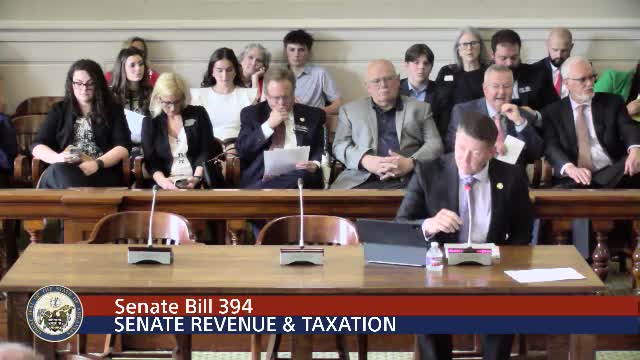
Senate Bill 394, a proposal to let counties and their municipalities negotiate and seek voter approval to reallocate countywide sales-tax revenue when one city’s population outstrips the rural county population, drew extensive public testimony and failed to win committee approval.
Senate Bill 394, a proposal to let counties and their municipalities negotiate and seek voter approval to reallocate countywide sales-tax revenue when one city’s population outstrips the county's rural population, drew extensive public testimony and failed to win committee approval on a roll-call vote.
Sen. Joshua Bryant, the bill sponsor, told the Revenue & Tax Committee that Act 26 of 1981 (and related 1981 provisions) created a countywide sales tax mechanism intended to support county infrastructure and services. Bryant said demographic changes and successive censuses have shifted collections toward growing cities, leaving counties with a shrinking share while county obligations — jails, courts and other constitutional services — remain.
"This bill simply recognizes that circumstances have changed since then and that voters should be given the opportunity to adjust how their county sales tax dollars are spent to accommodate those changes," Benton County Judge Barry Moring told senators. "Nothing changes unless voters say so." Moring told the panel Benton County has seen its county share fall from about 45% in 1990 to roughly 15% today and said the county’s jail capacity and caseloads have increased substantially.
Opposition came from a broad group of mayors, city finance officials and public-safety representatives who warned the measure could shift large sums away from city budgets that provide police, fire, EMS and other municipal services. Charles Snapp, mayor of Walnut Ridge, said SB 394 "is not good for the counties of Arkansas. It's gonna cause a strife," arguing his community generates most county sales tax revenue but receives a small share under older allocation agreements. Amber Strange, chief financial officer for North Little Rock, said, "If this were to pass and if this were to go to voters, you'd be asking the city of North Little Rock to find $19,000,000." Sherwood's finance director and other municipal speakers said county sales-tax receipts fund large portions of local general funds and essential services.
Fire-service groups also opposed the bill. Justin Scantlin, president of the Arkansas Association of Fire Chiefs, told the committee municipal budgets could be cut 20–35% in some cities if county allocations changed, reducing capacity in areas that now serve dense populations and provide mutual aid to rural areas.
Sponsor Bryant and supporters said SB 394 would not immediately alter current allocations. The bill would require the county judge and municipal leaders to negotiate an interlocal agreement; a quorum court ordinance adopting that agreement; and finally a countywide vote to approve any allocation change. Bryant and Benton County officials emphasized voters would have the final say and that the bill was intended to create a negotiating path rather than unilaterally reallocate revenue.
Committee action and public-comment rules
Earlier in the hearing the committee adopted a three-minute time limit for public testimony to ensure broad participation. The committee then considered a motion to report SB 394 with a do-pass recommendation. Senator Hester moved do-pass and Senator Petty seconded; after a roll-call vote the motion failed. The clerk recorded yes votes from Senators Hester, Hammer and Petty; a recorded no from Senator Caldwell; and several committee members not voting on the motion. The motion therefore did not carry.
What the bill would do and what it would not
- SB 394 would not change any existing allocation unless the county judge and the cities agree on an interlocal allocation, the quorum court passes an ordinance endorsing that agreement and voters in the county approve the allocation at the ballot box. - If the parties do not reach an interlocal agreement, existing statutory options remain, including the ability for electors to petition or for the quorum court/county judge to put an abolition or reauthorization question before voters under current law. - Sponsors stressed the proposal is designed to open a lawful negotiation channel before some counties hit what they described as a "cliff" where the county share becomes too small to fund constitutionally required services.
Numbers and examples raised to the committee
Testimony included specific local figures: Benton County was described as generating roughly $90 million from the countywide sales tax with about $15 million retained by the county under current allocations; projections discussed to 2030 anticipated larger totals collected but a declining county share. Officials said county jail capacity and caseloads have increased markedly since 1990; one county judge cited a projected shortfall of hundreds of jail beds within a few years. Mayors and finance directors cited city budget dependence on the county tax (Centerton said its $16 million annual budget includes roughly one-third from the county tax; North Little Rock cited about $19 million; Sherwood cited about $9.7 million).
What happened in committee
- Motion to limit public testimony to three minutes — adopted by voice vote. - Motion to report SB 394 as "do pass" — moved by Sen. Hester, seconded by Sen. Petty; roll-call vote failed. Yes: Hester, Hammer, Petty; No: Caldwell; several members not recorded as voting. Outcome: failed to advance from committee.
Why proponents and opponents disagree
Supporters framed the bill as a narrowly targeted tool to let voters and local officials address allocation inequities created by population shifts and annexation, giving counties and cities another negotiating option before voters might instead abolish county-level tax measures. Opponents said the proposal risks destabilizing municipal budgets and undermining city services that are funded in part by the county tax, and they warned of adverse effects on bonding capacity and public-safety budgets if municipal shares were reduced.
Where SB 394 stands now
SB 394 failed to get a do-pass recommendation from the Senate Revenue & Tax Committee after the hearing and recorded roll-call vote. The bill’s sponsor and many local officials said they would continue to discuss the issue locally; supporters said the underlying allocation tensions persist and that the bill was intended to provide a local negotiation path rather than impose immediate change.
Ending note
The committee hearing drew a wide range of local leaders — county judges, mayors, finance directors, and fire chiefs — reflecting that the statutory allocation of a countywide sales tax touches municipal budgets, public safety, court operations and long-term capital planning. Supporters and opponents agreed the question is complex; they disagreed sharply on whether SB 394 would make the problem easier or harder to resolve.