Get Full Government Meeting Transcripts, Videos, & Alerts Forever!
Get email alerts on the Affordable Housing topic
No spam. Unsubscribe anytime.
Developers brief Buena Vista trustees on Midland Apartments financing, deed restrictions and construction timeline
Summary
Developers for the Midland Apartments briefed the Buena Vista Board of Trustees on March 25, explaining the project’s capital stack, 30‑year deed restrictions and construction schedule and answering residents’ questions about why the building’s rents cannot reach lower income brackets.
Developers for the Midland Apartments gave the Buena Vista Board of Trustees a work-session briefing March 25 on the nine-year project’s history, financing and affordability restrictions, saying project funding shaped who the complex can serve and when it can open.
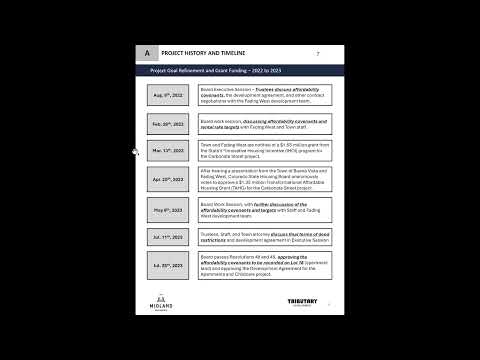
The presentation, led by Scott Simmons of Tributary, reviewed the project timeline from initial rezoning in 2016 through entitlements and the town’s adoption of affordability covenants in July 2023. “I think this has been a long process,” Simmons said, adding the development team wanted trustees and staff to be up to date on the capital stack, deed restrictions and next steps.
Why it matters: trustees and residents have pressed town staff and the developer about rents at the Midland and which households the building serves. The developer said the project was capitalized to serve “attainable” or middle-income households rather than the lowest-income brackets, because the available state and federal subsidy programs (and their timelines) dictated the feasible capital mix.
Most important facts: The developers said total project costs for the apartments plus the separate town-owned childcare building are about $18 million. The funding package included roughly $3 million in state grants administered by the Colorado Department of Housing (two programs referenced as an IHOY grant and a TAG grant), a CHFA (Colorado Housing and Finance Authority) loan, and a senior construction loan from Collegiate Peaks Bank. The developers reported roughly $11 million in total debt at the time of the briefing and that equity partners were accepting below-market returns to fill the capital stack.
Deed restrictions and rents: Trustees were shown the deed restrictions that cap rents at 80% area median income (AMI) for studios and 120% AMI for one- and two-bedroom units; those deed restrictions run for 30 years. The team said most of the project’s state funders (CHFA, the Department of Local Affairs and the Department of Housing) place deed-restriction conditions that are senior to the town’s. That affects allowable household definitions and prevents the project from relying on a two-earner roommate workaround (for example, two unrelated adults combining incomes to qualify for a unit) where state funding applies.
On utility inclusion and advertised rents: The developers said published rents include most utilities (internet is not included). They said the project’s posted rents in many unit categories are below the maximum allowable under the covenants; utilities were shown as a separate monthly charge in some public materials.
Construction and timing: Factory production of modular building components ran from November 2023 through February 2024, the team said, and a site groundbreaking occurred in April 2024. Developers told trustees they started factory work early to avoid production delays. The senior construction loan is a fixed-rate loan that converted to a 5-year term/30-year amortization on conversion; the team said the construction interest rate moved about a half percentage point during 2023 and they are exploring permanent financing options to lower long-term costs.
Town approvals tied to the project: Trustees voted at the March 25 meeting on two items tied to the Carbonate Street/Midland project. The board approved an ordinance vacating a portion of Arizona Street right-of-way adjacent to the project to align platting with existing field monuments and to provide the alley width the developer needs. Trustees also approved a resolution amending the project’s development agreement to allow staggered certificates of occupancy and to defer some exterior public improvements (plantings, irrigation, fencing, and final asphalt paving) until a specified later date so building occupancy can proceed while seasonal construction of landscaping and paving finishes. The town retained the right to require completion by the revised dates in the adopted amendment.
Tenant qualification and compliance: The Chaffee Housing Authority (CHA) will perform income verification and has a nominal ownership stake through a limited partnership that provides tax advantages. CHA also holds a right of first refusal to purchase the property if it is put up for sale; CHA may assign that right to the town. Developers said they had roughly 30 rental applications in process and were aiming to reach pre-leasing targets ahead of occupancy.
Paths to deeper affordability: The developers and trustees discussed possible ways to lower rents at Midland, including pursuing additional federal earmarks (a congressionally directed appropriation being processed through HUD), state funding opportunities such as Proposition 1/2/3 programs, fee waivers or town contributions, and further CHA involvement. The presenters said deeply subsidized lower-income units (below about 60% AMI) typically require LIHTC (Low-Income Housing Tax Credit) or other substantial subsidy sources; those awards are highly competitive and often require multiyear timelines and greater subsidy than the current project’s capital stack can deliver.
What the trustees approved related to the project: The board voted to vacate part of Arizona Street and to adopt a second amendment to the development agreement that (a) extended a construction completion milestone, (b) allowed certificate-of-occupancy issuance before final plantings and paving in limited cases and (c) set later firm dates for those exterior public improvements to be finished. The amendments were presented by planning staff and supported by the developer as a short-term measure tied to seasonal asphalt availability and sequencing of two building COs.
Background and next steps: The developers said phase 2 of the Carbonate Street site is intended to pursue a for-sale townhome component and that public improvements installed for phase 1 will benefit the later phase. They also noted the town contributed $400,000 in ARPA funds to subsidize the childcare building and donated the childcare parcel and building ownership structure that allows the town to hold that facility separately from the apartments.
Developers and staff asked trustees to consider local strategies that would make Buena Vista more competitive for future state housing funds (fee waivers, land contribution or other local support), and to weigh options to pursue deeper affordability for future projects. The developers said they will return to the board for any decisions required should additional federal earmarks be awarded and will keep the town updated on lease-up progress and tenant demographics.
Ending: The trustees’ votes cleared the way for the developer to continue staggered occupancy while finalizing paving and landscaping; the town and the development team said they would report back as permanent financing and occupancy progress continue.