Get Full Government Meeting Transcripts, Videos, & Alerts Forever!
Get email alerts on the Land Use topic
No spam. Unsubscribe anytime.
Planning Commission backs exemption for health services in MUO with carve‑out review for Mission corridor
Summary
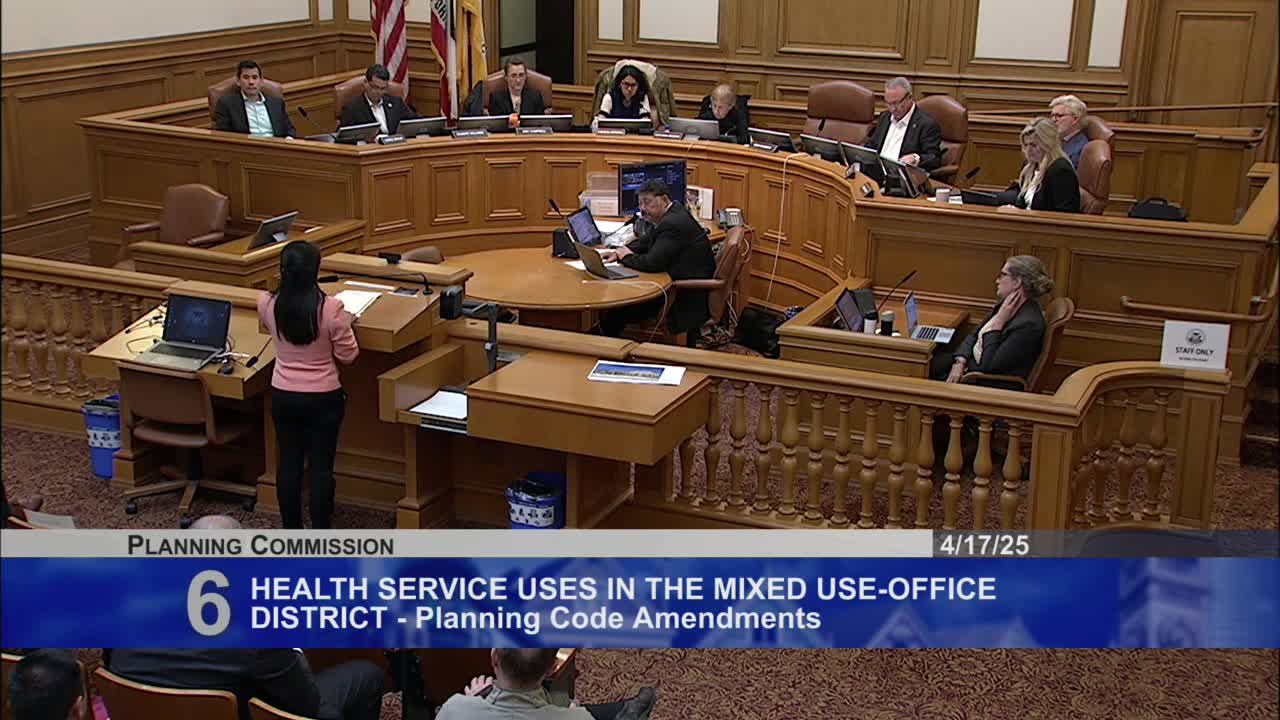
The San Francisco Planning Commission voted 5-1 to recommend approval of code changes exempting health service uses—including reproductive health clinics—from use‑size caps and retail‑ratio rules in the Mixed Use Office (MUO) district, while asking staff to consider removing the change for MUO parcels west of Seventh Street along Mission.
The San Francisco Planning Commission on April 17 recommended approval of changes to the Mixed Use Office (MUO) planning code that would exempt health service uses — including reproductive health clinics — from certain retail size limits and the MUO retail ratio requirement.
The recommendation passed 5-1 after an initial motion failed 3-3. Commissioners voted to advance the legislation with staff modifications and to ask the sponsor and department to evaluate whether the proposed changes should apply to MUO‑zoned parcels west of Seventh Street along Mission.
The ordinance, introduced by Supervisor Dorsey, would remove use‑size limitations that currently can trigger conditional use authorization for retail uses over 50,000 square feet and the hard cap of 120,000 square feet for retail in MUO. Planning staff said the exemptions are intended to allow medical and other health service uses — which the department does not consider the type of “big‑box” retail the original MUO controls sought to avoid — to locate in the district without being subject to the retail caps.
Planning Department staffer Madison Tam told commissioners: “This legislation allows for more flexibility and diversity of uses by eliminating retail size limits and retail ratio requirements for health service uses in the MUO District.” She added staff would recommend including reproductive health clinics in the exemption, reflecting the passage of Proposition O and subsequent state law.
Commissioners debated the scope of the change. Commissioner Campbell, who moved the first motion to adopt the recommendation for approval with staff modifications, said he supported the change as a way to help fill vacant retail space and to allow health uses to serve as “activity anchors” for neighborhoods. The first motion failed on a 3‑3 vote (Campbell, McGarry and Braun in favor; Williams, Imperial and Chair Moore opposed).
Commissioner Brown later offered a motion to adopt the recommendation with staff modifications and to “examine and potentially remove the application of this change from the MUO zoning west of Seventh Street.” That motion passed 5‑1, with Commissioner Williams casting the lone no vote.
Commissioners emphasized project‑level safeguards. Vice Chair Moore pressed staff on ground‑floor transparency and loading needs for medical uses; Planning staff said storefront transparency requirements remain in place and that individual projects would be reviewed during plan check for loading and circulation needs.
Why it matters: MUO covers corridors near downtown, Second Street, Townsend and the ballpark; the change could make it easier for health providers to take large vacant retail spaces in those areas. The commission’s request to study excluding MUO parcels west of Seventh Street along Mission reflects local concern about how the change would affect corridors with different building types and street‑level character.
Votes at a glance: A motion to adopt a recommendation for approval with staff modifications initially failed 3‑3 (yes: Campbell, McGarry, Braun; no: Williams, Imperial, Chair Moore). A subsequent motion to adopt with an added direction to review removing MUO west of Seventh Street passed 5‑1 (yes: Campbell, McGarry, Braun, Imperial, Chair Moore; no: Williams).
Next steps: The changes will move forward in the legislative process; staff and the sponsor said they will refine language and meet with the supervisor’s office and community members as the item returns for additional hearings.