Get Full Government Meeting Transcripts, Videos, & Alerts Forever!
Get email alerts on the Public Health Vector Control topic
No spam. Unsubscribe anytime.
Northwest Mosquito & Vector Control briefs Jurupa Valley council on West Nile and dengue work
Summary
The district presented mosquito-control tactics, surveillance and community outreach, urged residents to eliminate standing water and offered free backyard fish for larval control; staff noted the agency’s services are funded through a small benefit assessment paid by homeowners.
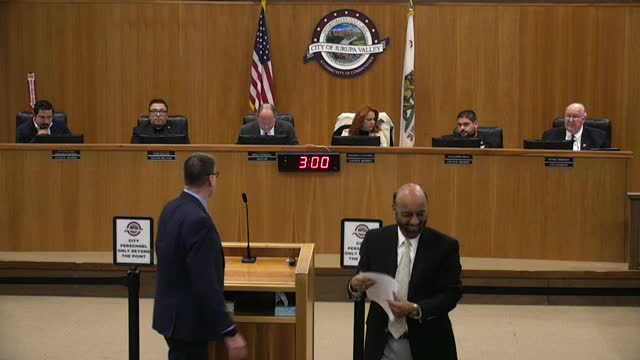
Mark Breidenbach, district manager for Northwest Mosquito & Vector Control, gave an informational presentation to the Jurupa Valley City Council on April 17 about the agency’s surveillance and control work for mosquitoes and other vectors that affect public health.
Breidenbach said the district, headquartered in Corona, serves seven cities in northwest Riverside County, including Jurupa Valley, on an annual budget of about $5 million. The district uses integrated vector management: staff monitor larvae and adult mosquitoes with traps, use targeted biological larvicides and raise mosquitofish (guppies) for distribution to residents, and test mosquito samples for vector-borne pathogens including West Nile virus. He said aedes aegypti—the species that spreads dengue—was introduced to the Inland Empire around 2015 and is a particularly persistent urban biter that breeds in small containers near homes.
The district’s control tactics include larval control with bacterial products that target mosquito larvae (minimizing non-target impacts), targeted adulticide applications only when surveillance thresholds are reached, and geographic information systems (GIS) and laboratory PCR testing to track virus detections and direct responses. Breidenbach said the district performs outreach events and that residents in the district pay a small annual assessment—“about $5 to $20 a year”—for the service, which makes individualized inspections and backyard surveys free to request.
Councilmembers asked whether the district performs proactive surveillance at known breeding basins and drainage areas; Breidenbach said field technicians maintain a database of known problem sites (curb-and-gutter drainage locations, basins) and perform routine checks, and the city and district can share new basin locations for targeted monitoring. He also answered residents’ technical questions about repellents and consumer devices: concentrated DEET formulations provide multiple hours of protection, certain essential oils can repel mosquitoes in concentrated form, and electronic zappers or light traps work differently depending on species and placement.
Breidenbach closed by repeating the district’s public message—“tip, toss and take action”—urging residents to remove standing water, and offered to arrange tours of the district’s Corona facility for councilmembers and staff. No council action was required or taken; the presentation was informational.