Get Full Government Meeting Transcripts, Videos, & Alerts Forever!
Get email alerts on the Noise And Event Permits topic
No spam. Unsubscribe anytime.
Jurupa Valley council studies tighter rules, clearer exemptions for private events and noise
Summary
City staff outlined existing temporary-event permit rules and the noise ordinance, including 60‑day application windows, deposit-based fees and residential decibel limits; councilmembers urged clearer exemptions for small private gatherings, stronger enforcement tools and faster permitting tiers for low-impact events.
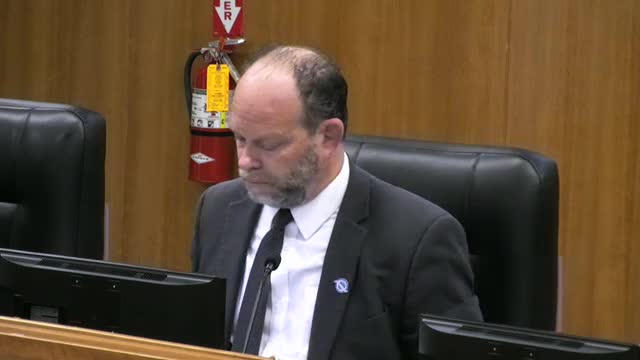
City staff presented a study session to the Jurupa Valley City Council on April 17 reviewing the city’s temporary-event permit rules and the noise ordinance and asking for council direction on possible amendments to streamline permitting and reduce neighborhood impacts.
The presentation, delivered by Community Development staff member Rob Gonzales, summarized current requirements in Jurupa Valley Municipal Code: temporary outdoor events generally require a site development permit processed by the Planning Division, applications are requested 60 days before an event, and the city requires an initial deposit-based application fee of $1,000; additional fees may be charged for events that need more review. The city enforces noise by an audibility rule (sound audible within 100 feet is a violation) and by land‑use decibel limits in Title 11 (residential limits cited as 55 A-weighted decibels daytime, 45 dB nighttime). Fines for noise violations escalate by offense within a year: $200 first, $500 second, $750 third, $1,000 fourth, and the code allows use of decibel meters or an audibility test for enforcement.
Gonzales reviewed four event categories in current code: outdoor entertainment (up to seven consecutive days, up to four times a year), outdoor sales (three to four days, up to four times a year), seasonal sales (up to 40 days, up to three times a year) and special events (typically one day, up to eight times a year). He said exemptions exist for events in established facilities (banquet halls, golf courses), for governmental events and for emergency public-health and safety events. The Community Development Director issues final approvals; appeals may be taken to the Planning Commission and then City Council. Code Enforcement can issue notices of violation (the ordinance cites a $200 base citation absent a city resolution changing the amount), and permits can be denied or revoked for unresolved violations or safety risks.
Councilmembers and residents who spoke at the study session pressed staff for several clarifications and changes. Speakers said the code is unclear about small, private gatherings such as backyard birthday parties with live music: staff and multiple councilmembers noted the rules currently send applicants to the site-development process even for small private events, creating confusion and a perceived burden for families and cultural gatherings. Several councilmembers asked staff to propose tiered permitting (shorter lead times and simplified, lower-cost review for low‑impact community, cultural, or religious events) and to define small/medium/large event thresholds.
Discussion also focused on enforcement and repeat offenders. Councilmembers asked staff to clarify whether permit denials for properties with prior violations are discretionary (“may deny”) or mandatory; staff said the language was left discretionary to allow consideration of new owners or unusual circumstances, but multiple councilmembers directed staff to return with firmer denial language and with options for defined denial periods tied to unresolved violations. Several councilmembers and commenters urged the city to clarify whether organizers, property owners, or both could be cited and to consider remedies that would prevent promoters or repeat organizers from evading enforcement by using family members’ names.
Councilmembers raised concerns about the practical application of decibel thresholds in different neighborhood settings. Members asked staff to consider different noise standards or guidance for lower-density, rural neighborhoods versus compact infill areas, and to propose cutoff hours (for example, stricter limits after 10 p.m.) that would be easier for deputies and code officers to apply. Members also requested staff consider holiday and cultural exceptions for short morning events (for example: Mother’s Day mariachi performances), while maintaining tools to address chronic repeat nuisance events.
Staff proposed possible streamlining options: a tiered review with shorter lead times for low-impact events, flat fees for defined categories, clearer linkage between the temporary-event and noise codes (including private-event exemptions), and increased interagency coordination (Sheriff’s Department, Cal Fire, Code Enforcement, Environmental Health) to ensure responders receive permit information when events are approved. Gonzales and Code Enforcement Officer Ryan Bautista told the council they would return with draft code language reflecting clearer exemptions for small private gatherings, alternative fee/lead-time proposals, options to tighten the “may deny” language, and enforcement clarifications identifying when organizers and/or property owners would be responsible.
The study session produced no formal action or vote. Councilmembers directed staff to return with proposed ordinance edits and implementation options that: (1) distinguish small private gatherings from large commercial events, (2) propose alternative timelines and fees for low‑impact events, (3) clarify enforcement and appeal procedures including responsibility for promoters and property owners, and (4) propose clearer decibel/time thresholds that reflect neighborhood density and are usable by deputies and code staff.
Staff said they would present draft revisions and accompanying enforcement guidance and public-education materials to the council at a future meeting.
Ending: The council’s comments emphasized balancing residents’ right to use their property for celebrations with neighbors’ quality-of-life concerns and directed staff to return with legally clear, enforceable code language and practical enforcement guidance.