
Bonding subcommittee hears agency needs; cemetery space, medical examiner facility and childcare renovations flagged as urgent
Get AI-powered insights, summaries, and transcripts
Sign Up Free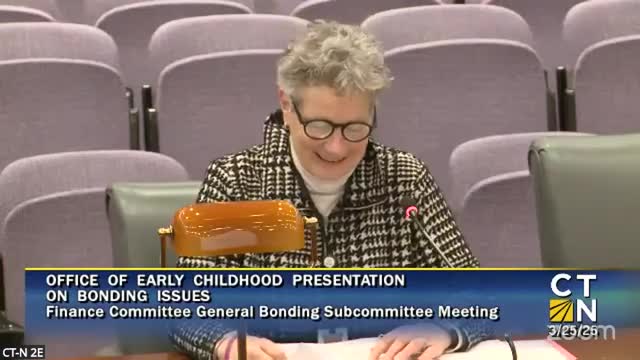
Summary
The Connecticut General Assembly’s bonding subcommittee on March 25 heard from nine state agencies seeking allocations, new authorizations and status updates on existing bonding. Lawmakers and agency officials emphasized three near-term priorities: expansion of veterans burial capacity near Middletown, a replacement or major expansion of the Office of the Chief Medical Examiner facility at UConn Health, and use of existing Smart Start/Early Start bond authorizations to renovate and expand child care facilities.
The Connecticut General Assembly’s bonding subcommittee on March 25 heard from nine state agencies seeking allocations, new authorizations and status updates on existing bonding. Lawmakers and agency officials emphasized three near-term priorities: expansion of veterans burial capacity near Middletown, a replacement or major expansion of the Office of the Chief Medical Examiner facility at UConn Health, and use of existing “Smart Start”/Early Start bond authorizations to renovate and expand child care facilities.
Why it matters: The hearing combined routine status updates with several items described by agency leaders as capacity or safety risks that could become urgent within 12–36 months. Lawmakers pressed for timetables and asked agencies whether existing unallocated authorizations could be moved into the bond commission process to allow work to begin.
Early childhood facilities and Care for Kids: Beth Bai, commissioner of the Office of Early Childhood, told the subcommittee that current unallocated bond authority would be used for “Early Start Connecticut” — a facility expansion and renovation program for state-funded child care programs. “The unallocated balance is for the Early Start Connecticut facility expansion and renovation of state funded child care facilities,” Bai said. Bai said the state already has roughly $40 million authorized for early childhood facility work and that $10 million was placed on the bond agenda earlier; that amount has produced more applications than can be funded.
Bai and staff described three related issues: (1) how to use existing “Smart Start” authority (public act 21-111 was cited in testimony) for Early Start projects; (2) how to ensure small family child-care providers can access capital when typical state requirements (for example liens on property) exclude renters or very small operators; and (3) long-term IT work for the Care for Kids subsidy system. Bai said the department has used ARPA and federal preschool-development funds for some IT improvements but that “this 800,000 is a small portion of what has to happen” and the parent-portal and integration work will likely cost several million dollars plus ongoing maintenance estimated at $1–2 million per year.
Agency-run competitive facility grants were discussed in detail. Kathleen Heinemann, who leads the facilities renovation construction grant program administered by Local Initiatives Support Corporation (LISC), said LISC ran an ARPA-funded round that generated far more requests than funds available and that a new round would follow bond-authorized funds if and when those funds are placed on the bond commission agenda.
K–12 education, charter and special-education projects: The State Department of Education summarized remaining balances and newly proposed items. Jessica Brunetti (chief of fiscal and administrative services) said the department has approximately $15.0 million remaining for low-performing schools, about $13.9 million for charter-school capital grants and roughly $22.8 million for grants to regional education service centers and interdistrict magnet schools. The governor’s budget proposes a $4.0 million grant program in FY27 to support creation or renovation of in-district special-education spaces to allow more students to be served locally; the department said it will develop a rubric to prioritize applications.
Connecticut Technical Education and Career System (CTECS): Dr. Alice Pritchard, executive director of CTECS, told the committee the system manages roughly 3.7 million square feet across 20 locations and has significant deferred maintenance and equipment replacement needs. CTECS asked that certain funds currently administered through the Office of Grants Administration (OGA) be moved into traditional state construction authorization so projects can proceed faster and without the municipal cost-sharing and priority-list delays that apply under Chapter 173. CTECS highlighted requests for $30 million per year for deferred maintenance and equipment, plus larger projects such as a new Wyndham technical school and repair work at Goodwin and other campuses. The committee discussed transportation buses: CTECS owns a fleet used for student activities and must electrify 18 buses by 2030 and the remainder by 2040 under state statute, creating a need for chargers and charging infrastructure in addition to vehicles.
Department of Administrative Services and the Office of the Chief Medical Examiner (OCME): Commissioner Michelle Gilman (DAS) reviewed the governor’s capital proposals, including putting the HVAC grant program into the school construction program (Chapter 173) and a proposal to help state agencies install solar. Doctor. Michael Gill (chief medical examiner) told the subcommittee the OCME continues to work toward an addition/renovation at UConn Health; by statute the OCME must be on a medical-school campus, and the office still needs space and refrigeration capacity. Gill reported the office has reduced temporary refrigerated trailers from three to one but said a modernized facility should be able to refrigerate about 200 bodies and include more autopsy capacity; engineers have estimated options in the $64–$80 million range depending on scope.
Department of Emergency Services and Public Protection (DESPP): Commissioner Ronald A. Higgins said DESPP manages 73 structures and nearly 36% have ratings of unsatisfactory to fair; roughly one-quarter of Connecticut State Police troop barracks are in poor condition. DESPP outlined projects for troop facilities, generator replacement, underground storage tank upgrades and construction of an Emergency Vehicle Operations Course (EVOC) for statewide use. The agency also reiterated that its school- and nonprofit-security grant programs fund eligible applicants up to $50,000 (private/nonprofit cap) and that public-school entities are eligible for larger awards through the program; DESPP staff said new application rounds would open “very shortly.”
Department of Correction (DOC): Deputy Commissioner Sharonda Carlos said DOC’s five‑year capital plan totals about $673 million and the governor proposes $50 million in FY26 and $55 million in FY27 for renovations, maintenance and capacity projects. DOC described large, complex projects at older facilities (for example, window and door work at Cheshire/Osborn) and said projects are paced so construction disruption can be managed in 24/7 operations. The Mason Youth Institute renovation design is in early phases using a $5 million authorization; DOC said it will use the design work to phase construction and estimate total costs for follow-up funding requests.
Connecticut Military Department: The department reported it executes large amounts of federally funded military construction (MILCON) but requires state matching funds (typically about 20% state / 80% federal). The department said recent and planned projects include an aerospace and ground vehicle maintenance facility at Bradley ANGB and a Readiness and Sustainment Center for military police, and requested design funding for a medical readiness center at Camp Niantic. The military department also described a long-running need for a modern logistics/warehouse facility at Camp Hartell in Windsor where vehicle maintenance and logistics staging are centered; that project has repeatedly sought federal MILCON priority and remains unfunded at the federal level.
Veterans Affairs: Commissioner Welch told the committee the department has nearly completed most authorized projects but needs remaining allocations to finish its boiler replacement work; the department currently leases a backup boiler at roughly $30,000 per month. Welch also said the Middletown Veterans Cemetery is approaching capacity and the department needs a larger, new cemetery site (the department is seeking roughly 50–100 acres and included a $7.5 million ask in the governor’s proposal for cemetery expansion or a new site). Welch said a prior negotiated 13‑acre purchase failed at public hearing and the department is working with DAS and others to find a larger suitable parcel and complete needed infrastructure (committal shelter, roads, drainage, irrigation) so the cemeteries can continue to perform burials and cremated‑remains internments that qualify for federal reimbursement.
What lawmakers asked for: Committee members repeatedly requested clearer timetables and asked agencies to provide line-item lists the committee can use to prioritize allocations at bond commission hearings. Several members asked DAS for a written explanation of how proposed moves (for example folding HVAC grants into the school construction program) will affect districts already awarded funds and how applications will be processed going forward (DAS testified the nonpriority monthly application model will increase predictability for districts). Legislators also asked for updated lists of unallocated balances and the names of projects that are ready to be moved onto the bond agenda.
Ending note: Agencies said existing authorizations in several programs (Smart Start / Early Start, school grants, CTECS priority balances and DOC unallocated amounts) are insufficient to meet current demand and that placing already‑authorized funds onto the bond agenda would speed delivery. Several agency leaders asked the committee to consider both capital and operating interactions—for example, Care for Kids IT improvements that reduce administrative burden and free subsidy dollars for families, or energy projects (solar and HVAC) that lower long-term operating costs.
The subcommittee recessed after the hearing and scheduled follow-up dates to review additional materials and updated project lists.